
- How Tracking Forklift Activity Helps Businesses
- Why is Forklift Monitoring Essential in 2026?
- How to Choose the Right RTLS Technology for Tracking Forklift Activity
- Must-Have Features of an Advanced Forklift Monitoring System
- Essential Questions to Select the Right Forklift Tracking System
- Get Started with Expert Forklift Tracking Solutions
- FAQs on Tracking Forklift Activity & Forkift Monitoring Systems
Tracking forklift activity is no longer optional for warehouses and manufacturing plants that need to stay competitive, safe, and compliant. A forklift monitoring system uses real-time location technology, onboard sensors, and analytics software to capture where every forklift moves, how it operates, and where safety risks emerge, and where inventory stands — making it an effective real-time inventory tracking system for the entire facility.
The challenge most operations face is not whether to track, but which technology to deploy. Infrastructure-based RTLS (UWB or BLE), reverse RTLS, forklift-mounted AI cameras with SLAM (SLAM-based forklift tracking), and AI agents running on existing camera networks each solve different problems at different price points.
Choosing the wrong approach wastes budget and leaves blind spots. Choosing the right one gives you continuous visibility into fleet utilization, operator behavior, near-miss patterns, and compliance readiness. This guide breaks down how modern forklift monitoring systems work, where each technology fits, and how to select the right solution for your facility’s layout, safety requirements, and growth plans.
What Are Forklift Monitoring Systems?
Forklift monitoring systems are operational tools that combine real-time forklift tracking hardware, onboard sensors, and analytics software to track and manage forklift activity across industrial facilities. They replace manual observation and paper-based logs with continuous, data-driven visibility into the equipment location, movement patterns, utilization rates, and operator behavior.
These systems use indoor location technologies such as UWB, BLE, RFID, or vision-based positioning to capture real-time forklift locations. The data feeds into dashboards, alerting engines, and real-time inventory management software that surface actionable insights on idle time, route efficiency, speed violations, and safety incidents.
When implemented correctly, these systems function as a real-time inventory tracking system alongside equipment monitoring, helping teams reduce unplanned downtime, prevent collisions, enforce compliance, and make operational decisions based on what actually happens on the floor rather than assumptions.
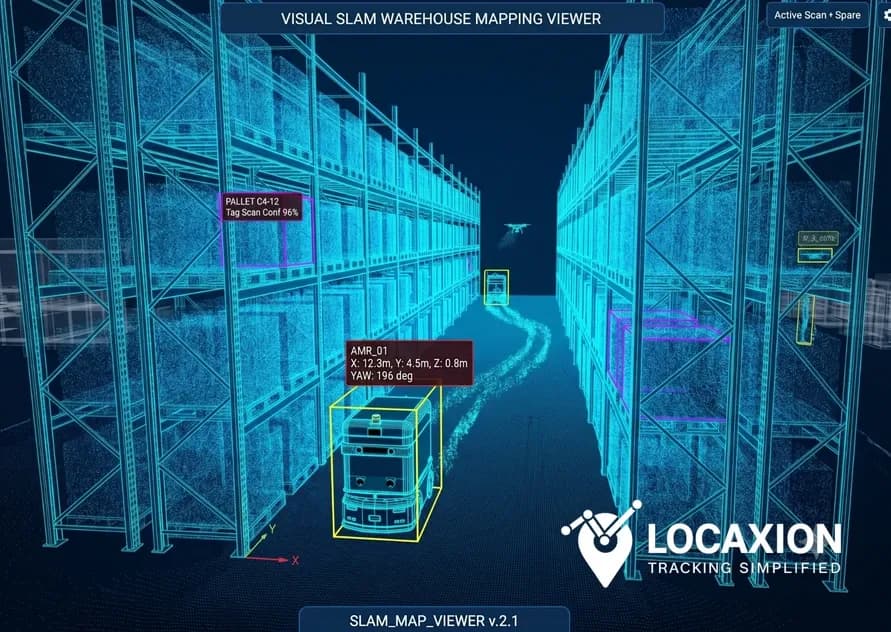
Track every forklift with SLAM-based precision.
ZERO anchors and ZERO tags required! 15 cm high accuracy tracking!
Get Started
How Tracking Forklift Activity Helps Businesses
These same systems unlock the benefits of inventory visibility by giving teams a live view of WIP, stock locations, and asset movement across the facility.
- Real-Time Equipment Visibility. Instantly locate every forklift across the facility, reducing the 10–15 minutes per shift that supervisors typically spend searching for available units, while supporting a real-time inventory tracking system across the operation.
- Proactive Safety and Incident Prevention. RTLS forklift safety features such as proximity alerts, geofenced speed zones, and automated slowdowns intervene before collisions happen, not after. Facilities using these systems report significant reductions in near-miss events and pedestrian incidents.
- Fleet Right-Sizing and Utilization. Real-time utilization data reveals which forklifts are overworked and which sit idle. Tracking forklift activity exposes ghost fleet units and enables data-driven decisions about fleet size, shift allocation, and equipment rotation, capabilities that directly complement your real-time inventory tracking system.
- Data-Driven Decision-Making. Heatmaps, spaghetti diagrams, and dwell-time analytics replace gut-feel management. Detailed reports on performance, usage trends, and maintenance needs guide operational strategy and reduce unplanned downtime.
- Reduced Operational Costs. Optimized routes, lower idle time, predictive maintenance, and fewer accidents combine to cut fuel consumption, repair expenses, and labor waste.
Why is Forklift Monitoring Essential in 2026?
Three forces are converging to make tracking forklift activity a baseline requirement for modern facilities, reflecting the broader benefits of real-time data monitoring in manufacturing across safety, compliance, and efficiency.
Safety Is Now the Primary Driver
Safety has overtaken efficiency as the leading reason facilities invest in forklift monitoring. OSHA’s enforcement programs, including the Warehousing NEP, authorize unannounced inspections at high-injury-rate facilities. Penalty maximums now reach $16,550 per serious violation. Facilities without digital audit trails for operator behavior, speed enforcement, and near-miss tracking face steep citation risk.
RTLS forklift safety systems generate continuous compliance documentation automatically. Proximity alerts, zone-based speed control, and collision avoidance logs create the digital evidence that inspectors expect during audits.
Mixed Fleets Demand Coordinated Tracking
Warehouses increasingly run forklifts alongside AGVs and AMRs. Each vehicle type operates on its own control loop with different reaction times and safety logic. When they share the same floor, tracking forklift activity alongside autonomous vehicles becomes essential for preventing path conflicts, managing intersection priority, and maintaining consistent safety coverage across the mixed fleet.
Tighter Margins Require Operational Proof
Supply chain pressure demands evidence that fleet operations are lean. Combined with the benefits of inventory management system integration, tracking forklift activity provides the utilization, throughput, and route efficiency data that justifies fleet size, staffing levels, and capital investment decisions.
inefficiencies, optimize workflows, and automate processes for faster operations.
Example: A warehouse operating with 20 forklifts reduced idle time by 30%, saving hundreds of hours annually.
How to Choose the Right RTLS Technology for Tracking Forklift Activity
Choosing the right RTLS technology is a critical decision in forklift tracking system deployment. The software layer matters, but accuracy, reliability, and safety outcomes depend on how the actual location data is captured on the floor. Below is a breakdown of the five main approaches used in warehouses and manufacturing environments today.
Explore the Best Industry Standard RTLS devices with LocaXion
Get Started
Infrastructure-Based RTLS (UWB, BLE)
Infrastructure-based RTLS uses a fixed network of anchors (or beacons) across the facility to continuously locate forklifts. Systems powered by Ultra-Wideband (UWB) or BLE are ideal for environments requiring constant visibility.
UWB delivers 10–30 cm accuracy with fast update rates, making it the best fit for high-traffic facilities with blind corners, dense racking, and mixed pedestrian zones. BLE Angle-of-Arrival (AoA) offers a cost-effective alternative with sub-meter accuracy at scale.
Best for: Continuous fleet tracking, RTLS forklift safety with collision avoidance, near-miss detection, Digital Twin integration, and multi-use deployments covering forklifts, pedestrians, WIP, and real-time inventory tracking system needs.
Key advantage: Facility-wide visibility that supports predictive analytics, passive safety, heatmaps, and the ability to improve inventory visibility across zones all from a single infrastructure investment.
Consideration: Higher upfront infrastructure cost, offset by multi-use ROI. LocaXion can assist with business case and ROI modeling.
Reverse UWB Proximity Systems
Reverse UWB flips the traditional RTLS architecture. While the core components remains the same – anchors mounted on the ceiling with tags on forklifts and pedestrians – it is the tags in this scenario that calculate their position in real time. The forklifts become spatial aware.
This approach excels at forklift-to-pedestrian and forklift-to-forklift proximity detection in real time. Because the sensor is on the vehicle, it measures distance to nearby workers with centimeter-level precision and can trigger immediate slowdowns or stops when someone enters a danger zone.
Best for: Safety-first deployments focused on pedestrian and forklift protection, especially in facilities that are dense, high-velocity environments with limited operator visibility.
Key advantage: Fast deployment, lower infrastructure cost, and immediate RTLS forklift safety impact. Each forklift becomes a safety node.
Consideration: Provides proximity and safety alerting together with full facility-wide location tracking of forklifts.
Forklift-Mounted AI Cameras with SLAM
AI cameras mounted directly on the forklift use SLAM (Simultaneous Localization and Mapping) to build a real-time map of the environment while simultaneously tracking the vehicle’s position within it. Combined with object detection models, these systems identify pedestrians, pallets, racking, and other forklifts in the camera’s field of view.
The result is context-aware safety. The system does not just know that something is nearby, it knows what is nearby and predicts movement trajectory. This enables graded responses: a visual warning for a distant pedestrian, an audible alert for a closer one, and automatic braking when a collision is imminent.
Best for: Safety-critical environments where object classification and predictive collision avoidance matter, such as high-traffic intersections, dock areas, and mixed pedestrian-forklift zones.
Key advantage: No fixed infrastructure required on the ceiling. Each forklift carries its own perception system and can operate independently.
Consideration: Performance can vary in heavy dusty environments, lighting changes, and dense visual obstructions common in industrial settings.
AI Agents on Existing Camera Infrastructure
Many warehouses already have CCTV or security camera networks installed across their facility. AI agent software can be layered onto this existing infrastructure to detect, classify, and track forklifts, pedestrians, and other assets in real time without installing any new hardware on the floor or the vehicles.
These AI agents use computer vision and deep learning models to analyze video feeds continuously. They identify forklift movement patterns, flag unsafe operator behavior such as excessive speed or failure to stop at intersections and detect pedestrians in forklift paths. The analytics layer transforms passive security cameras into an active safety and operational monitoring platform.
Best for: Facilities looking to extract immediate tracking and safety value from hardware already in place, especially those with tight budgets or those wanting a fast proof-of-concept before committing to full RTLS infrastructure.
Key advantage: Near-zero hardware cost if cameras are already deployed. Software-only deployment can go live in days.
Consideration: Accuracy depends on camera placement, resolution, and coverage. Fixed cameras have blind spots that vehicle-mounted or infrastructure RTLS systems do not. Best used as a complementary layer alongside dedicated RTLS for comprehensive coverage.
Non-Infrastructure Ranging Systems (TWR)
Non-infrastructure, Two-Way Ranging (TWR) systems rely on direct distance measurements between forklifts and fixed reference points. These setups are simpler and require less infrastructure, but visibility is limited to line of sight.
Best for: Open layouts with minimal obstructions and facilities prioritizing basic proximity alerts over full tracking.
Key advantage: Low setup costs – ideal for facilities looking to avoid high upfront infrastructure costs.
Consideration: Non-infrastructure TWR systems are less suitable for environments with blind turns or obstructions, as they cannot track around corners. For facilities with heavy foot traffic or complex layouts, infrastructure-based RTLS or vision solutions may be more appropriate.
Indoor-Outdoor Hybrid Tracking
Operations that span indoor warehouses and outdoor yards need tracking continuity as forklifts move between environments. Indoor areas use UWB or BLE for precise positioning. Outdoor zones use GPS, RTK, or LoRaWAN to maintain coverage for yard management, raw material handling, and dock-to-truck operations.
Best for: Large facilities with yard operations, multi-building campuses, and supply chain workflows that cross indoor-outdoor boundaries.
Consideration: Outdoor systems typically offer lower accuracy and slower update rates than indoor RTLS. RTK improves precision but adds cost and affects the tag’s battery life.
Read More: Optimizing Yard Management Supply Chains with RTLS
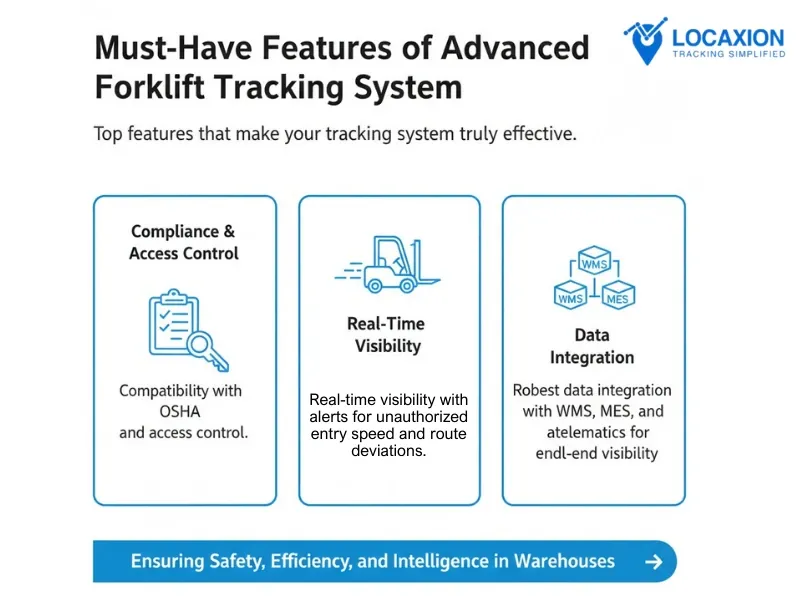
Must-Have Features of an Advanced Forklift Monitoring System
With the right tracking technology in place, the system’s value depends on the features it delivers. Essential capabilities include:
- Safety automation: Proximity alerts, geofenced speed zones, automated slowdowns, and near-miss logging for continuous RTLS forklift safety enforcement.
- Compliance readiness: Digital pre-shift inspection checklists, operator certification tracking, and OSHA-ready audit reports that can be produced in minutes.
- Fleet analytics: Utilization dashboards, idle-time tracking, heatmaps, and route optimization recommendations.
- System integration: Robust data exchange with real-time inventory management software, WMS, MES, ERP, and telematics platforms , and your real-time inventory tracking system for end-to-end operational visibility.
- Scalability: Architecture that supports expansion from a single-zone pilot to multi-facility deployment without rearchitecting the core system.
Also Read: New OSHA Regulatory Compliance in 2026
Essential Questions to Select the Right Forklift Tracking System
Before committing to a solution, work through these decision filters:
- What is your primary objective? Safety-first deployments favor reverse UWB and AI camera solutions. Efficiency-first deployments lean toward full infrastructure RTLS.
- Is forklift tracking just the starting point? If your roadmap includes pedestrian tracking, WIP monitoring, or inventory tracking, choose an infrastructure platform that scales across use cases.
- What does your facility environment demand? Dust, lighting variations, and dense racking affect technology selection. Infrastructure-based systems handle obstructions well. Vision systems need adequate lighting.
- What existing infrastructure can you leverage? Facilities with existing camera networks can deploy AI agents immediately. Those with Wi-Fi coverage may benefit from basic BLE-based tracking.
- How important is system integration? Effective tracking forklift activity requires data flowing into WMS, MES, telematics, and safety platforms. Prioritize solutions with open APIs and proven integrations and deployments.
Get Started with Expert Forklift Tracking Solutions
With over 25 combined years of RTLS experience, LocaXion delivers vendor-neutral forklift tracking solutions aligned with real operating conditions. As the world’s first pure-play RTLS and Digital Twin systems integrator, we evaluate every technology on the market and recommend only what fits your facility’s layout, safety requirements, and growth plans.
Our consulting helps manufacturers and warehouse operators improve safety, fleet utilization, and throughput using real-time location intelligence. We support RTLS pilots, site surveys, system integration, and professional services to take solutions from design to live operations.
LocaXion specialists have delivered 100+ RTLS deployments across manufacturing and warehousing environments, including complex, high-traffic facilities. We focus on scalable architectures that solve today’s visibility gaps while staying flexible for future use cases like Digital Twin analytics and expanded asset tracking.
Explore the Best Industry Standard RTLS devices with LocaXion
Get StartedFAQs on Tracking Forklift Activity & Forkift Monitoring Systems
What is the most accurate technology for tracking forklift activity indoors?
UWB-based RTLS along with SLAM-based camera systems are the most accurate indoor tracking technologies, delivering 10–30 cm and 5-10 cm precision respectively with fast update rates (10 Hz and 15 Hz respectively). BLE Angle-of-Arrival provides sub-meter accuracy at lower cost. The right choice depends on whether your primary goal is safety enforcement, fleet optimization, or both.
How do reverse UWB systems improve forklift safety?
Reverse UWB calculates real-time position on forklift itself and detects tags worn by pedestrians nearby. This gives the forklift real-time awareness of workers in its proximity, triggering alerts or automatic slowdowns before a collision occurs. It is one of the fastest paths to RTLS forklift safety without deploying full ceiling-mounted infrastructure.
Can AI cameras on forklifts replace RTLS for tracking?
Forklift-mounted AI cameras with SLAM provide strong safety coverage by detecting and classifying objects in the vehicle’s path. They excel at pedestrian detection and predictive collision avoidance. However, they do not provide multi use-case capabilities the way infrastructure-based RTLS does. Some advanced deployments combine both: cameras for immediate safety, infrastructure-based RTLS for additional use cases.
Can I use my existing security cameras for forklift tracking?
Yes. AI agent software can be layered onto existing CCTV or security camera networks to detect and track forklift movement, flag unsafe behavior, and identify pedestrians in forklift paths. This is a fast, low-cost entry point, though accuracy depends on camera placement and coverage. It works best as a complement to dedicated RTLS for complete RTLS forklift safety coverage.
How does forklift tracking support OSHA compliance?
Forklift monitoring systems generate digital audit trails that cover operator behavior, speed enforcement, pre-shift inspections, and near-miss events. Under OSHA’s Warehousing NEP, facilities face unannounced inspections where producing organized digital records is the difference between passing and receiving citations. Tracking forklift activity with RTLS automates the compliance documentation that inspectors expect.
What ROI can I expect from a forklift monitoring system?
Facilities typically see ROI within 6–12 months through reduced idle time, fewer safety incidents, lower maintenance costs, and improved fleet utilization. The strongest returns come from combining multiple use cases, such as safety, fleet optimization, and inventory tracking, on a single RTLS platform.