


Real-Time Location Systems (RTLS) have transformed navigation and tracking in enclosed spaces, offering critical solutions for industries like retail, healthcare, and manufacturing. When evaluating an indoor RTLS deployment, calculating the total RTLS system cost is a primary consideration for operational leaders. Among available technologies, Wi-Fi-based indoor positioning stands out for leveraging existing enterprise networks to provide cost-effective, scalable tracking. This approach helps facilities optimize their RTLS return on investment while eliminating the need for expensive proprietary reader infrastructure.
How Wi-Fi Indoor Positioning Works?
Wi-Fi-based RTLS utilizes the following methods:
- Received Signal Strength Indicator (RSSI): Measures the strength of Wi-Fi signals from access points to estimate device locations.
- Time of Flight (ToF): Calculates distance based on the time it takes for a signal to travel between a device and an access point.
- Fingerprinting: Matches real-time signal data with a pre-mapped database of Wi-Fi signal strengths to determine precise locations.
Accuracy and Limitations
Wi-Fi indoor positioning typically achieves an accuracy range of 5-15 meters. Precision is influenced by factors such as:
- Signal interference from walls, furniture, metal obstructions, or other obstacles.
- Multipath effects where signals bounce off surfaces.
- Network configurations and access point density.
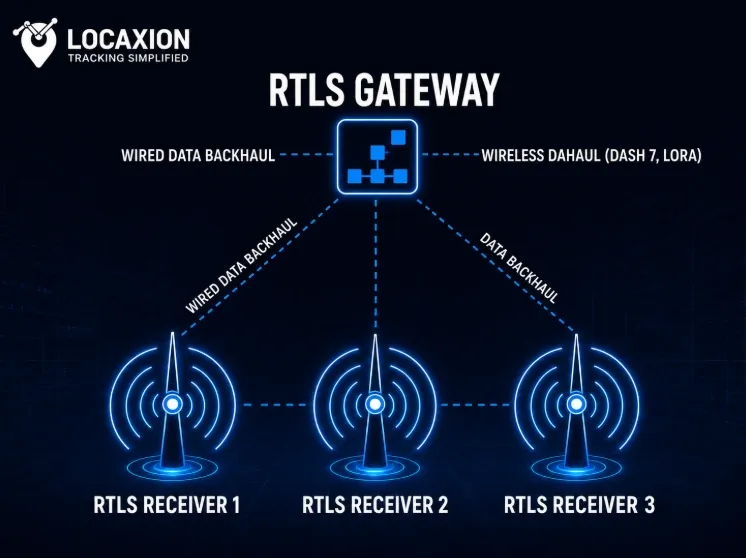
While effective for broad applications, Wi-Fi positioning falls short of the centimeter-level accuracy provided by technologies like Ultra-Wideband (UWB) or Bluetooth Low Energy (BLE) which shifts the business calculation toward analyzing the lower infrastructure overhead and warehouse management system cost factors. However, the operational benefits of real time locating system deployments can still be captured effectively at a fraction of the cost
Applications of Wi-Fi Indoor Positioning
- Retail: Enhanced customer indoor navigation, foot-traffic analytics, and targeted proximity promotions to boost conversion.
- Healthcare: Real-time asset tracking of mobile medical equipment and monitoring patient flow to minimize bottlenecks.
- Smart Offices and Homes: Optimizing layout configuration, employee navigation, and calculating RFID warehouse management system cost trade-offs against Wi-Fi alternatives.
Benefits of RTLS via Wi-Fi Infrastructure
- Leverages existing enterprise Wi-Fi networks, massively helping to reduce costs RTLS projects typically incur during hardware installation.
- Supports large-scale deployments across wide areas.
- Offers a balance of accuracy and affordability for many applications.
Challenges and Considerations
- Privacy Concerns: Addressing data security and compliance with tracking regulations.
- Accuracy Variability: Environmental factors can impact performance.
- Maintenance: Requires regular calibration and updates to ensure reliability.
Future Trends in Wi-Fi Indoor Positioning
- Integration with Artificial Intelligence (AI) and Machine Learning (ML): These technologies improve accuracy and enable predictive insights.
- Enhanced use cases in IoT ecosystems, where Wi-Fi positioning supports automation and smart environments.
Implementing Wi-Fi Indoor Positioning in Your Organization
Selecting the right solution requires careful evaluation of:
- Compatibility with existing Wi-Fi infrastructure.
- Software and hardware integration capabilities.
- Scalability to meet future needs
Conclusion
Wi-Fi indoor positioning offers a highly practical approach to enterprise tracking by balancing affordability with robust functionality. Because it relies on pre-existing network infrastructure rather than proprietary hardware, organizations can bypass heavy upfront capital expenditures, significantly lowering the overall RTLS system cost. For facilities looking to modernize their logistics, this technology provides several core advantages:
- Rapid Time-to-Value: Utilizing existing enterprise Wi-Fi networks accelerates deployment timelines and minimizes operational disruptions compared to installing dedicated tracking anchors.
- Scalable Architecture: The system easily expands across massive campuses, allowing managers to capture the fundamental benefits of RTLS like workflow automation and asset visibility, at a fraction of the cost.
- Data-Driven Adaptability: Strategic facility mapping and advanced filtering algorithms help mitigate standard Wi-Fi accuracy limitations, allowing enterprises to confidently scale operations while systematically measuring ROI of AVD deployment strategies.
LocaXion Intelligence provides expert, technology-agnostic guidance to help you navigate these architectural trade-offs. Whether you are optimizing a Wi-Fi setup to reduce infrastructure overhead or exploring multi-layered tracking architectures with UWB, our team ensures you maximize your absolute RTLS return on investment*.* Contact us today for a customized facility evaluation.
FAQs on Wi-Fi Indoor Location Tracking
What is Wi-Fi indoor positioning?
Wi-Fi indoor positioning uses existing Wi-Fi networks to determine the location of devices or assets indoors. It leverages signal strength and triangulation from multiple access points to pinpoint locations.
How accurate is Wi-Fi indoor positioning?
Accuracy typically ranges from 3 to 10 meters, depending on the environment and the density of access points. Additional techniques, like fingerprinting, can improve accuracy.
What are the limitations of location tracking using Wi-Fi?
Limitations include dependence on network infrastructure, potential interference from physical obstructions, and varying accuracy based on environmental factors.
Where is Wi-Fi indoor positioning commonly used?
It is used in various environments, including retail for customer behavior analysis, healthcare for asset tracking, and large venues for navigation assistance.
Can Wi-Fi RTLS be combined with other technologies?
Yes, it can complement other technologies like Bluetooth, RFID, and Ultra-wide band (UWB) for enhanced accuracy and multilayered tracking solutions.
Is Wi-Fi indoor positioning suitable for all types of buildings?
While it can be effective in various types of buildings, its performance may vary based on layout, materials used in construction, and potential interference sources.
Is Wi-Fi RTLS cost-effective for small businesses?
Yes, provided the business selects an architecture that matches its accuracy requirements. Utilizing Wi-Fi or hybrid Bluetooth tracking allows smaller operations to skip heavy infrastructure installation fees, making the project highly cost-effective and yielding a fast time-to-value.