Skip to content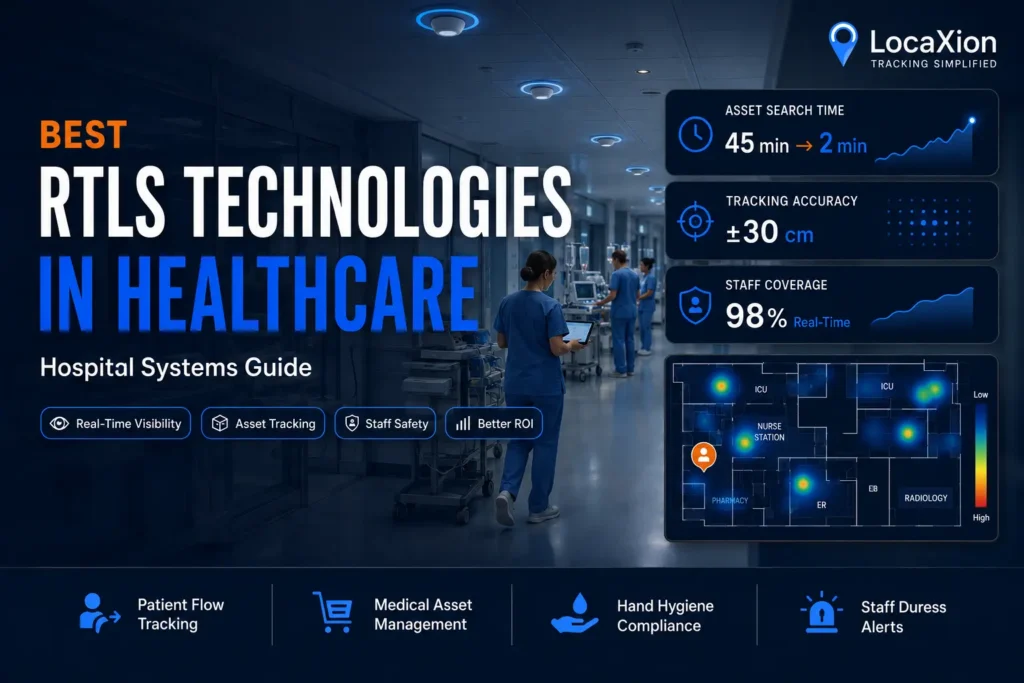
Hospitals operate under intense, non-stop pressure. Clinicians must deliver immediate patient care while constantly battling asset shortages, chaotic workflows, and strict compliance regulations. Implementing RTLS technology in healthcare facilities provides a direct solution to these hidden operational friction points.
By tracking equipment, patients, and staff in real time, medical facilities can wipe out daily bottlenecks and maximize throughput. This spatial intelligence allows hospitals to shift from reactive firefighting to proactive care coordination.
Think about your current digital stack. Your Electronic Health Record (EHR) system tracks clinical documentation and historical patient data. Your Admission, Discharge, and Transfer (ADT) system logs exactly when a patient moves beds. However, neither system provides continuous visibility into real-time physical movement between those milestone events.
Stop letting spatial blind spots drive clinical inefficiency as hospitals chasing real operational visibility and strong ROI need a scalable RTLS framework. See exactly how modern indoor tracking transforms medical workflows.
What Constitutes the Best Healthcare RTLS Platforms
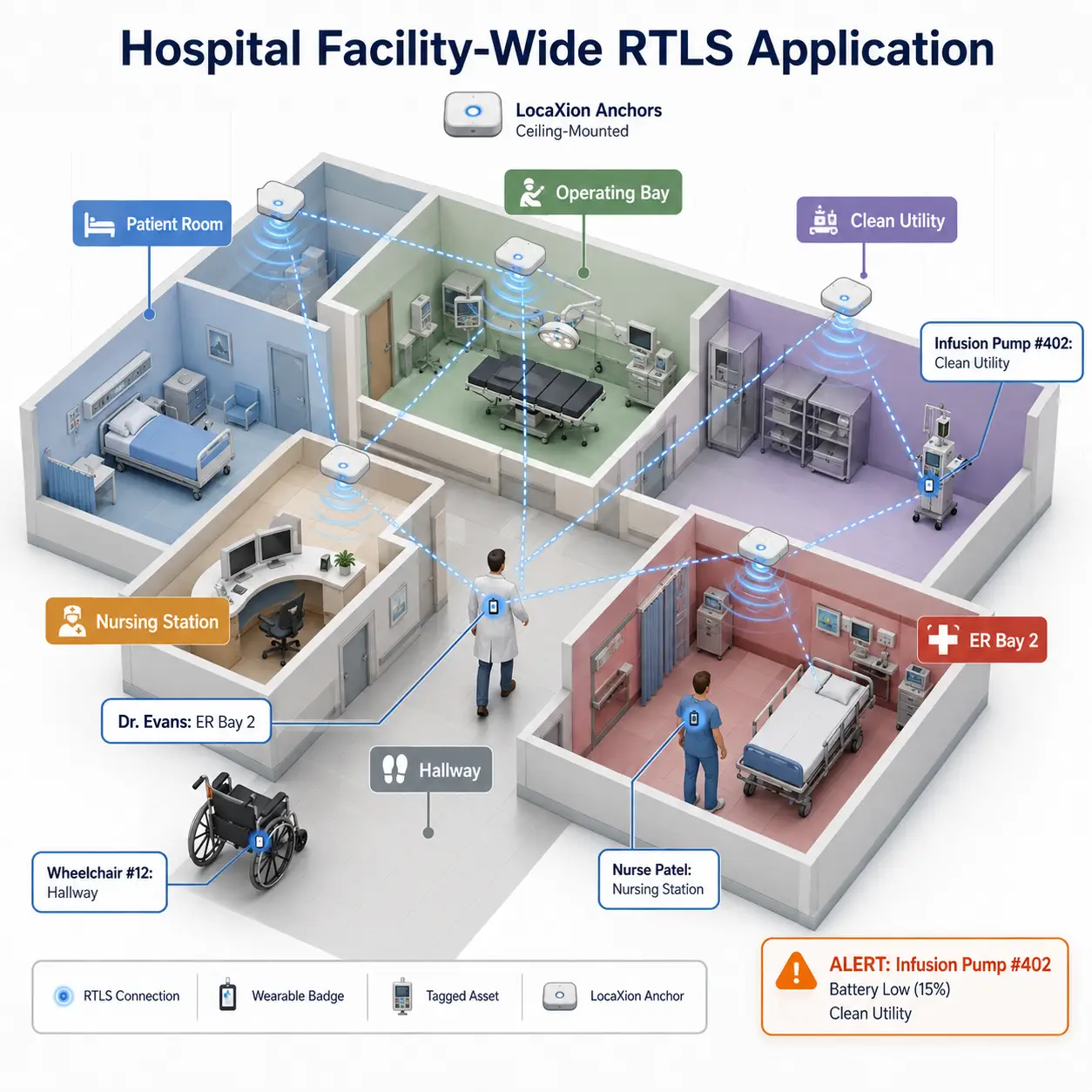
Modern healthcare location tracking relies on a network of physical tags, fixed anchors, and specialized software. Together, these elements form a unified digital twin of the physical facility. Depending on the specific architectural needs of a department, these systems utilize different radio frequencies or light waves to compute exact locations.
The Role of Radio Frequency and Sensor Integration
- Signal Transmission: Active tags attached to medical devices or wearable staff badges emit periodic location pulses.
- Network Reception: Overhead sensors intercept these signals and pass the data directly to a central positioning engine.
- Software Mapping: The positioning engine translates raw signal data into precise coordinates, updating the facility's digital layout instantly.
Navigating the Multi-Vendor Landscape
The current tracking market is heavily fragmented. Many original equipment manufacturers (OEMs) focus purely on selling proprietary hardware setups. This creates severe vendor lock-in, making it incredibly difficult and expensive for a hospital to scale or expand its system over time.
An alternative, smarter approach relies on technology-agnostic design. By partnering with an unbiased integration expert, hospitals can build a vendor-neutral framework. This strategy integrates various hardware standards into a single, cohesive network, choosing the ideal tracking technology for each distinct medical zone.
Comparing Tracking Modalities: Ultrasound vs. BLE
Different clinical workflows demand different levels of location precision. For basic inventory management, sub-meter accuracy works perfectly. For infection control, asset hoarding prevention, or staff safety, true room-level or bay-level accuracy is mandatory.
Understanding Ultrasound RTLS Engineering
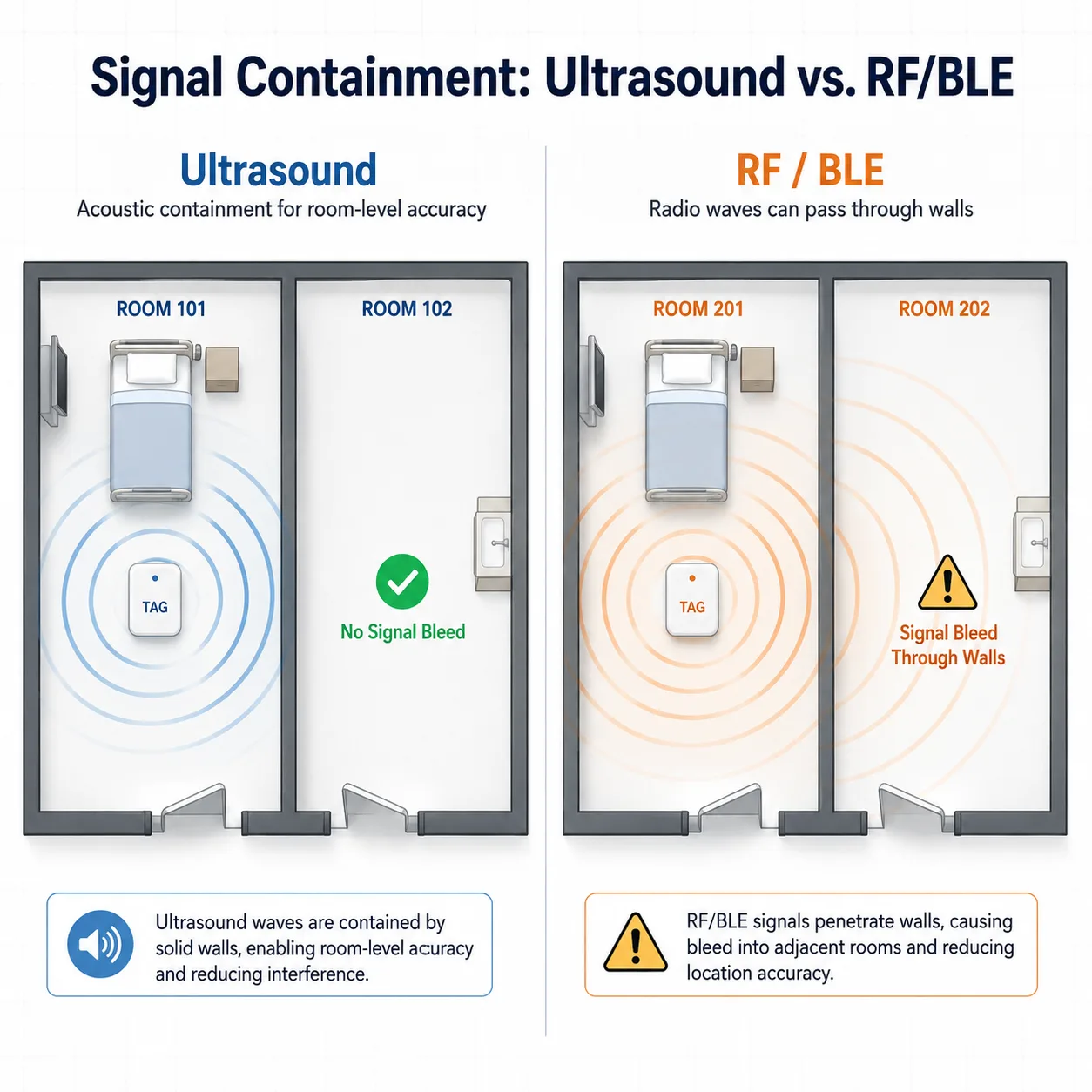
An ultrasound RTLS setup operates on acoustic principles rather than radio waves. Fixed microphones or transponders are mounted on ceilings throughout patient care areas. Wearable tags emit high-frequency sound waves that are completely imperceptible to humans.
Because sound waves cannot pass through solid drywall or heavy privacy curtains, the system delivers absolute room-level isolation. There is zero risk of signal bleed into adjacent rooms or hallways.
Advantages of Acoustic Systems
- Absolute Zoning: Delivers definitive room-level and bay-level precision, which is critical for automating patient milestone tracking.
- Interference Immunity: Operates entirely outside the radio frequency spectrum, preventing interference with sensitive medical imaging equipment or telemetry networks.
- Reliable Contact Tracing: Ensures a tag is genuinely inside a room, providing a vital, airtight metric for tracking hand hygiene or infectious exposure.
Disadvantages and Operational Challenges
- Line-of-Sight Constraints: Sound waves can be blocked by thick bedding, heavy clothing, or hanging equipment, requiring strategic tag placement.
- Component Density: Achieving complete coverage requires a high density of ceiling transponders, increasing the initial physical infrastructure footprint.
Range, Cost, and Accuracy Comparison
| Technology | Accuracy | Typical Range | Price Tier | Best Healthcare Use Case |
|---|---|---|---|---|
| Ultrasound | True Room/Bay-level | Confined by physical walls | Premium | OR patient tracking, contact tracing |
| BLE (Bluetooth) | Sub-meter to Zone | Broad area coverage | Cost-Effective | General asset tracking, standard inventory |
Top 5 RTLS Hospital Systems for Asset and Workflow Automation
Look at the top 5 RTLS hospital systems not as hardware brands, but as operational engines. Healthcare leaders do not care about proprietary tags. They care about organizational outcomes. It is a shift in perspective. View these systems exclusively through the lens of what they actually fix on the floor.
Enterprise Asset Management Systems
- Equipment theft, hoarding, and misplacement cost hospitals millions annually. Stop the bleeding.
- Track mobile medical equipment like infusion pumps, telemetry boxes, and specialty beds down to the inch.
- Biomedical teams need to find devices in seconds, not hours. Automate your inventory tracking to make that a reality.
- Optimize par levels. Eliminate the need to blindly rent unnecessary equipment.
Patient Throughput and Flow Systems
- From check-in to discharge, patient milestones run on autopilot.
- Utilize patient-worn tags across geofenced zones. Think waiting rooms, pre-op bays, and recovery suites.
- Stop guessing on wait times. Calculate the exact data.
- The second a room becomes vacant, environmental services gets the alert. Bed turnaround times accelerate instantly.
Staff Safety and Duress Alert Systems
- Healthcare workers face a rising tide of workplace security challenges. Address it head-on.
- Equip your teams with wearable badges featuring discrete panic buttons.
- Trigger an alert, and the system broadcasts the clinician's exact, continuous location straight to security personnel.
- Protect your frontline workers. Rapid response prevents escalation.
Environmental and Temperature Monitoring Systems
- Blood banks, pharmacies, and lab tissues demand strict temperature controls for compliance.
- Rip out the manual log sheets. Drop in automated, wireless sensors.
- Record temperatures 24/7 without human intervention.
- If a refrigeration unit drifts outside the approved range, the system fires an instant alert to save the inventory.
Hand Hygiene and Quality Compliance Systems
- Infection control remains the ultimate priority for clinical quality assurance.
- Track the literal interactions between staff badges and soap dispensers right outside patient rooms.
- Did the provider sanitize their hands before and after entering the care zone? The system logs it.
- Give facilities the raw, unbiased data required to move the needle on safety metrics.
Top 5 RTLS Users in Hospital Ecosystems
An integrated tracking platform delivers business value far beyond a single department. Look closely at the top 5 RTLS users in hospital environments. You start to see exactly how different teams leverage this spatial data to completely rewire their daily operations.
Clinical Nursing Teams
- Nobody relies on location data more frequently than the nursing staff.
- Find critical care equipment instantly. Give that saved time right back to direct patient care.
- Personal protection matters. Wearable duress badges offer immediate backup during security incidents.
Biomedical and Clinical Engineering Departments
- Use tracking software to lock down preventive maintenance and regulatory compliance schedules.
- Stop wandering the entire facility looking for a recalled IV pump or a device due for calibration.
- Locate the specific asset. Keep the hospital safe and compliant.
Emergency and Operating Room Directors
- Perioperative and emergency settings run on high-volume patient traffic. Spatial data brings order to the chaos.
- Watch digital dashboards to track operational delays the second they happen.
- Identify bottleneck patterns before they derail the shift.
- Push the utilization rates of operating suites and trauma bays to the absolute limit.
Supply Chain and Inventory Managers
- Use historical tracking metrics to hunt down and eliminate waste.
- Confidently adjust those expensive rental contracts by analyzing real asset utilization data.
- Stop over-purchasing equipment to cover the blind spots.
- Maintain razor-sharp inventory levels across every clean utility room in the building.
Hospital Security and Risk Management Personnel
- Manage facility access and respond to active duress events through a dedicated location network.
- Deploy officers instantly using real-time coordinate updates.
- Pinpoint the exact room of an alarm. Mitigate liability while ensuring a safer environment.
Outcomes and ROI
Every investment in healthcare technology must tie directly to a measurable business value or patient safety outcome. Relying on manual processes for tracking assets and workflows introduces massive operational costs.
Before and After Integration Metrics
Before System Integration: Clinical staff spend up to 45 minutes per shift searching for clean, calibrated equipment. This search time results in delayed patient treatments, increased staff frustration, and significant lost productivity every single year.
After System Integration: Care teams locate any required asset in under two minutes using a centralized digital dashboard. This rapid access eliminates workflow delays, lowers equipment replacement costs, and delivers a quick, definitive financial payback.
Transitioning to a Vendor-Neutral Architecture
To maximize long-term payback, a hospital must avoid closed, proprietary systems that create isolated data pools. A vendor-neutral systems integrator evaluates the unique layouts and clinical goals of each facility.
This approach allows hospitals to blend different hardware standards—such as BLE for broad asset tracking and ultrasound for precise room-level patient workflows—into a single, scalable digital twin framework. This integrated strategy ensures maximum efficiency, complete traceability, and reliable operational control.
FAQs on RTLS Technologies for Healthcare
How does ultrasound RTLS provide better room-level accuracy in hospitals compared to standard BLE systems?
Ultrasound RTLS in healthcare uses time-of-flight acoustic signals confined within physical barriers, preventing RF bleed-through seen in BLE/Wi-Fi systems. This ensures deterministic, room-level accuracy, critical for hospital workflows like OR tracking, patient flow monitoring, and compliance-sensitive zones.
What do users say about the effectiveness of RTLS solutions in healthcare?
Users report that RTLS significantly improves healthcare efficiency by enabling real-time visibility of equipment, patients, and staff, reducing search time and streamlining hospital workflows. Many highlight better patient flow, enhanced safety, and improved care delivery. Solutions like LocaXion further help healthcare teams turn RTLS insights into measurable operational and patient experience improvements.
What are the main advantages and disadvantages of deploying healthcare RTLS for asset tracking?
Healthcare RTLS enables real-time asset visibility, reduced search latency, optimized inventory levels, and predictive maintenance. Constraints include CAPEX for infrastructure deployment and OPEX for battery lifecycle management across active tags in large hospital environments.
How do the top RTLS hospital systems improve patient throughput and reduce wait times?
RTLS hospital systems leverage real-time patient telemetry, milestone tracking, and workflow orchestration to identify bottlenecks. Automated triggers for room turnover and resource allocation reduce dwell time, improving patient throughput and minimizing emergency department wait times.
Who are the key RTLS users in hospital environments and what value do they gain?
Primary RTLS users in hospitals include clinical staff, biomed teams, OR coordinators, supply chain managers, and security personnel. They benefit from real-time location intelligence, reduced operational friction, optimized asset utilization, and enhanced staff safety through duress tracking.
What factors influence the cost and long-term ROI of a healthcare RTLS deployment?
RTLS deployment costs depend on tag density, infrastructure type (BLE, ultrasound), and system integration complexity. A hybrid, technology-agnostic architecture—such as LocaXion—optimizes TCO by aligning accuracy requirements with appropriate technologies, maximizing long-term ROI in healthcare environments.