Passive legacy measures such as floor tape, mirrors, and beeping alarms only work when an operator notices them in time. Active safety closes that gap by detecting the hazard and slowing or stopping the forklift automatically, using technologies like UWB RTLS, AI cameras with SLAM, or radar together with AI agents running on existing camera infrastructure as a supplemental technology to enhance forklift accident prevention overall. Since no single technology fully covers every safety scenario, the most reliable approach typically combines multiple of them. The most important decision is to implement a system with an open architecture, one not tied to a single technology or use case, so it can incorporate additional capabilities as safety needs and operational realities evolve.
Passive vs Active Forklift Safety: What the Difference Really Means
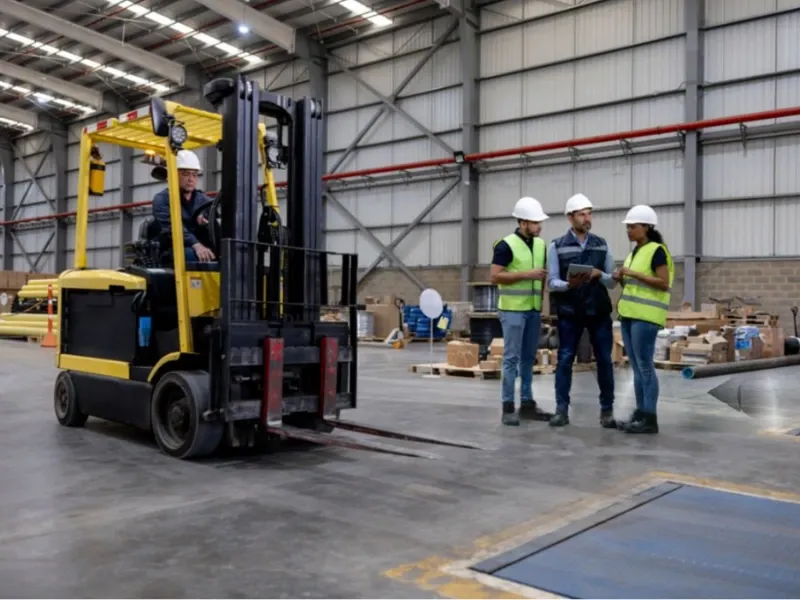
Most warehouses already run a forklift accident prevention program that looks complete on paper, with painted walkways, convex mirrors at the blind corners, reversing alarms, and a binder of operating rules every new operator signs on day one. The useful question is not whether those measures exist, but what they do in the half-second when a pedestrian steps out from behind a rack into the path of a moving truck.
That half-second is where the distinction between passive and active safety becomes concrete. A passive measure communicates a hazard and waits for a human to do the right thing, so a mirror only helps if the operator glances at it, and a beeper only helps if the person hearing it still treats it as a signal rather than background noise. An active measure does not wait, because it senses the developing collision and intervenes by cutting the truck’s speed or bringing it to a stop, regardless of whether anyone reacted.
Safety professionals already rank these approaches through the hierarchy of controls, which places engineering controls that physically reduce a hazard well above administrative controls and personal protective equipment that depend on behavior. As Figure 01 shows (below), passive measures cluster in the bottom two tiers where controls are weakest, while active intervention is the engineering control that moves protection up the ladder. None of this argues for throwing out mirrors and floor markings, but it does explain why forklift accident prevention built only on passive measures tends to plateau no matter how much training you add.
Figure 01, The Hierarchy of Controls Ranks Engineering Above Training and PPE
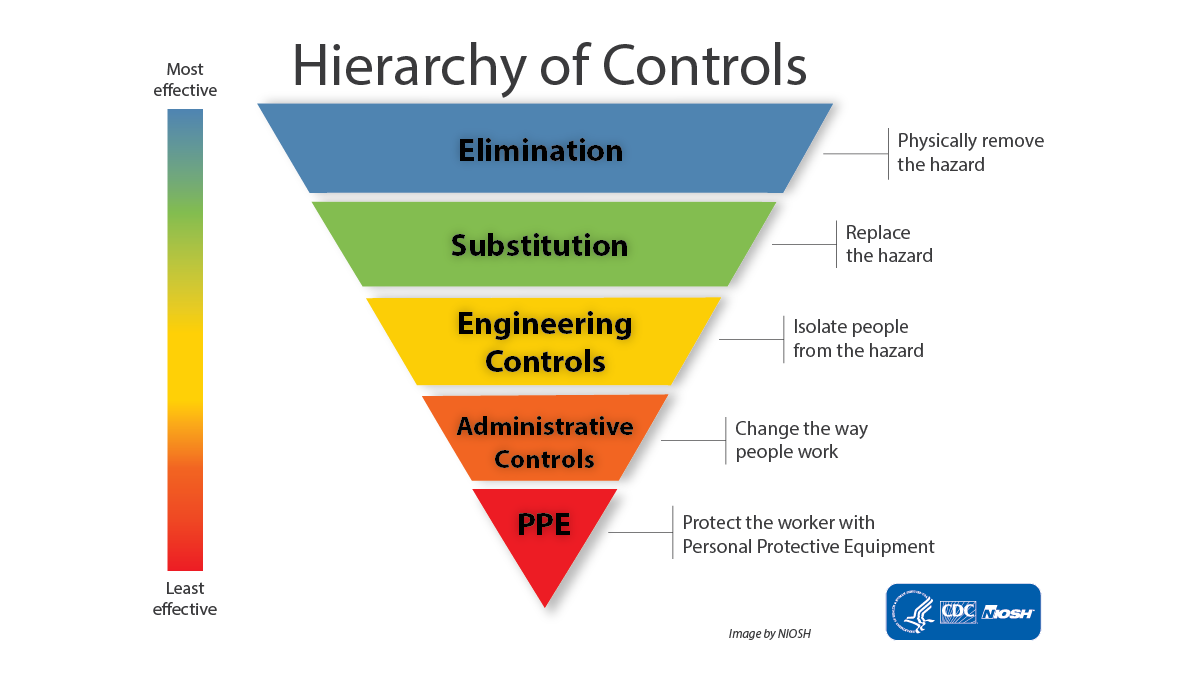
(Source: NIOSH, Hierarchy of Controls. Read from the top down, most passive forklift measures sit in the bottom two tiers.)
Why Passive Systems Reach a Ceiling
The legacy stack in most facilities is almost entirely passive, and it shares one structural weakness: every layer routes through a person noticing something and choosing to act. Speed limits, traffic plans, and high-visibility vests are all valuable, yet they assume an attentive operator and an attentive pedestrian meeting in the same moment, which is precisely the assumption that breaks down during a long shift near the end of a quota.
Alarm fatigue is the most predictable failure mode. When a proximity sensor beeps at every aisle entrance and passing rack, the warning meant to protect people turns into wallpaper, and within a week operators stop registering it. The enforcement gap that follows is the subject of our piece on enforcing forklift safety rules in a warehouse, because a rule no one feels is not really a control.
The stakes are not abstract. The US Bureau of Labor Statistics recorded 84 forklift-related work deaths in 2024 in its Census of Fatal Occupational Injuries, alongside tens of thousands of nonfatal injuries each year, and pedestrians struck by trucks account for a disproportionate share of fatal cases, mechanisms NIOSH documented in its forklift safety alert and that have not materially changed since. OSHA’s 29 CFR 1910.178 sets the baseline for training and safe operation, and ANSI/ITSDF B56.1 governs the trucks themselves, but compliance defines the floor of forklift accident prevention rather than its ceiling, and most recoverable risk sits in the gap between what the rules require and what a distracted moment delivers.
Active Forklift Accident Prevention Toolkit (in Plain Terms)
Active forklift accident prevention is not a single product you buy once, it is a family of technologies that each detect hazards differently, and knowing what each is good at is the difference between a system that fits your floor and one that fights it.
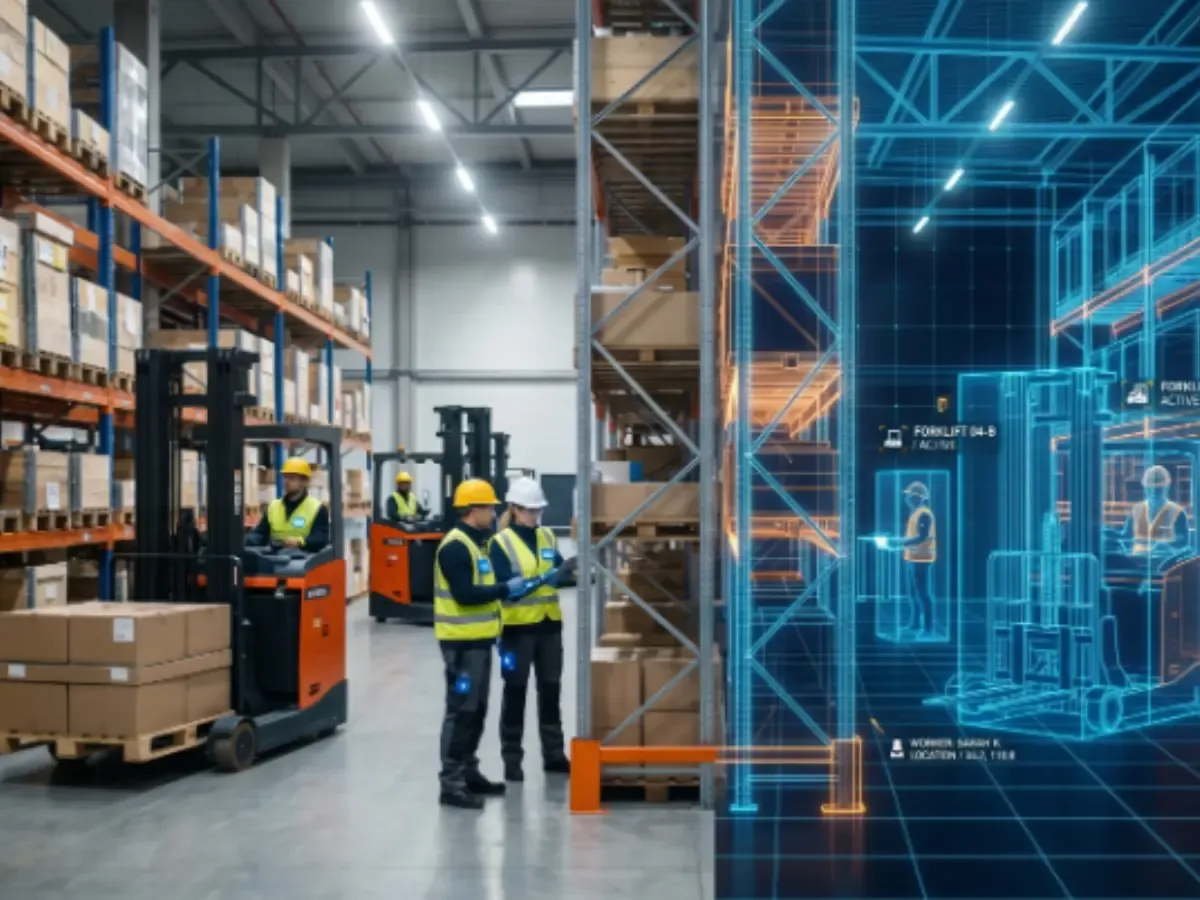
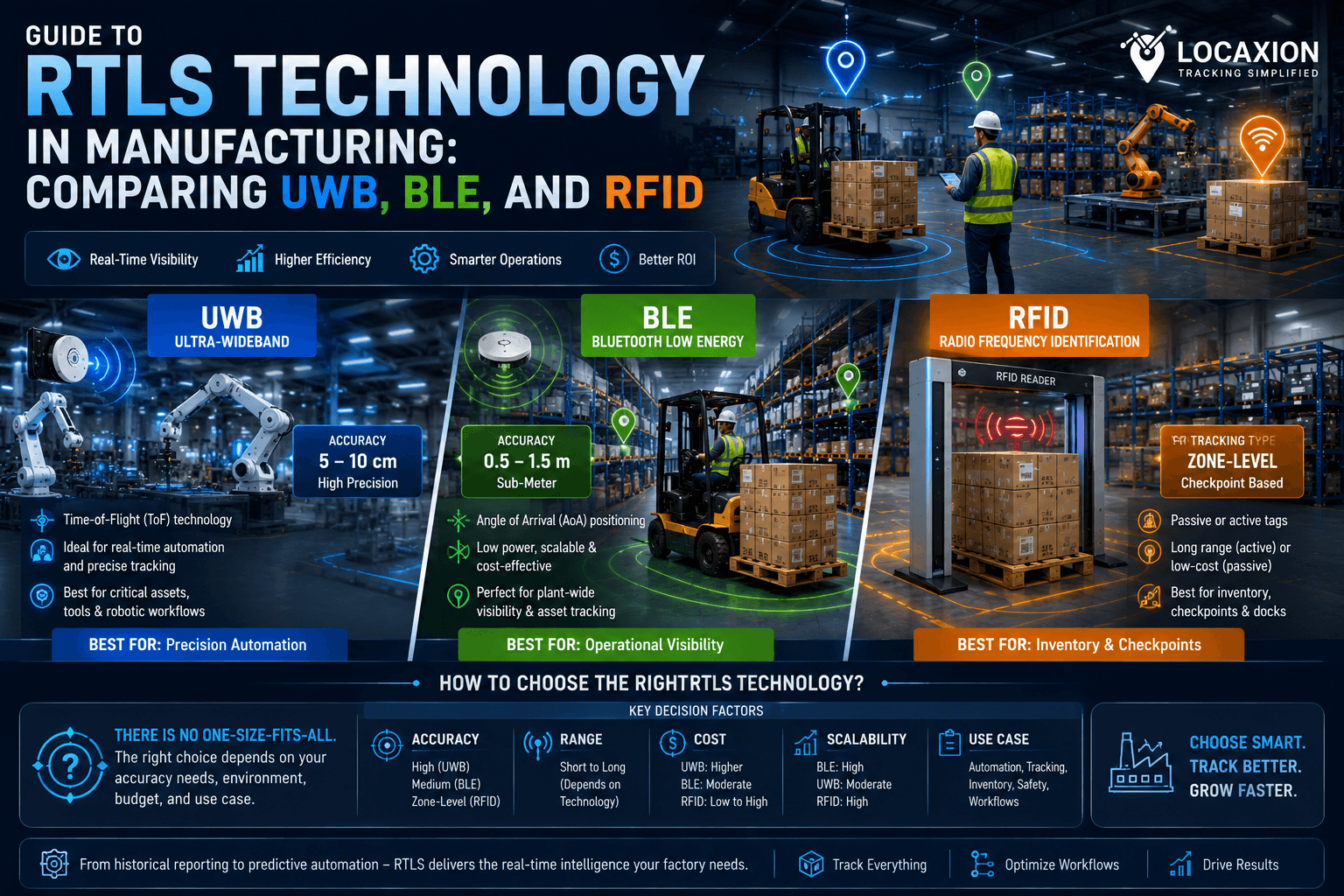
One of the options is ultra-wideband RTLS, a radio technology that locates a forklift and a tagged person to within roughly ten to thirty centimeters and updates many times a second, letting it enforce slow-down and stop zones around blind corners where a camera sees nothing. It works from fixed ceiling anchors reading wearable tags worn by operators and pedestrians, so it reaches through racking and walls, but only protects people wearing one. The trade-offs between proximity alerts and true automatic intervention are covered in our forklift proximity alert system guide.
AI vision cameras follow a different architecture, where the sensing and the compute both sit on the forklift itself rather than in fixed infrastructure. Pointed at the travel path, they recognize the human form without any tag, which is what you need for the unequipped pedestrian, and a full setup stitches several views into near 360-degree coverage. Their limitation is line of sight, since a camera cannot see behind a steel upright, which makes vision-only setups a poor fit for dense racking, deep aisles, or blind intersections where the hazard sits outside the view. Vision need not stay a standalone detector, because AI cameras can be combined with SLAM so the truck localizes itself against a live facility map, turning the camera layer into a genuine RTLS source. We go deeper on vision-based detection in our guide to forklift and pedestrian safety in Warehouse 4.0.
Radar is worth considering as an alternative to AI cameras used without SLAM, since both are tag-free detectors that sense what is near the truck without producing position. Radar holds accuracy in dust, glare, and poor light, the conditions that degrade optics, and is simpler to fit. The trade is resolution, because radar registers that something is there without reliably telling you whether it is a person or a rack leg, where a camera classifies it. On a dusty floor that does not need scalable positioning, radar is often more dependable.
Telematics handles access control, pre-shift checklists, and impact recording, less about the moment of collision than the discipline around it, as we explain in our overview of forklift monitoring systems. AI agents can also run on existing fixed CCTV cameras, flagging a pedestrian crossing into a forklift lane, checking that PPE is worn, and detecting hazards such as blocked aisles. Be precise about this layer, because a fixed ceiling camera has no link to the drivetrain and cannot slow anything down. Treat it as supplemental, widening what the site sees while intervention stays with the on-truck systems. Table 01 compares them.
Table 01
| Technology | How It Detects | Best For | Watch-Out | Scales to Other Use Cases |
|---|---|---|---|---|
| UWB RTLS Tags | Ceiling anchors locate worn tags and trucks to 10 to 30 cm | Blind corners, through-rack coverage, automatic slow and stop zones | Only protects people wearing a tag | Yes. Position data feeds wider fleet use cases |
| AI Vision Cameras | Recognizes the human form, no tag required | Untagged pedestrians, visitors, near-360 view on the truck | Needs line of sight, limited in dense racking | No. Detects locally, no position output |
| AI Vision plus SLAM | Vision detection plus self-localization on a live facility map | Tag-free detection with true positioning, mixed fleets | Map upkeep as the layout changes | Yes. RTLS-grade position, no tags |
| Radar Sensing | Reflected radio waves for close-range presence | Dust, glare, and poor visibility conditions | Coarser than UWB, fewer object details | No. Proximity only, no position |
| Telematics / Impact | On-truck sensors, access control, impact logging | Operator discipline, accountability, trend data | Mostly records, does not prevent on its own | No. Event data, no spatial context |
| AI on Existing CCTV Supplemental | Software agents analyze current fixed camera feeds | Hazard and PPE monitoring, site-wide visibility, no new truck hardware | Cannot slow or stop a truck, bounded by where cameras already point | No. Fixed viewpoints, no truck position |
See UWB and AI cameras with SLAM slow a forklift before a blind-corner collision, with your existing CCTV widening what the site can see.
There Is No Single Winner: Designing the Mix
The temptation is to ask which technology is best for forklift accident prevention, and the honest answer is that there is no clear winner in the abstract. What decides it is the operational reality of the site, and two factors do most of the work: the environment itself, and whether the people on the floor can realistically be asked to wear a tag.
The environment comes first. A facility packed with deep racking, narrow aisles, and heavy cross-traffic gives a camera little clear line of sight, which favors UWB because radio reaches through the obstructions that block optics, while an open floor with wide lanes plays to vision with SLAM and needs no wearables.
Tag wearability decides the rest. Where everyone on the floor is badged staff already wearing a lanyard, a wearable is a small addition and UWB gives precise location. Where the traffic is contractors, drivers, and visitors who will never reliably carry anything, tag-free detection is the only approach that covers everyone at risk. Neither is better in general, they answer different operational realities.
Because operational reality is also the thing most likely to change, the decision that matters most is not which sensor you pick first but whether the platform can absorb the next one. If each technology arrives as a sealed box with its data locked inside, you have bought several safety systems that cannot talk to each other. The alternative is to feed every sensing technology into the LocaXion Digital Twin, an open layer that ingests location and detection events from any source, holds the slow-down and stop policies in one place, and lets you add a technology later without disturbing what runs today.
How to Buy Without Boxing Yourself In
The most expensive mistake we see in forklift accident prevention is not choosing the wrong sensor, it is buying a system so tightly scoped that it can only do the one thing it was sold for, which strands the spend when the operation changes.
Active safety pays back fastest when the same location data that prevents a collision can later produce a Fleet OEE report, because the sensors and integration work were the hard part and are already done. A buying process that protects that option looks less like a product comparison and more like a short discipline:
- Define the hazard, not the product. Start from the collisions in specific zones you need to prevent, and let that specify the capability, so you buy an outcome rather than a brand.
- Pilot one zone with one mix. Instrument a single high-traffic intersection with the technologies that suit it, and validate accuracy and intervention behavior across a full production week, because vendor demos run under conditions your floor does not.
- Insist on open integration. Require that the system exposes its location and event data through documented, open interfaces, so it can join a wider platform instead of a sealed dashboard.
- Check the second use case before you sign. Confirm the same infrastructure can later serve Fleet OEE and truck utilization, operator behavior and impacts, and forklift traffic flow, because that turns a safety cost into a platform investment.
- Scale by zone. Extend coverage one area at a time and revalidate integrations as you go, since each zone brings layouts and traffic patterns the pilot never showed.
The honest part is that scaling runs slower than the pilot, because every new area surfaces integrations to prove out, and we would rather walk your floor and tell you which zone to start with than sell you a site-wide rollout you do not yet need. Active safety does not replace your OSHA obligations either, it sits on top of them as the engineering control the hierarchy rewards, and bodies such as MHI are a useful reference as the program widens. You can see what a layered deployment delivered in practice in our warehouse forklift tracking case study. Build it open, and the system that stops a collision this quarter becomes the one that optimizes your fleet next year.
FAQs on Forklift Accident Prevention
What is the difference between active and passive forklift safety?
Passive forklift accident prevention warns and relies on a person to react in time, including painted walkways, mirrors, signage, and beeping proximity alarms. Active safety detects an imminent collision and intervenes automatically, slowing or stopping the truck without waiting for operator reaction.
Which technologies are used for active forklift accident prevention?
The common building blocks are ultra-wideband RTLS that gives precise location for tagged people and trucks, AI vision cameras that detect untagged pedestrians and can be combined with SLAM for tag-free positioning, radar for close-range presence, and telematics for impact and access control, supplemented by AI agents running on a facility’s existing cameras for hazard and PPE monitoring. Which combination is right depends on the operational reality of the site.
Do AI cameras replace UWB tags for pedestrian detection?
They are alternatives suited to different conditions rather than direct replacements. AI cameras detect untagged people but need clear line of sight, which limits them in dense racking, while UWB works through obstructions but only protects people who carry a tag. Combining AI cameras with SLAM adds tag-free positioning, so the choice comes down to site density and whether everyone on the floor will reliably wear a tag.
Can we use our existing warehouse cameras for forklift safety?
Often yes, as a supplemental layer. AI agents can run on existing fixed CCTV feeds to flag pedestrians entering forklift lanes, verify PPE compliance, and detect other hazards such as blocked aisles. They cannot slow or stop a truck, because a fixed camera has no link to the drivetrain, so they widen visibility and evidence while on-truck systems handle the intervention.
Is a single technology enough for forklift accident prevention?
Yes, it often is. Where the operational reality is consistent, a single well-matched technology such as UWB or AI cameras with SLAM can cover the risk properly on its own, and there is no need to buy more than the floor requires. The caveat is what happens next, because layouts change, traffic grows, and new hazards appear. Implement that single technology on an open platform such as a Digital Twin layer, so you can add further sensing later and extend the same data into Fleet OEE, operator behavior, and traffic flow rather than starting again.
How do we avoid vendor lock-in when buying a safety system?
Specify capability rather than a brand, require open interfaces and a documented API, prefer systems built on open RTLS standards, and confirm the platform can serve more than the one safety use case before you commit.
Does active safety remove the need for OSHA compliance?
No. OSHA 29 CFR 1910.178 remains the baseline for training, evaluation, and safe operation. Active technology sits on top of compliance as an engineering control, it does not replace the program.
About LocaXion: LocaXion is an RTLS and Digital Twin systems integrator. We design and deploy location-aware safety and operations layers across warehousing, discrete manufacturing, and healthcare, selecting the right mix of ultra-wideband, AI vision, radar, Bluetooth, RFID, and SLAM for each floor rather than selling a single technology. Every engagement starts with a one-zone pilot validated under real shift conditions, and every deployment is built on an open layer so it can expand beyond the use case it started with.