

- How RTLS Enhances Workplace Safety
- How RTLS Works for Staff Protection
- Industry-Specific Applications of RTLS for Staff Protection
- RTLS for Staff Protection: How to Choose
- ROI of RTLS for Staff Protection
- RTLS and Compliance in Workplace Safety
- Conclusion
- Ready to Improve Staff Safety with RTLS?
- Frequently Asked Questions
Workplace safety is no longer just a compliance requirement. In healthcare, manufacturing, warehouses, retail, and hospitality environments, staff face real risks every day, from workplace violence and lone worker exposure to equipment-related injuries and delayed emergency response.
RTLS for staff protection addresses a growing visibility gap in how organizations manage these risks. Globally, 2.9 million people die each year(https://www.ilo.org/topics-and-sectors/safety-and-health-work) from work-related accidents and diseases, and hundreds of millions more suffer non-fatal workplace injuries, many worsened by slow detection and response. When teams lack real-time awareness of where employees are during critical moments, incidents escalate before help arrives.
This guide explores how RTLS for staff protection is applied to improve situational awareness, where it is applied, and how to select the right setup based on your environment and safety risks.
How RTLS Enhances Workplace Safety
An RTLS solution for workplace environments strengthens your safety layer by transitioning from passive monitoring to active intervention. By providing a continuous data stream, the technology improves safety outcomes in four key areas:
-
Reducing response time in emergencies with real-time alerts.
-
Preventing accidents with geo-fencing and hazard detection.
-
Ensuring compliance with safety regulations like OSHA and HIPAA.
-
Providing detailed incident analytics to improve future safety measures.
How RTLS Works for Staff Protection
Key Components of RTLS in Staff Safety
RTLS for staff protection is built on a combination of wearable devices, fixed infrastructure, and software that together provide real-time visibility into employee location and movement.
Key Components of RTLS in Staff Safety
- RTLS Tags – Worn by employees to track location and trigger alerts. Learn more about how Personnel Tags support real-time tracking and emergency response in high-risk work environments.
- Anchors & Gateways – Fixed infrastructure that receives location signals and calculates employee position across indoor environments.
- RTLS Software – The control layer that visualizes staff movement, manages alerts, and stores historical data for incident review and compliance reporting.
How RTLS Detects & Responds to Threats
RTLS systems are designed to detect risk events as they happen and initiate response workflows automatically.
- Panic Buttons – Employees can trigger a distress alert in case of emergencies,enabling immediate response.
- Geofencing – Sends warnings when employees enter restricted or hazardous areas.
- Real-Time Alerts – Instant notifications sent to security personnel in critical situations.
Industry-Specific Applications of RTLS for Staff Protection
RTLS for staff protection is applied differently across industries, but the objective is the same: faster response, clearer visibility, and proactive accident prevention.
Healthcare
Healthcare environments face high exposure to workplace violence, emergency situations, and compliance requirements.
- Workplace duress RTLS enables nurses and hospital staff to trigger alerts during violent or threatening incidents
- RTLS and employee safety workflows improve emergency response by providing precise staff location in real time
- Supports HIPAA compliant handling of staff and patient location data
- Enables faster intervention in critical care and improves hospital staff safety in high risk zones
This makes RTLS a practical RTLS solution for workplace safety in hospitals and clinical facilities.
Manufacturing & Warehouses
Industrial sites involve heavy machinery, restricted zones, and frequent lone worker scenarios.
- Accident prevention RTLS reduces risk by monitoring entry into hazardous areas and enforcing geofencing rules
- Worker safety RTLS supports lone workers through real time location tracking and automated distress alerts, including personal alarm integration.
- Improves OSHA compliance by maintaining visibility in confined spaces and isolated zones
- Enables faster incident response when workers are exposed to machinery related or environmental risks.
Here, RTLS directly addresses accident prevention and operational safety at scale.
Retail & Hospitality
Large public facing environments present different safety challenges related to customer interactions and dispersed staff.
- Panic alerts support staff facing aggressive or unsafe customer situations
- Faster response times by guiding security teams to exact incident locations
- Consistent coverage across hotels, malls, casinos, and large venues without relying on manual reporting.
RTLS for Staff Protection: How to Choose
What Are Your Primary Safety Objectives?
Choosing RTLS for staff protection is less about features and more about fit. The right system should align with your risk profile, operating environment, and long-term safety strategy.
1. Define Your Primary Safety Objectives
Start with the risks you are trying to control.
- Are you focused on accident prevention, such as forklift collisions, restricted zone entry, or PPE violations?
- Do you need faster emergency response for duress events, lone workers, or medical incidents?
- Are regulatory requirements like OSHA confined space rules or ISO 45001 driving the need for continuous staff visibility?
Clear objectives help determine whether you need zone based awareness, precise staff location tracking, or active alerting.
2. Understand Your Operating Environment
The physical environment directly impacts which worker safety RTLS technologies will perform reliably.
- Are there challenges such as dust, poor lighting, high noise levels, or heavy metal structures?
- Do employees move only indoors, or across indoor and outdoor areas?
- Will the system need to operate in confined spaces, multi level facilities, or isolated zones?
These factors influence whether UWB, BLE, vision, or hybrid approaches are viable for staff protection.
3. Plan for Scale Beyond Initial Use Cases
Many organizations start with employee safety and expand later.
- Will this RTLS for staff protection later support asset tracking, workflow visibility, or evacuation management?
- Do you need a modular setup that can grow into broader workplace safety or operational use cases?
- Can the system handle higher data volumes without sacrificing accuracy or responsiveness?
Scalability matters if staff protection is part of a longer digital safety roadmap.
4. Evaluate Integration Requirements
Staff safety systems should not operate in isolation.
- Does the solution need to integrate with alarm systems, incident management tools, or access control?
- Can it support reporting for OSHA audits 2026 or internal safety reviews?
- Will it work alongside existing ERP, MES, or IoT systems for unified safety visibility?
Strong integration ensures safety data translates into action.
5. Account for Practical Limitations Early
Many deployments struggle due to overlooked constraints.
- Are you aware of BLE performance limits in metal heavy environments?
- Have infrastructure requirements been assessed realistically, such as anchor density or camera coverage?
- Do you have mitigation plans for signal interference, downtime, or maintenance access?
Addressing these early prevents pilots that fail to scale.
ROI of RTLS for Staff Protection
Investing in RTLS for staff protection is not only a safety decision. It is an operational and financial one. While RTLS deployment involves upfront costs for hardware, software, and integration, organizations typically see measurable returns by reducing incidents, downtime, and response delays.
Cost Breakdown: Implementation vs. Long-Term Savings
RTLS deployment does involve upfront investment across hardware, software, and integration. However, the value becomes clear once systems are active and safety events are managed in real time rather than after the fact. The table below shows how initial costs are typically offset by measurable, ongoing savings.
| RTLS Investment Area | What It Involves | Long-Term Savings and Impact |
|---|---|---|
| Hardware and Tags | Staff location tags, anchors, gateways | 15-30 % reduction in safety incidents, lowering injury-related costs and insurance exposure |
| Software and Analytics | Dashboards, alerts, historical reporting | 20-40 % faster response times, improving escalation control and safety oversight |
| System Integration | Linking RTLS with alarms, safety systems, or dashboards | Fewer operational disruptions during incidents and emergency response |
| Compliance Enablement | Automated logs and safety reporting | Reduced OSHA audit risk and avoidance of fines through consistent documentation |
| Incident Management | Real-time alerts and post-incident data | 10-25 % reduction in injury-related downtime and faster return-to-work |
Reduction in Workplace Incidents & Insurance Claims
Organizations using worker safety RTLS systems consistently see fewer workplace injuries and safety violations because risks are identified and addressed in real time rather than after incidents occur.
In practice, this leads to:
- Fewer injury-related absences and faster return-to-work timelines
- Lower legal, medical, and workers’ compensation costs
- Reduced insurance claims and long-term liability exposure
The result is not just compliance, but a safer operating environment where safety investments translate into measurable, recurring savings.
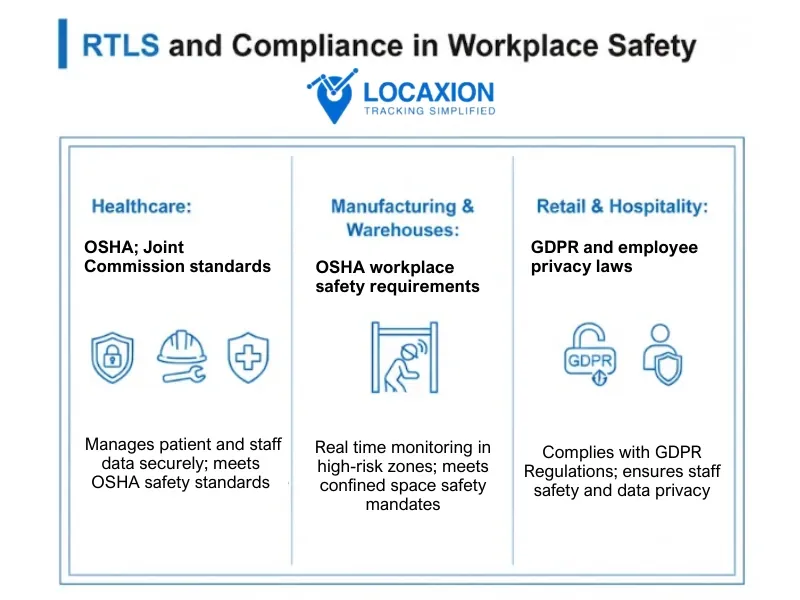
RTLS and Compliance in Workplace Safety
Healthcare: HIPAA, OSHA, Joint Commission Standards
RTLS ensures that patient and staff data are managed securely in compliance with HIPAA while also meeting OSHA’s safety standards.
Manufacturing & Warehouses: OSHA Workplace Safety Requirements
OSHA requires real-time monitoring of employees in high-risk zones, and RTLS helps meet these confined space safety mandates.
Retail & Hospitality: GDPR & Employee Privacy Laws
For industries handling customer and employee data, RTLS solutions must comply with GDPR regulations while ensuring staff safety.
Conclusion
RTLS for staff protection moves workplace safety from reactive reporting to real-time awareness. Across healthcare, manufacturing, warehouses, retail, and hospitality, organizations use worker safety RTLS to reduce response times, prevent incidents, and maintain compliance without adding operational friction.
The real value is not tracking alone. It is knowing when and where to act. When staff location data is available in real time, safety teams can intervene earlier, respond faster, and make decisions based on how the floor actually operates, not how it is assumed to work.
As organizations look toward 2026, combining RTLS with Digital Twin capabilities takes staff protection a step further. Location data becomes a living safety model, helping teams simulate risk, test response paths, and continuously improve protection strategies before incidents occur.
Ready to Improve Staff Safety with RTLS?
Talk to a LocaXion expert to identify visibility gaps in your facility. Let’s build a RTLS and Digital Twin roadmap that protects your team and ensures your safety strategy is ready for the demands of 2026.
Frequently Asked Questions
How does RTLS improve staff protection?
An rtls for staff protection strategy improves safety by providing sub-meter visibility and automated alerts. If an employee enters a dangerous zone or triggers a distress signal, the system notifies security instantly, closing the gap between the incident and the response.
Which industries benefit most from RTLS staff protection?
While any high-traffic environment benefits, industries like healthcare, manufacturing, and warehousing see the most impact. These sectors use worker safety rtls to manage complex risks, from heavy machinery proximity to workplace violence prevention.
What are the key factors to consider when choosing an RTLS safety solution?
You must evaluate your facility layout, environmental interference (like metal racking), and scalability. The most effective rtls solution for workplace safety is one that integrates seamlessly with your existing alarm and management systems.
Can the system help with RTLS contact tracing at the workplace?
Yes. In the event of a health or safety exposure, rtls contact tracing at workplace allows management to pull historical proximity reports. This ensures you can isolate risks and notify impacted staff without shutting down the entire facility.
How does the system handle emergencies in isolated areas?
For lone workers, rtls for staff location is a lifeline. If a worker becomes incapacitated or activates a workplace duress rtls alert, the system transmits their exact coordinates to the response team, even in areas where traditional radio signals might fail.
What is the typical ROI of an RTLS & employee safety investment?
Most organizations realize a return on investment within 12–18 months. By focusing on accident prevention rtls, companies significantly reduce costs associated with OSHA fines, insurance premiums, and work stoppages caused by preventable injuries.