Skip to content
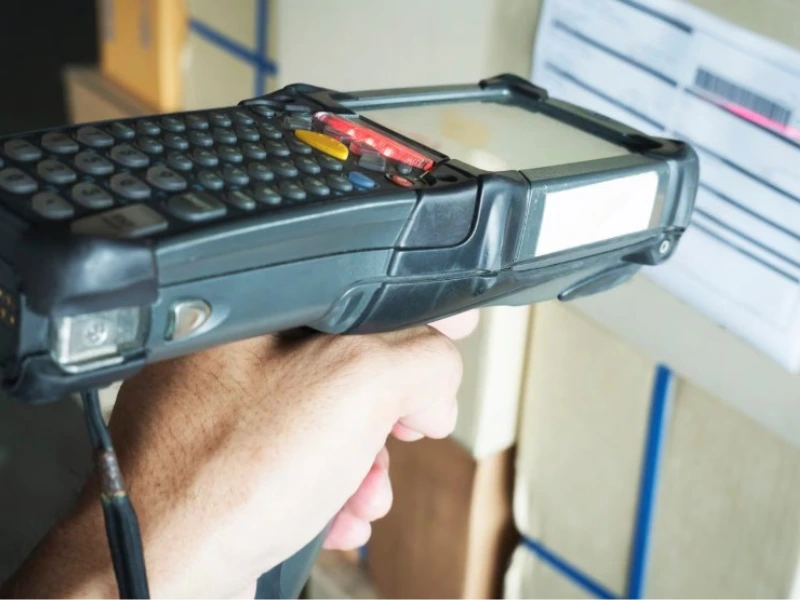
Most industrial supply chains struggle with inventory accuracy for the same reason. The system confirms transactions, but it cannot keep pace with movement. Barcodes confirm that a scan occurred. RFID confirms that inventory actually moved. That distinction becomes critical as supply chains scale.
In the RFID Vs barcoding for inventory management discussion, discrepancies rarely stem from poor discipline. They stem from physics. Barcodes depend on line of sight and sequential capture. One item, one scan, one operator. Even with the industry shift toward data-rich 2D barcodes under Sunrise 2027, the constraint remains unchanged. Line of sight does not scale with velocity.
As materials move faster across plants, warehouses, yards, and docks, scanning falls behind flow. Scan friction builds into scan debt, where systems look accurate while floor reality drifts. This is not a people problem. It is a throughput problem.
The real question in RFID Vs barcode decisions is not which method records data better, but which one holds up when the supply chain is under pressure.
The Architecture of Truth: Transactional Scans Vs Continuous Visibility
The choice between barcode scanning and RFID is not just a hardware preference. It is a choice in how your data model reflects reality. One records an event. The other monitors a state.
Barcoding: The Discrete Event Record
Barcode tracking generates “truth” through intentional, transactional confirmation. The system only knows what a human operator tells it at a specific point in time.
- Discrete Scan Events:
A barcode is a checkpoint technology. Between Point A (Receiving) and Point B (Assembly), the item is effectively invisible to the system. - Operator Dependent Truth:
The accuracy of inventory is tethered to operator compliance. If an operator is under pressure and moves a pallet without scanning, the truth in the WMS or MES immediately diverges from physical reality. - Line of Sight Constraint:
This is the physical bottleneck. Every truth requires a physical encounter. The label must be visible, oriented correctly, cleared of dust, and scanned.
Key Message:
Barcode confirms that a scan occurred. It cannot guarantee that inventory remained in the same location or state five minutes later.
RFID: The Automated State Engine
RFID generates truth through autonomous, zone-based detection. It removes the human gatekeeper from the data capture process.
- Zone Based Presence:
Instead of waiting for a scan, RFID enabled zones such as docks, staging areas, or workstations continuously interrogate the environment. The system knows an item is in Zone 4 simply because it exists there. - Transition Logic:
Unlike barcoding, which requires a stop, RFID captures inventory during movement. As a pallet passes through a portal, the state of change from In Transit to Received occurs at the speed of the forklift. - Bulk Intelligence:
RFID creates truth at scale. It can capture hundreds of serial numbers in a single pass, eliminating the human error inherent in sequential manual counting.
Key Message: RFID confirms that inventory has moved, providing a continuous stream of location events that support high-fidelity Digital Twin.
RFID Tag Vs Barcode Scanning: Key Technical Differences
The primary differentiator in an industrial setting is the shift from manual validation to autonomous spatial awareness. In the RFID Vs barcoding for inventory management decision, barcodes remain the foundation of transactional history, confirming that a recorded action occurred. RFID supports automated detection of inventory movement, allowing system state to update as assets move through operational zones.
As throughput increases, RFID Vs Barcoding capture models behave very differently, which is why the comparison below focuses on performance under real industrial conditions rather than feature lists.
| Factor | Barcode Scanning | RFID Tags |
|---|---|---|
| Capture Model | Transactional confirmation at scan points | Continuous, zone-based observation |
| Update Method | Manual scan required for each event | Automated detection as inventory moves |
| Identification Type | 1D and 2D barcodes | Passive RFID (UHF, HF) and Active RFID |
| Read Range | ~2–60 cm depending on scanner and label | Passive RFID: ~1–10 m Active RFID: ~20–30+ m |
| Line of Sight Requirement | Mandatory | Not required |
| Bulk Read Capability | Single item per scan | Hundreds of items per pass |
| Movement Capture | Stops when scanning stops | Continues during transit and staging |
| Human Dependency | High and continuous | Low after deployment |
| Throughput Behavior | Degrades under congestion | Scales with flow |
| Typical Tag Cost | Printed labels: ~USD 0.01–0.05 per label | Passive RFID: ~USD 0.10–0.50 Active RFID: ~USD 10–50 |
| Operating Cost Profile | Low upfront, labor cost scales with volume | Higher upfront, marginal operating cost near zero |
| Digital Twin Readiness | Limited checkpoint-based data | Strong state and movement data |
Also Read: RFID Vs NFC Tags: Differences in Cost, Range, and Industrial Use Cases
The Cost of Scan Dependency Under Throughput Pressure
Scan based models introduce hidden cost not because scanning is inaccurate, but because manual confirmation becomes a bottleneck at scale. This is where most RFID Vs barcode cost comparison discussions miss the point.
A barcode scan takes 3-5 seconds. At 5,000 movements per shift, that consumes 4 -7 labor hours per day. Under peak load, scans are deferred. Pallets move without confirmation, and scan debt begins to accumulate as physical flow outpaces recorded events.
Accuracy losses of 1-3 % during congestion are common, triggering rework, delays, and shipment holds. These costs surface overtime, expedited freight, and audit findings. Scan dependency fails quietly by shifting costs from execution to recovery.
These costs rarely appear on budgets. They surface overtime, missed starts, expedited freight, and audit findings. Scan dependency fails quietly by shifting costs from execution to recovery.
Where Barcoding Still Works Well
Evaluating RFID Vs barcode for inventory management, barcode scanning continues to perform reliably where movement is constrained, and confirmation can keep pace with execution.
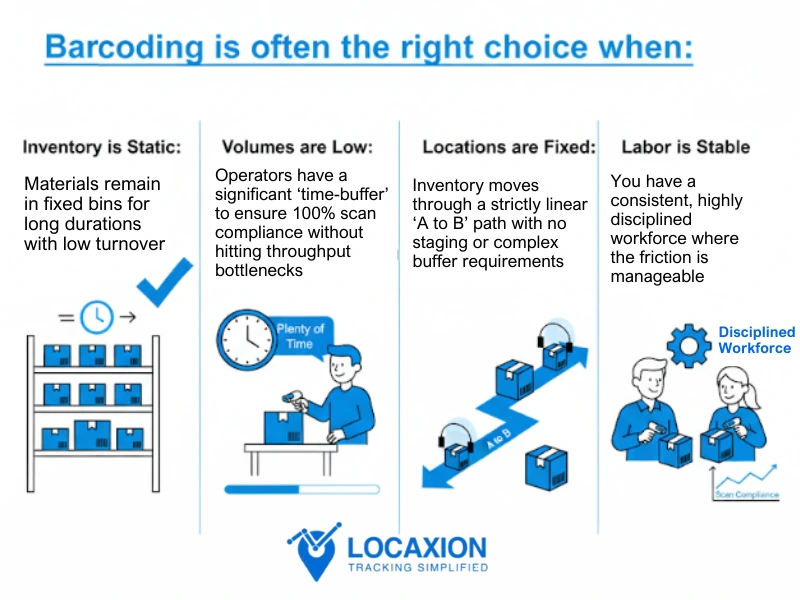
Barcoding is often the right choice when:
- Inventory is Static:
Materials remain in fixed bins for long durations with low turnover. - Volumes are Low:
Operators have a significant "time-buffer" to ensure 100% scan compliance without hitting throughput bottlenecks. - Locations are Fixed:
Inventory moves through a strictly linear "A to B" path with no staging or complex buffer requirements. - Labor is Stable:
You have a consistent, highly disciplined workforce where the "Scan Friction" is manageable.
Where Inventory Operations Break Scan-Based Models
The most critical realization for any operations leader is this: Inventory failures occur between scans, not at scan points.
Scan-based models are designed for "happy path" logistics, but they break down in the high-mix, high-congestion reality of industrial hubs. The system fails in the "In-Between":
- Staging & Buffer Zones:
When pallets are moved to "temporary" storage to clear a lane, they often go unscanned. These areas become black holes where inventory exists physically but vanishes digitally. - Cross-Dock Environments:
In high-velocity loading docks, the time required to find, orient, and scan every barcode is a direct hit to your outbound KPIs. This is where scan leakage is the highest. - Yard and Overflow Areas:
When a warehouse hits 90%+ capacity, inventory is often placed in non-traditional locations (aisles, yards, or trailers). If there isn't a fixed scan point at the door, that movement is never recorded. - High-Mix Production:
On a manufacturing line with hundreds of sub-assemblies, requiring a manual scan at every handoff introduces a "tax" on every minute of OEE.
In these environments, the choice between RFID Vs barcode isn't about preference; it’s about survival. RFID provides visibility, capturing the "flow" of the facility automatically, while barcodes only capture the "intent" of the operator.
Common Mistakes in RFID Vs Barcode Decisions
In industrial environments, choosing a technology from a spec sheet usually leads to a pilot that never scales. This is where decision logic typically breaks.
- The One Cent Label Myth
Teams compare a $0.01 barcode to a $0.15 RFID tag and assume the gap is cost. It is not. It is labor. If a worker spends 10 seconds locating and scanning a barcode, that single data capture costs roughly $0.08 in labor. At high velocity, operations pay a recurring labor tax to keep a system that appears cheap. - Treating RFID as a Faster Scanner
RFID is an event stream, not a trigger replacement. Without filtering logic to manage thousands of reads per second, RFID does not improve data quality. It overwhelms legacy WMS systems built for one scan equals one transaction. - The Binary Choice Fallacy
High ROI environments do not force a winner. Barcodes work well in static, low value storage where humans are already present. RFID belongs in staging, dock doors, and high mix flows where assets move faster than scanning can keep up. - Ignoring Physics in the Pilot
Barcodes work on steel or plastic. RFID does not. If metal interference and liquid attenuation are not engineered during the pilot, failure is guaranteed on the live floor.
Read More: Forklift Monitoring Systems: The Ultimate Tracking Guide
LocaXion’s Vendor-Neutral Perspective in RFID Vs Barcode Scanning
At LocaXion, we have learned the hard way that RFID Vs barcoding for inventory management is rarely a clean either-or decision. Barcodes usually fail only after teams have already outgrown them. RFID usually disappoints when it is dropped in without understanding how the floor actually moves. Our job is to prevent both mistakes.
We start by asking an uncomfortable question. Where does scanning stop keeping up with reality? In many facilities, barcode scanning still works perfectly fine in fixed storage and slow-moving lanes. Problems show up in staging, cross docks, rework, and congestion zones, where people are moving faster than systems can confirm. That is where RFID earns its keep, not as a replacement for barcodes, but to see what happens between them.
We stay vendor neutral because operations never stand still. Layouts change. Volumes spike. New identification methods come and go. We help teams layer RFID and barcode tracking where each actually works, integrate it cleanly into existing systems, and adjust as the floor evolves. The goal is not more technology. It is fewer surprises when inventory accuracy suddenly matters most.
Conclusion
The choice between RFID Vs barcode is not about which technology is newer. It is about which one survives the pressure of your facility.
As Sunrise 2027 approaches, 2D barcodes will improve data density, but they will not change physics. A line of sight remains in the bottleneck. Whether you manage warehouse inventory, high throughput manufacturing, automotive assembly, medical device production, or aerospace logistics, the objective is the same. Eliminate blind spots.
Aligning the right capture method with the right zone, you ensure that your system doesn't just look good on a spreadsheet; it reflects the ground truth of your floor. The result is an operation that stays accurate, compliant, and ready for whatever technology comes next.
Identify where scan-based models break down and where RFID actually adds value to your operation. We help teams map high friction zones, validate where a hybrid RFID and barcode approach protects OEE, and plan transitions without forcing a rip and replace.
Book a 30 Minute Scan Debt Audit
FAQs on RFID Vs Barcode Tracking
Which is better for inventory management a barcode scanner or RFID?
In RFID Vs barcoding for inventory management, the better option depends on throughput. Barcode scanners perform well when inventory is static, and scans can keep up with movement. RFID performs better when inventory moves continuously through staging, docks, and shared zones where manual scanning becomes a bottleneck.
Is RFID better than barcode?
In a RFID Vs barcode comparison, RFID is not universally better. It outperforms barcodes when operations scale, and inventory moves faster than people can scan. Barcodes remain effective for controlled workflows, while RFID maintains accuracy under congestion and peak load.
Will RFID replace barcodes?
No. A barcode Vs RFID technology comparison shows that the two serve different roles. Barcodes remain the simplest and most cost-effective option for transactional confirmation. RFID complements barcodes by covering the gaps between scans, not by replacing them entirely.
How does RFID affect inventory management?
RFID affects inventory management by shifting from manual confirmation to automated movement capture. When you compare RFID Vs barcode scanning systems for live inventory accuracy, RFID reflects where inventory actually is within operational zones, while barcode systems reflect the last confirmed scan.
What are the advantages and disadvantages in RFID Vs barcodes?
Barcodes are simple, inexpensive, and reliable in static environments. RFID provides automated visibility and bulk reads but requires proper engineering for metal, liquids, and layout. The right choice depends on movement patterns, not preference.
How do you compare RFID Vs barcode scanning systems for live inventory accuracy?
Barcode systems reflect the last confirmed scan. RFID systems reflect where inventory actually is within instrumented zones. Live accuracy improves with RFID when inventory moves frequently or passes through shared spaces.
When does barcode Vs RFID technology comparison favor a hybrid approach?
Hybrid models work best when barcodes handle static storage and low velocity lanes, while RFID covers staging, docks, yards, and high mix areas. This balances cost, accuracy, and operational reality without forcing a full replacement.