
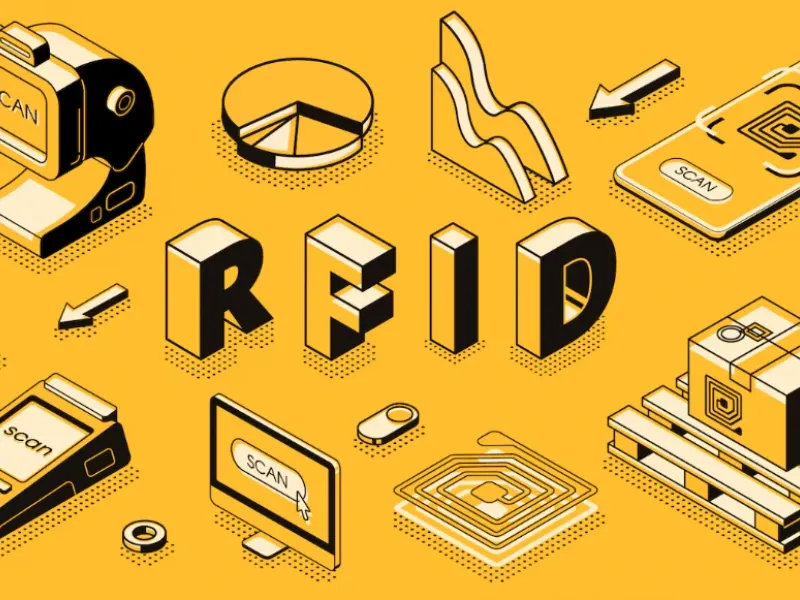
RFID technology (Radio Frequency Identification) is a technology that uses electromagnetic fields to automatically identify and track tags attached to objects. Emerging in the mid-20th century, RFID has evolved from a simple identification tool to a sophisticated technology integral to modern supply chains, inventory management, and access control systems. Today, RFID technologies are used across virtually every major industry, supporting everything from inventory management and access control to complex RFID industrial applications involving asset tracking, manufacturing automation, and warehouse visibility. Understanding how an RFID system operates is the first step toward selecting the right RFID solution for your business.
As businesses continue investing in digital transformation and Industry 4.0 initiatives, understanding what is RFID technology, how an RFID system works, and where it delivers the greatest value has become increasingly important. This guide explores the fundamentals of RFID, its industrial applications, benefits, challenges, and implementation best practices.
How Does an RFID System Work?
Every RFID system consists of three core components that work together to enable accurate identification, communication, and real-time data capture.
Tags: These contain unique identifiers and data, which are transmitted to readers. RTLS Tags are categorized as:
Active: Battery-powered for continuous data transmission.
Passive: Powered by the RFID reader’s electromagnetic signal, ideal for cost-effective solutions.
Semi-passive: Combine a battery for specific functions with passive transmission capabilities.
Readers: RFID readers communicate with tags by transmitting radio signals and capturing the returned data for processing within enterprise systems.
Antennas: Antennas create the radio frequency field required for reliable communication between readers and tags.
The process: The RFID reader emits a radio signal, activating the tag. The tag transmits its data back to the reader for storage or processing.
Practical Example: Think of your hotel door and keycard. The RFID reader on the door is constantly emitting a radio signal and your keycard has a unique identifier on a small computer chip. Once the keycard is within the range of the RFID reader, it reads its unique identifier and outputs a binary response. 0 or 1, and locks or unlocks the door.
Types of RFID Systems and Their Industrial Applications
| RFID Type | Features | Use Cases |
|---|---|---|
| Low-Frequency (LF) RFID | Operates at 30–300 kHz, short read range (up to 10 cm). | Animal tracking, keyless entry systems. |
| High-Frequency (HF) RFID | Operates at 3–30 MHz, read range up to 1 meter. | Payment systems, access control, library systems. |
| Ultra-High-Frequency (UHF) RFID | Operates at 300 MHz–3 GHz, read range up to 12 meters. | Supply chain management, inventory tracking, asset management. |
Applications of RFID Technology
RFID technology has evolved far beyond simple identification systems. Today, RFID industrial applications span multiple industries, helping organizations improve asset visibility, automate data collection, strengthen security, and optimize day-to-day operations. Some of the most common RFID technology applications include:
Retail: Inventory management and loss prevention.
Healthcare: Patient tracking and medication management.
Manufacturing: Asset tracking and quality control.
Logistics: Supply chain visibility and shipment tracking.
Access Control: Secure entry for buildings and restricted areas.
Benefits of RFID Technology
One of the biggest reasons organizations continue investing in RFID technologies is their ability to improve operational performance while reducing manual processes. The key benefits include:
Improved Data Accuracy: Eliminates manual data entry errors.
Real-Time Tracking: Enables live updates on asset locations and statuses.
Enhanced Security: Prevents unauthorized access and theft.
Operational Efficiency: Reduces labor costs and streamlines workflows.
Challenges and Considerations
While RFID technologies offer significant advantages, organizations should consider several operational and technical factors before implementation to ensure long-term success.
Privacy Concerns: Protecting sensitive data and preventing unauthorized tracking.
Implementation Costs: Initial investment in hardware, software, and integration.
Interference Issues: Addressing signal disruptions caused by metals or liquids.
Accuracy: RFID can be vary widely in accuracy given the environment in which it is deployed.
Standardization: Ensuring compatibility with regional and global RFID standards.
Future of RFID Technologies
Integration with IoT: RFID’s synergy with IoT enables advanced automation and analytics.
Advancements in RFID Tags: Development of smaller, more durable, and energy-efficient tags.
Expanding Applications: Growth in areas like healthcare, agriculture, and smart cities.
Implementing RFID Solutions in Your Business
Assessing Needs: Before implementing an RFID solution, organizations should evaluate operational challenges, tracking requirements, environmental conditions, and expected business outcomes.
Planning Deployment: Design an RFID system that integrates seamlessly with existing ERP, WMS, or warehouse visibility platforms while supporting future scalability.
Training Staff: Educate employees on RFID functionality and best practices.
Measuring ROI: Measure the effectiveness of your RFID solution by monitoring inventory accuracy, asset utilization, labor productivity, and overall operational efficiency.
Conclusion
RFID technology offers immense potential for transforming operational efficiency, security, and data accuracy across industries. From inventory management and asset tracking to access control and supply chain visibility, RFID industrial applications are helping organizations streamline operations, reduce manual errors, and make faster, data-driven decisions.
As businesses continue to embrace digital transformation and Industry 4.0 initiatives, understanding the capabilities and limitations of RFID is essential for selecting the right solution. By implementing a well-designed RFID system, organizations can improve productivity, enhance operational visibility, and build a more connected and intelligent enterprise.
Choosing the right RFID solution for you organization, consider factors such as the types of assets to be tracked, required accuracy, deployment environment, and budget. Consulting with Locaxion Intelligence expert to for free consultation who will help tailor the solution to your needs.
FAQs on RFID Industrial Applications
What is RFID technology?
RFID technology uses radio waves to automatically identify and track tagged assets, equipment, or inventory without requiring direct line of sight. An RFID system typically consists of RFID tags, readers, and antennas that work together to capture and transmit real-time data.
What are the benefits of RFID technology?
The key benefits of RFID technology include improved inventory accuracy, faster asset tracking, enhanced operational efficiency, reduced manual data entry, and greater visibility across supply chains and industrial operations.
What industries use RFID technologies?
RFID technologies are widely used in manufacturing, warehousing, logistics, healthcare, retail, and security. These RFID industrial applications help organizations improve inventory management, equipment tracking, worker safety, and operational efficiency.
How do I choose the right RFID solution for my business?
The ideal RFID solution depends on your operational environment, asset types, tracking range, and business objectives. LocaXion helps organizations evaluate these requirements and implement scalable RFID systems tailored to their operational needs.
Can RFID technology be integrated with RTLS?
Yes. RFID technology is often integrated with RTLS to provide enhanced asset visibility and location intelligence. LocaXion combines RFID with advanced RTLS solutions to help organizations improve tracking accuracy, operational visibility, and decision-making across industrial environments.