Skip to content
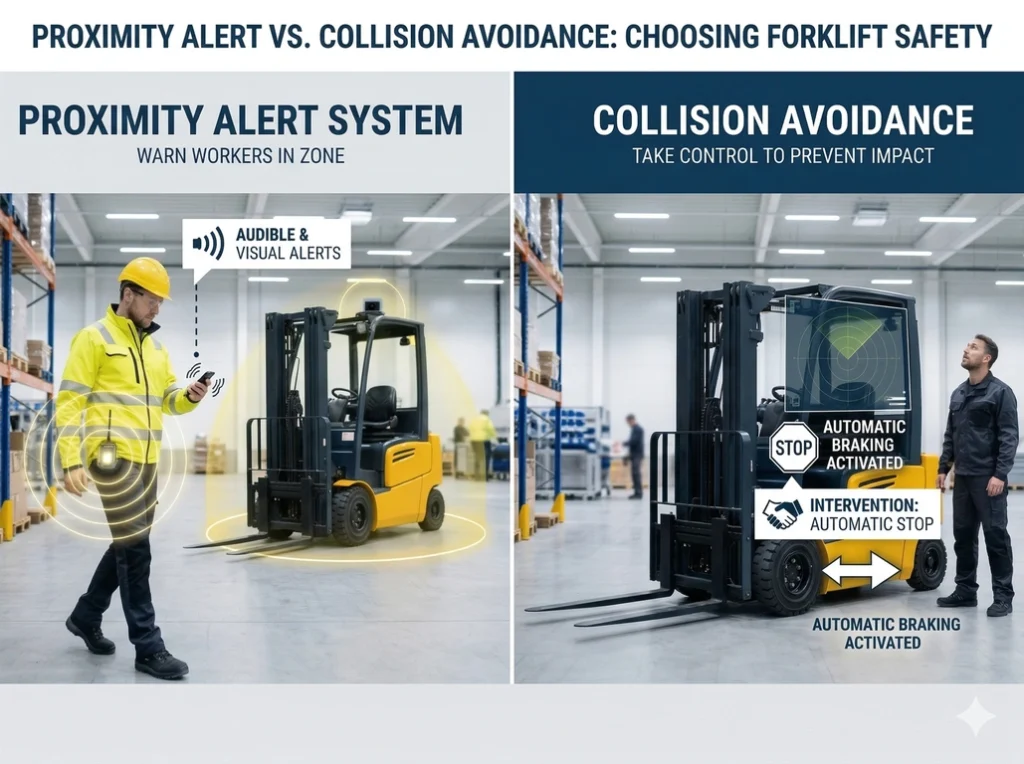
A forklift proximity alert system is the most common safety tool on plant floors today. Blue spot lights, backup beepers, and intersection horns warn workers that a forklift is nearby and rely on human reaction to prevent a collision. These tools are useful but are inherently limited, because in high-traffic, high-noise environments, the typical forklift proximity alert system stops delivering real protection.
But collision avoidance systems for forklifts work differently. Instead of issuing a warning and hoping someone acts on it, these systems use Real-Time Location Systems (RTLS), Ultra-Wideband (UWB) positioning, and Digital Twin intelligence for precise forklift tracking to autonomously slow or stop the vehicle before an incident occurs, i.e., the vehicle intervenes on its own. This blog explains the practical difference between a standard forklift proximity alert system and active collision avoidance, where each approach reaches its limits, and what plant safety managers should consider when choosing their next investment.
Alarm Fatigue: Disadvantages of Forklift Proximity Alarms
According to OSHA, forklift incidents cause approximately 85 fatalities and 35,000 serious injuries in the U.S. each year. The National Safety Council reported 84 forklift-related deaths in 2024 alone, with 36% involving pedestrians. Most of these facilities had forklift proximity alarms in place. The equipment was present, but the results were not.
The reason is alarm fatigue; a well-documented phenomenon where repeated exposure to alerts causes workers to eventually start ignoring them completely. Research from the Agency for Healthcare Research and Quality (AHRQ) defines it as desensitization resulting from excessive alarms. In industrial settings, the effect is identical: when every pass through an aisle triggers a beep, the brain stops treating it as a warning.
In environments where ambient noise exceeds 85 decibels, the OSHA threshold for hearing protection, a forklift horn may not even be audible above the mix of compressors, conveyors, and other equipment. The more alerts a forklift proximity alert system generates, the less effective each one becomes. The safety tool designed to protect workers ends up creating a false sense of compliance.
Consider the before and after states of a facility that installs forklift proximity alarms at every intersection:
For the first two weeks, operators and pedestrians respond to every alert. By month three, the alerts are ambient noise. By month six, workers walk through active forklift zones barely registering the beeps. The forklift proximity alert system is still running. The behavioral protection it was supposed to provide is not.
UWB Precision: The Foundation of Modern Forklift Safety Systems
If the core problem with a forklift proximity alert system is its dependence on human reaction, the fix is to remove that dependency. This is made possible with Ultra-Wideband (UWB) RTLS.
UWB calculated position using time-of-flight measurements resulting in far superior positioning accuracy compared to technologies like BLE or Wi-Fi. According to the FiRa Consortium, the UWB RTLS market is projected to exceed $600 million by 2030, driven by demand for precision safety in manufacturing and logistics.
What makes this forklift proximity alert technology viable for collision avoidance is that the position calculation runs on the forklift itself. There is no delay caused by a round-trip of the signal to a server and back.
Latency is reduced to milliseconds, such that the system can detect and react to hazards in a faster way than any human operator is able to perceive a hazard. This on-board computation is among the most critical forklift safety features in next-generation platforms.
Geofencing Intelligence: How a Proximity Alert System for Forklifts Becomes Collision Avoidance
Precise positioning is the raw computation. The intelligence layer, virtual geofences, is what transforms tracking into intervention and separates a collision avoidance platform from a basic forklift proximity alert system.
Static geofences enforce rules that are bound to specific areas, such as speed limits in pedestrian zones, mandatory stops at blind intersections, or no-go zones around sensitive equipment. They apply to every forklift, every shift, automatically.
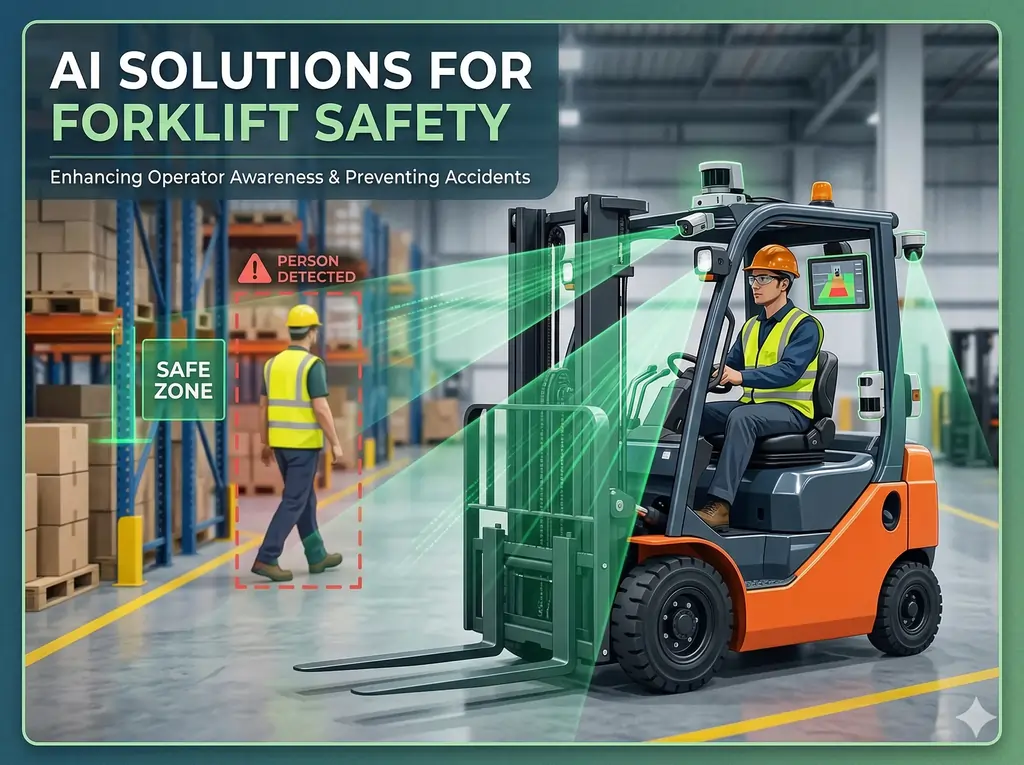
Dynamic geofences move with the vehicle and person in real-time. They create an invisible safety bubble around each forklift and pedestrian. When those geofences (bubbles) intersect, the system reduces speed or stops the forklift entirely - this can happen completely without human input.
The size of each geofence is configurable based on vehicle type, load weight, and operational speed, ensuring the intervention matches the actual risk profile. These intelligent geofencing methods consequently benefit forklift and pedestrian safety within the facility.
Milliseconds Matter: A Real-World Forklift Stopping Scenario
A forklift that is moving at a speed of 8 mph covers approximately 11.7 feet per second. The average perception-reaction time of an operator is 1.0-1.5 seconds. During that window, the truck travels 12 to 18 feet before braking even begins with another 8 to 10 feet needed to stop, resulting in a total of 20 to 28 feet; assuming the driver saw the hazard at all.
With an RTLS-based system, the forklift detects a pedestrian’s UWB tag the instant they enter the safety zone, including around blind corners and behind pallet stacks. Deceleration begins within milliseconds, not seconds. A forklift proximity alert system warns after the hazard is present. Collision avoidance intervenes before contact can occur. In scenarios measured in single-digit feet, that difference is the entire margin of safety.
The LocaXion Angle: Configurable Forklift Proximity Alert Technology with Digital Twin
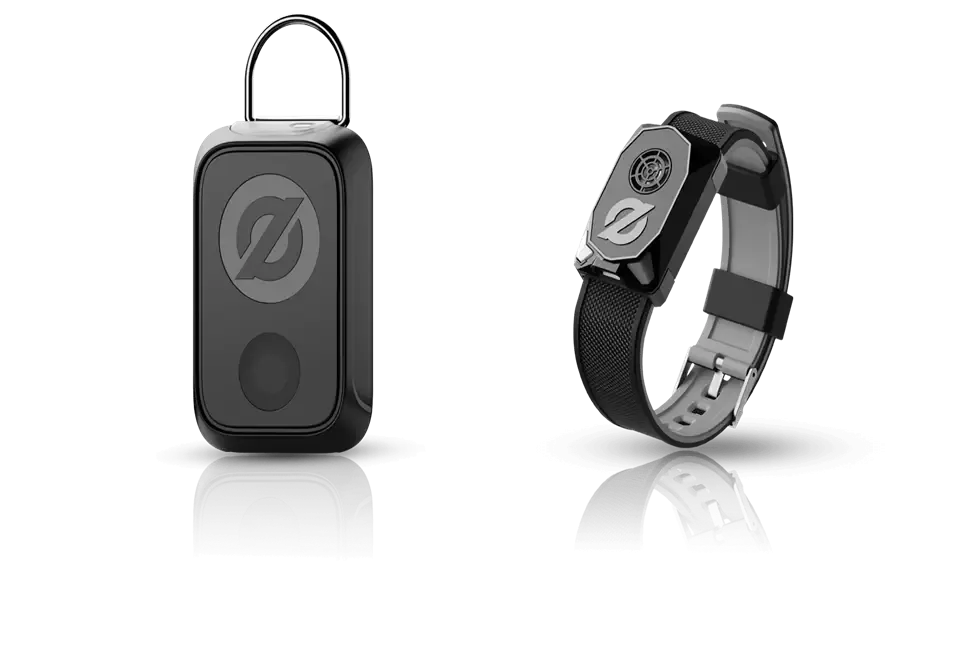
LocaXion deploys both static and dynamic geofencing tailored to each facility’s layout. Speed restrictions, intersection stops, and dynamic protective zones around every forklift and tagged worker; all configurable and enforced in real time. Every event feed into LocaXion’s vendor-agnostic Digital Twin, giving HSE teams incident heatmaps, OSHA-compliant checklists, and long-term safety KPI dashboards.

The system also works where traditional forklift proximity alarms cannot: around blind corners, behind racking, and during backing maneuvers where the driver’s line of sight is blocked. UWB tracks tagged pedestrians regardless of physical obstructions.
The RTLS operates from a facility-wide perspective and initiates a slow-down or stop before the operator is physically capable of seeing the hazard. No camera, mirror, or standard forklift proximity alert system can match that capability. Our real-time digital twin solution also enables mixed AGV fleet management and tracking for overall safety and compliance.
Moving Beyond Just Alarms with the Right Forklift Proximity Alert System
The next reduction in forklift-related incidents will not come from a louder forklift proximity alert system or brighter lights. It will come from systems that act autonomously; with centimeter-level precision, millisecond-level response, and zero dependence on human reaction.
For safety managers, the test is simple: does your current proximity alert system for forklifts still work when the floor is loud, crowded, or when sight lines are blocked? Can it tell you where your highest-risk zones are?
If not, it may be time to invest in a forklift proximity alert system your workforce will actually adopt; one that protects them without relying on their attention and delivers the operational data to streamline processes and stay ahead.
The ROI case is straightforward. Fewer incidents mean fewer OSHA citations, less downtime, and a workforce that trusts the safety infrastructure around them. When a forklift proximity alert system evolves from passive noise into active protection, the return shows up in every metric that matters.
Frequently Asked Questions on Forklift Proximity Alert System
Q: How does a forklift proximity alert system work?
A: These systems use lights, horns and mirrors to warn operators and pedestrians when a forklift is nearby. They depend on human reaction to prevent a collision. More advanced versions integrate with RTLS to add automated vehicle slow-downs and stops.
Q: Why do forklift proximity alarms lose effectiveness over time?
A: Because repeated alerts cause fatigue over time. Workers stop treating them as warnings at some point, especially in environments above 85 decibels where audible signals blend into background noise.
Q: How accurate is UWB positioning or tracking as a forklift safety feature?
A: UWB delivers 10 to 30 centimeter accuracy, even in metal-rich industrial environments. This is far more precise than Bluetooth or Wi-Fi, making it the preferred forklift proximity alert technology for safety-critical applications.
Q: Can collision avoidance detect pedestrians the driver cannot see?
A: Yes. RTLS tracks tagged pedestrians regardless of physical obstructions like racking or blind corners. The system triggers a slow-down based on position data, not the operator’s line of sight.
Q: Does active collision avoidance replace operator training?
A: No. It supplements training and existing forklift safety features as an additional protective layer. OSHA still requires operator certification and refresher training.
Q: What data does a Digital Twin provide for safety management?
A: Near-miss zone heatmaps, traffic conflict analysis, OSHA compliance dashboards, and long-term safety KPI tracking turning raw location data into actionable intelligence.