Skip to content
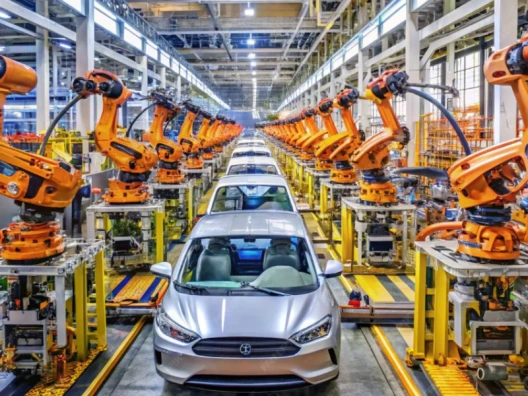
Automotive manufacturing environments are among the most challenging settings for deploying Real-Time Location Systems (RTLS). High ceilings, dense metal structures, outdoor yards, automated equipment, and strict safety requirements place unique demands on signal stability and system uptime.
Many production tracking solutions for automotive manufacturing fail not because the technology is fundamentally flawed, but because evaluation focuses on isolated features rather than performance across the full vehicle lifecycle.
This guide outlines five critical evaluation criteria that determine the success or failure of RTLS deployments. It is designed for operations, IT, and safety teams assessing RTLS solutions for the automotive industry and looking to achieve reliable operational visibility at scale.
Five RTLS Evaluation Criteria for Automotive Manufacturing
CRITERION 01: Coverage - Complete Facility Visibility
RTLS for automotive manufacturing must deliver continuous coverage across the entire facility, not just individual process areas. Vehicles, parts, tools, and equipment constantly move between assembly lines, warehouses, outdoor yards, and support zones.
Here are some automotive-specific coverage requirements:
Assembly Lines & Body Shop
-
- Need: 100% visibility of work-in-progress vehicles across 200,000 to 500,000 sq ft from body-in-white to final assembly
- Challenges: High ceilings (15 to 25 m), dense metal structures, automated conveyors, paint booth RF interference
- Technology Fit: UWB anchors every 15 to 20 m, powered via PoE
Outdoor Yards & Shipping Areas
- Need: Track thousands of finished vehicles, trailers, and containers across 50 to 200 acres
- Challenges: GPS accuracy limits, weather exposure, vehicle stacking, multi-level parking
- Technology Fit: GPS or GNSS with LTE connectivity and long-life battery tags
Warehouses & Parts Supermarkets
- Need: Real-time inventory visibility for engines, transmissions, seats, and high-volume SKUs
- Challenges: High-bay storage (12 to 18 m), dense racking, AGV and forklift interference
- Technology Fit: UWB for high-value parts, BLE for zone-level tracking, RFID at entry and exit point
Tool Cribs & Calibration Centers
- Need: Centimeter-level tracking for 5,000 to 20,000 calibrated tools
- Challenges: Small form factors and high-value assets
- Technology Fit: UWB tags with tamper alerts, geofencing, and automated calibration reminders
LocaXion's Coverage Approach
We utilize a hybrid, multi-technology architecture to ensure seamless production tracking solutions automotive manufacturing teams can rely on. Assets transition automatically from indoor UWB to outdoor GPS, maintaining continuous visibility within a unified Digital Twin without the "blind spots" typical of single-tech solutions.
- 100% indoor and outdoor coverage
- 1M+ sq. ft covered in single deployments
- <2 sec indoor-to-outdoor handoff
CRITERION 02: Accuracy - Sub-Meter Indoors, Yard-Grade Outdoors
In automotive manufacturing, applying sub-meter accuracy everywhere is operational overkill and budget suicide. Effective RTLS for automotive parts and vehicles requires matching the accuracy level to the specific operational risk.
Some accuracy benchmarks for automotive applications:
Ultra-High Precision (10 to 30 cm)
- Required for: Quality gate verification, AGV coordination, robotic cell safety, precision tool tracking, and multi-variant model sequencing
- Operational Risk: Incorrect part installation, sequencing errors, and collision risk
- Technology Fit: UWB with anchor density of approximately one anchor per 250 sq. m
Room-Level Precision (1 to 3 m)
- Required for: Zone-based inventory management, worker safety and mustering, forklift traffic analysis, and dwell-time measurement
- Operational Risk: Search delays, congestion, and incomplete visibility
- Technology Fit: BLE beacons with active badges or smartphone-based tracking
Yard-Grade Accuracy (3 to 5 m)
- Required for: Finished vehicle yard management, trailer and container tracking, and campus-level fleet visibility
- Operational Risk: Manual yard checks, dispatch delays, and misrouted vehicles
- Technology Fit: GPS or GNSS combined with cellular connectivity and long-life or solar-assisted tags
LocaXion's Accuracy Approach
Accuracy is validated during pilot deployments using real-world conditions rather than theoretical benchmarks. Performance is tested across representative zones, including high-ceiling areas, metal-dense environments, and transition points between indoor and outdoor spaces.
- Pre-deployment site surveys with accuracy modelling
- Ongoing accuracy monitoring across production zones
- Continuous optimization as layouts and workflows change
Recommended Read: How to Get Started with Manufacturing Process Automation
CRITERION 03: Integration - MES, WMS, ERP, Safety Systems
RTLS solutions for the automotive industry deliver limited ROI in isolation. The real value is unlocked when location data is fused with MES, WMS, ERP, and safety platforms. Integration determines whether RTLS remains a visibility layer or becomes an operational system that drives automation, traceability, and real-time decision-making.
A few critical integration points for automotive manufacturing:
Manufacturing Execution Systems (MES)
Priority: Critical
Why it matters:
- Correlates vehicle location with production orders, build sheets, and quality checkpoints
- Triggers work instructions as vehicles enter stations
- Detects sequencing breaks and missing components in real time
- Enables VIN-level traceability linking vehicles, operators, tools, and timestamps
- Common Systems: SAP ME/MII, Siemens Opcenter Execution, Delmia Apriso, Plex
- Integration Consideration: Support for real-time event exchange using standard APIs or industrial protocols
- Priority: High
- Why it matters:
- Confirms physical inventory location against system records
- Optimizes put-away and picking based on real-time space availability
- Improves line-side delivery and cross-dock coordination
- Common Systems: SAP EWM, Manhattan, Blue Yonder, Oracle WMS Cloud, Infor
- Operational Impact: Reduced picking errors, faster material movement, and higher inventory accuracy
Enterprise Resource Planning (ERP)
- Priority: Medium
- Why it matters:
- Aligns real-time WIP and asset location with financial and planning modules
- Improves MRP accuracy using actual material availability
- Supports audit readiness for fixed assets and inventory valuation
- Common Systems: SAP S/4HANA, Oracle ERP Cloud, Microsoft Dynamics 365
- Integration Consideration: Batch and event-based synchronization depending on use case
Safety and Compliance Systems
- Priority: Critical for OEM and Tier-1 facilities
- Why it matters:
- Enforces geofencing for restricted areas such as robotic cells and paint booths
- Enables real-time mustering and headcount during emergencies
- Supports lone-worker monitoring and forklift proximity alerts
- Compliance Support: OSHA 1910, ISO 45001, ISO 3691-4
- Operational Benefit: Auditable safety logs and incident reconstruction using location history
LocaXion's Integration Approach
Integration is designed around real-time event flow rather than static data exchange. Location events are streamed to enterprise systems to trigger workflows, alerts, and updates without manual intervention.
- Standard REST APIs, MQTT messaging, OPC-UA connectors, and webhooks
- Pre-configured connectors for leading automotive MES and ERP platforms
- Continuous monitoring with automated data reconciliation and failover.
 CRITERION 04: Scalability - Millions of Location Updates Per Day
In automotive manufacturing, RTLS deployments rarely stay small. What begins as a pilot on a single line often expands to multiple buildings, yards, asset types, and even global sites. At scale, production tracking solutions for automotive manufacturing must handle massive data throughput without latency, or RTLS quickly becomes a constraint on operations.
Some scalability dimensions for automotive RTLS:
Data Throughput and System Performance
- Typical Load:
- Small plant: Hundreds of tags generating millions of updates per day
- Large OEM campus: Thousands of tags generating hundreds of millions of updates per day
- Why it matters:
- Location updates must be processed and visualized in near real time
- Performance must remain stable during shift changes and peak activity
- Evaluation Focus:
- End-to-end latency from tag to dashboard
- Ability to handle peak loads without dropped events
Multi-Site and Campus Expansion
- Why it matters:
- Automotive facilities often expand incrementally across buildings and yards
- Many OEMs standardize RTLS across multiple plants and regions
- Evaluation Focus:
- Centralized visibility across sites
- Local site operation during network outages
- Consistent performance as new facilities are added
Asset and Use-Case Expansion
- Why it matters:
- RTLS typically expands from vehicles to tools, forklifts, AGVs, and workers
- Each asset type introduces different update rates, accuracy needs, and workflows
- Evaluation Focus:
- Support for multiple tag types and technologies within one system
- Ability to add new rules, alerts, and workflows without custom development
Licensing and Architecture Flexibility
- Why it matters:
- Rigid licensing models limit expansion and increase long-term cost
- Architecture choices determine whether scaling requires reinstallation
- Evaluation Focus:
- Modular licensing aligned to asset count or use cases
- Cloud-native or hybrid architectures that scale compute and storage dynamically
LocaXion's Scalability Approach
RTLS deployments are designed to scale gradually, supporting additional assets, zones, and sites without redesign. System capacity adapts automatically as demand increases, ensuring consistent performance across pilot and production environments.
- Proven deployments supporting tens of thousands of tracked assets
- Stable performance across single plants and multi-site campuses
- Expansion without disruption to existing operations
CRITERION 05: Compliance - Worker Safety, Calibration, Traceability
RTLS for automotive manufacturing is a compliance engine. It generates the auditable data required for ISO, OSHA, and IATF standards. When evaluating RTLS, teams must assess whether the system is compliance-ready from day one, not modified later to meet requirements.
Here are the critical compliance areas for automotive manufacturing:
Worker Safety and Regulatory Compliance
Regulatory Scope: OSHA 1910, ISO 45001
- Why it matters:
- Prevents unauthorized access to hazardous zones such as robotic cells, paint booths, and high-voltage areas
- Enables real-time mustering and headcount during emergency evacuations
- Supports lone-worker monitoring in confined or high-risk environments
- Evaluation Focus:
- Reliable geofencing and proximity alerts
- Tamper-proof logging of safety events
- Ability to reconstruct incidents using historical movement data
Tool Calibration and Quality Compliance
Regulatory Scope: ISO 9001, IATF 16949, ISO/IEC 17025
- Why it matters:
- Ensures only calibrated tools are used on production lines
- Links tool usage to specific vehicles and operations for traceability
- Evaluation Focus:
- Automated alerts for expired calibration
- Lockout or restriction mechanisms for non-compliant tools
- Audit-ready calibration and usage records
Product Traceability and Recall Readiness
Regulatory Scope: IATF 16949, TREAD Act, EU Type Approval
- Why it matters:
- Tracks vehicle movement at the VIN level across all production stages
- Links component serial numbers, operators, tools, and timestamps
- Enables precise recall targeting instead of broad, costly recalls
- Evaluation Focus:
- End-to-end production history availability
- Ability to replay workflows for root cause analysis
- Automated generation of regulatory and audit reports
LocaXion's Compliance Approach
Compliance workflows are built into RTLS deployments rather than added as reporting layers. Location data is retained, validated, and structured to support audits, investigations, and certification requirements.
- Pre-configured workflows aligned to automotive safety and quality standards
- Long-term retention of traceability and compliance records
- Rapid generation of audit-ready reports without manual data preparation
Read More: RTLS for Staff Protection: Smarter Safety Solutions
Turning RTLS Evaluation into Confident Decisions
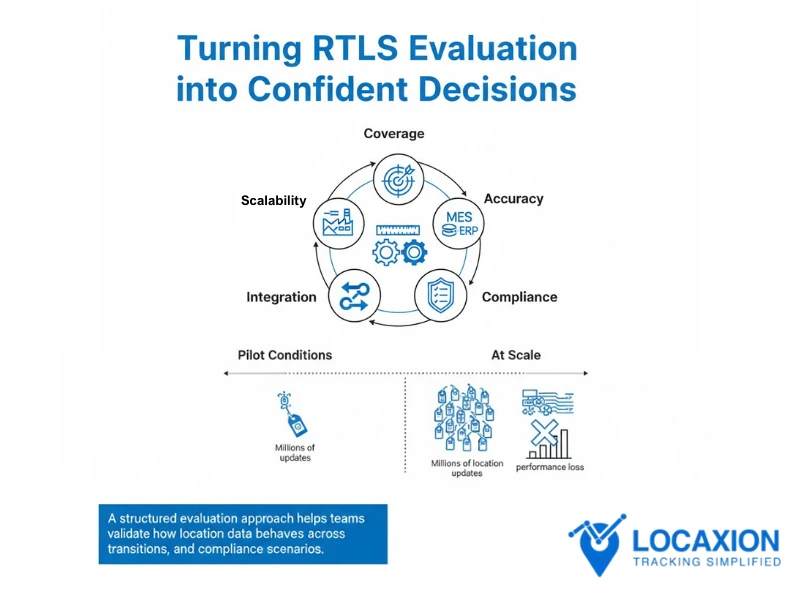
RTLS success in automotive manufacturing depends on how well coverage, accuracy, integration, scalability, and compliance work together once systems move beyond pilot conditions. Constraints typically emerge at scale, when RTLS must process millions of location updates per day, maintain accuracy across metal-dense indoor zones and outdoor yards, and support production, safety, and audit workflows without performance loss.
Evaluating RTLS through isolated tests or feature comparisons often overlooks these realities. A structured evaluation approach helps teams validate how location data behaves across transitions, peak loads, and compliance scenarios before committing plant-wide or multi-site deployment.
Planning to evaluate RTLS for automotive manufacturing?
LocaXion supports OEMs and Tier-1 suppliers with vendor-neutral RTLS evaluations, performance validation, and scalable deployment planning.
Talk to LocaXion about an RTLS evaluation for your facility.
Frequently Asked Questions
What is RTLS and how does it work in automotive manufacturing?
RTLS refers to technologies that continuously track the real time location of vehicles, tools, equipment, and personnel across a facility. In automotive manufacturing, RTLS is used to provide live visibility across assembly lines, logistics areas, and yards by combining technologies such as UWB, BLE, RFID, and GPS.
This approach, often referred to as automotive RTLS, captures precise location events and streams them into systems like MES and safety platforms, replacing manual scanning with real time, location driven intelligence.
What are the main use cases for RTLS in automotive manufacturing?
Manufacturers use RTLS across WIP tracking, tool and die management, internal logistics, yard operations, worker safety, quality gate verification, inventory control, equipment utilization, and cycle time optimization. These use cases often start independently and later connect into a unified operational view.
How is RTLS for automotive manufacturing different from RTLS used in other industries?
RTLS for automotive manufacturing must operate reliably across large, metal-dense facilities that combine high-precision indoor assembly lines with expansive outdoor yards.
Unlike RTLS used in retail or healthcare, automotive RTLS must support continuous vehicle and parts movement, high tag volumes, strict safety requirements, and integration with MES, WMS, and quality systems. These demands place greater emphasis on coverage continuity, accuracy validation, and scalability.
Is RTLS suitable for Tier-1 and Tier-2 automotive suppliers, or only OEMs?
RTLS for automotive parts and production tracking is widely applicable across OEMs, Tier-1, and Tier-2 suppliers. While OEMs often deploy RTLS at campus scale, suppliers use RTLS to improve line-side logistics, tool compliance, WIP visibility, and quality traceability. Scalable RTLS solutions for the automotive industry allow deployments to start small and expand as operational needs grow.
What should teams look for when evaluating production tracking solutions for automotive manufacturing?
Teams should assess whether production tracking solutions for automotive manufacturing maintain accuracy and reliability across full production cycles, including shift changes, peak activity, and indoor-outdoor transitions. Key evaluation areas include coverage continuity, system latency, integration depth with MES and WMS, scalability under high tag volumes, and the ability to support safety and compliance workflows without customization.
Can one RTLS solution support both automotive parts tracking and finished vehicle tracking?
Yes, but only if the RTLS architecture is designed to support multiple technologies and accuracy levels. Automotive parts often require high-precision indoor tracking using UWB, while finished vehicles in yards require GPS or GNSS-based tracking.
Effective RTLS solutions for the automotive industry allow assets to transition seamlessly between indoor and outdoor environments without data gaps, enabling end-to-end production tracking solutions for automotive manufacturing.