
- Worker Badges vs. RTLS Personnel Tracking
- How RTLS Personnel Tracking Works
- Comparing Personnel Tracking Technologies
- Lone Worker and Connected Worker Use Cases
- Integrating Personnel Tracking with ERP, MES, and CMMS
- Compliance and Standards Alignment
- Protecting Worker Privacy by Design with LocaXion
- Choosing a Personnel Tracking System
- FAQs about RTLS Personnel Tracking
RTLS personnel tracking is the use of real-time location systems to show, continuously, where every worker is inside a facility. The underlying technology can be UWB, BLE, Wi-Fi, RFID, GNSS, AI cameras, or a hybrid, but what matters is that an RTLS-based personnel tracking system replaces single badge swipes with a live picture of the workforce integrates with your internal safety, operations, and business systems.
RTLS personnel tracking is a category of technology, not a single product. Some deployments use UWB or BLE wearables and fixed reference points. Others rely on RFID personnel tracking at chokepoints, AI cameras on existing CCTV, GNSS for outdoor yards, or a hybrid of all of the above. The right mix depends on the hazard, the facility, and the environment.
The shift matters because the cost of ‘we don’t know where our personnel is’ is now measured in seconds. A lone worker who falls down, a contractor who wanders into a restricted area, or 800 employees who must be accounted for after an alarm – these are problems a paper roster cannot solve effectively. A modern personnel tracking deployment streams continuous location, status, and safety data from the floor and pushes that data into the systems your operation already runs on; EHS, ERP, MES, CMMS, HR, and access control.
This guide covers how personnel tracking works across technologies, how it compares to traditional RFID badges, where tags are typically worn, how it integrates with the connected-worker stack, and how it supports lone-worker programs in line with OSHA, NFPA 101, and ISO 45001 expectations.
Worker Badges vs. RTLS Personnel Tracking
Traditional ID badges are designed for access. They confirm that a worker passed a reader at a specific moment, then go silent until the next swipe. Between those events, the system has no idea whether the person is at a workstation, in a confined space, or motionless on the floor.
RTLS changes that model. Whether the location signal comes from a UWB or BLE tag pinging to a ceiling anchor or an AI camera identifying a worker by silhouette and PPE, the result is the same: a continuous, dashboard-ready picture of the workforce. That is the foundation of any modern employee tracking system.
| Capability | Traditional ID Badge | RTLS Personnel Tracking |
|---|---|---|
| Location data | Single event at a reader | Continuous, up to sub-meter accuracy, live |
| Emergency response | Manual roll call | Automated mustering and missing-person alerts |
| Lone worker safety | None | Man-down, panic button, inactivity timer |
| Restricted zones | Door-by-door access only | Dynamic geofences with PPE checks |
| Audit trail | Entry/exit log | Full path, dwell time, incident replay |
| Integration | Access control only | EHS, ERP, MES, HR, CMMS, access control |
The practical difference shows up during incidents. With badges, a supervisor knows a worker entered a building. With RTLS people tracking, the same supervisor sees the worker is in Zone 4, hasn’t moved in 90 seconds, and that a forklift just entered the same area.
How RTLS Personnel Tracking Works
There is no single architecture for personnel tracking. Three patterns dominate, and most production deployments mix them:
- Anchor-and-tag systems Battery-powered wearables (badge, wristband, helmet clip, belt clip) broadcast a unique ID several times per second. Fixed anchors on the ceiling resolve position by time-of-flight (UWB), angle of arrival (BLE AoA), or signal strength (Wi-Fi, BLE RSSI). This is the precision tier, used where accuracy matters.
- RFID and chokepoint systems Passive or active RFID tags read by gate-mounted scanners record presence at zone boundaries. Lower precision, lower cost, and ideal for mustering, contractor check-in, and access enforcement. The systems represent the legacy approach to personnel tracking.
- Vision-based detection Fixed or vehicle-mounted AI cameras identify and locate people from video detection, with no wearables required. Used for PPE verification, occupancy counting, and forklift-pedestrian detection.
All three feed into the same two upper layers: a location engine that fuses the signals into a position, and an application layer that turns that position into floor maps, geofence rules, alerts, mustering dashboards, and integrations with EHS, HR, ERP, CMMS and access control.
Comparing Personnel Tracking Technologies
There is no single best technology, there is the right mix for your environment, hazard profile, and facility.
| Technology | Accuracy | Range (One Location Cell) | Wearable Battery Life* | Best For | Limitations |
|---|---|---|---|---|---|
| UWB | Sub-meter | 1 – 50 m | Weeks to years | Lone worker rescue, forklift proximity, safety-critical zones, high-precision tracking | Wearables more expensive and limited compared to BLE |
| Reverse UWB | 30 – 50 cm | 1 – 50 m | Days | High-velocity DCs and warehouses, automated forklift slow-down | Effective for forklift and pedestrian safety & visibility, limited for layered use cases |
| AI & SLAM Cameras on Forklifts | 10 – 30 cm | 1 – 20 m (around forklift) | No wearable | High-velocity DCs and warehouses, automated forklift slow-down | Effective for forklift and pedestrian safety & visibility, limited for layered use cases |
| BLE AoA | 1 – 2 m | 1 – 30 m | Weeks to years | Mid-precision employee tracking, wide wearable options | Lower wearable variety compared to RSSI BLE, still higher than UWB |
| BLE (RSSI) | 3 – 5 m | 5 – 100 m | 1 – 3 years | Building-wide presence, low-cost rollout, wide wearable options | Accuracy varies; better accuracy needs high beacon density |
| Active RFID | 5 – 10 m | 10 – 50 m | 3 – 5 years | Personnel tracking for mustering, hazardous areas | Accuracy varies; higher accuracy needs dense reader deployment |
| Wi-Fi | 5 – 10 m | 30 – 50 m | Uses APs | Reuse existing wireless for general presence | Low update rates; accuracy depends on AP layout |
| AI Cameras | Camera density dependent | Per camera FOV | Wired | PPE detection, behavior analytics, no-wearable zones | Coverage and accuracy depend on CCTV density |
*Depends on tag (wearable) settings and update rate.
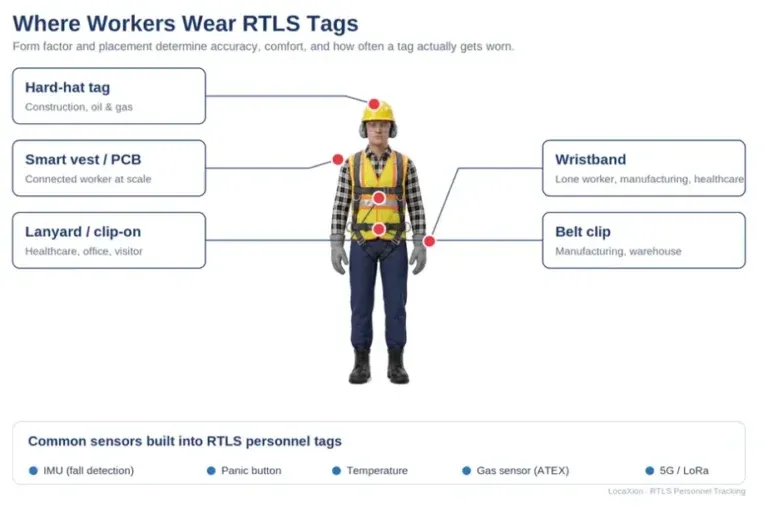
Figure 1: Common RTLS tag placements and their typical use cases.
Lone Worker and Connected Worker Use Cases
A lone worker is anyone who performs a task out of sight or earshot of a colleague: a maintenance technician in a tank, a night security patrol, a driver at a remote yard. OSHA’s General Duty Clause and ISO 45001 both require employers to assess and control these risks.
A connected worker deployment gives lone workers four core protections:
- Live location Supervisors see the worker’s position on a live map, including the last known point if signal is lost.
- Man-down detection An IMU senses an unusual angle or impact and raises an alert if the worker doesn’t cancel within a set time.
- Panic button A press triggers an alert with the exact location, no voice call needed.
- Inactivity monitoring A worker who hasn’t moved for a configurable period is flagged for check-in.
Connected worker programs extend this to the whole workforce. The same wearable that protects a single technician also enforces geofenced no-go zones, supports automated mustering during an evacuation, and feeds dwell-time analytics into safety reviews. This is where employee location tracking stops being a safety tool and becomes operational intelligence. AI cameras can be layered on top for PPE compliance detection.
Integrating Personnel Tracking with ERP, MES, and CMMS
A personnel tracking system that lives in its own dashboard is a half-deployment. The value compounds when live worker location flows into the same systems that already run the operation: EHS, ERP, MES, CMMS, HR, and access control systems.
Typical integrations on a connected-worker rollout:
- MES Worker presence at a workstation auto-logs labour against the active production order; line stoppages flag the absence of a certified operator.
- CMMS Maintenance work orders open and close on the technician’s arrival at and departure from the asset, eliminating manual time entry and proving on-site response.
- ERP Field-service hours, contractor billing, and shift attendance are reconciled against actual time on site instead of clock-in declarations.
- EHS and access control — PPE certification, training currency, and zone permissions are checked at the geofence in real time. A worker without a valid LOTO sign-off cannot enter the controlled area.
- HR Identity records and exit workflows are the system of truth; the personnel tracking layer references HR.
The integration pattern that ages best is event-driven: the location platform publishes presence, dwell, and zone-violation events to an API; downstream systems subscribe to what they need. That keeps the personnel tracking layer thin, the systems-of-record authoritative, and the whole stack customizable as the operation evolves.
Compliance and Standards Alignment
Real-time location data supports a growing list of safety obligations:
- OSHA 29 CFR 1910.146 Permit-required confined spaces. RTLS provides time-stamped entry/exit logs and inactivity alerts.
- OSHA 29 CFR 1910.132 PPE. AI cameras can verify PPE before a worker enters a controlled zone.
- NFPA 101 Life Safety Code Occupant accountability during evacuation.
- ISO 45001 OH&S management. RTLS provides the continuous monitoring and audit trail the standard expects.
- GDPR In the EU, employee location data is personal data. Most lawful programs use the legitimate-interest basis, restrict tracking to work hours and work areas, anonymize where possible, and complete a DPIA.
Protecting Worker Privacy by Design with LocaXion
A safety system that workers do not trust will not be worn. Modern personnel tracking is built so that real-time location data does its job without exposing identities to anyone who does not need them.
Three patterns dominate well-run programs:
- Codenames on the live map. Operations dashboards display anonymized labels (Operator-A14, Tech-23) instead of real names. The control-room view confirms that a person is in a zone or has triggered an alert without revealing identity.
- Hash-mapped identity. Each tag ID is paired with a hash that resolves to the worker’s record only inside an access-controlled database. Safety, operations, and security teams see live positions; only HR or designated departments can resolve a hash to a name, and every lookup is logged.
- Role-based access and retention limits. Raw position history is purged on a short cycle (often 24 to 72 hours) unless an incident flags it for retention. Aggregated heatmaps and dwell-time analytics keep their value indefinitely; the person-identifying layer does not.
This separation of duties is what turns employee location monitoring from a surveillance question into a safety service. It is also the practical answer to GDPR’s data-minimization principle and the reason works councils in Europe will sign off on a deployment that they would otherwise reject.
Choosing a Personnel Tracking System
Start with the question the RTLS is solving. Lone worker rescue and forklift & pedestrian collision avoidance demand high accuracy and real-time response. Building-wide presence and warehouse employee tracking work well on BLE or RFID. Most real deployments are typically hybrids.
Ask vendors three questions: Do you support open standards and API so I am not locked in? Can the system integrate with my access control, CMMS, MES, EHS, and ERP? Do you have references in my industry?
A short pilot, usually 30 to 60 days in a designated hazardous area, is the fastest way to confirm both technical fit and worker acceptance before scaling.
FAQs about RTLS Personnel Tracking
What is RTLS personnel tracking and how is it different from a badge system?
RTLS personnel tracking is a real time employee tracking system that shows where every worker is, continuously. A badge only logs a single swipe at a door. RTLS streams live location, dwell time, and safety status from anywhere on the floor.
How accurate is an indoor personnel tracking system?
Accuracy depends on the technology. UWB delivers 30–50 cm, BLE AoA reaches 0.5–1 m, and active RFID or Wi-Fi typically lands in the 5 – 10 m range. UWB is preferred for safety-critical zones and forklift & pedestrian safety; BLE and RFID personnel tracking suit wider, lower-precision coverage.
How does RTLS protect lone workers?
Lone worker tags include man-down detection, a panic button, inactivity timers, and live location streaming. If a technician falls or stops moving, an alert reaches a supervisor with the exact location, no voice call required, cutting rescue time from minutes to seconds.
Is employee location monitoring legal under GDPR and US privacy law?
Yes, when scoped correctly. Most lawful programs rely on legitimate interest under GDPR, complete a DPIA, restrict tracking to work hours and work areas, display anonymized codenames on the live map, and hash worker identities so only HR can resolve them. US deployments also address state rules such as CCPA and CPRA.
How do AI cameras and SLAM fit alongside an RTLS system?
Fixed AI cameras add PPE detection and behavior analytics on existing CCTV. Forklift-mounted cameras paired with SLAM detect pedestrians inside the truck’s safety envelope and trigger automatic slowdowns. Combined they can produce dual-source evidence for incident review.
What ROI can a warehouse employee tracking deployment expect?
Outcomes vary by scope, but mature programs commonly report fewer recordable incidents, faster evacuations and mustering, higher PPE compliance, and lower insurance premiums. The fastest payback usually comes from automated mustering and forklift-pedestrian collision prevention.