
- Why the Best RTLS Question Has No Universal Answer
- The Solution Stack Around the Hardware
- Seven Technologies, Seven Trade-Offs
- The Five Lenses We Apply When We Shortlist
- Matching Use Cases to the Right Technology
- Same Goals, Different Technologies: Healthcare Versus Manufacturing
- Why an Integrator Picks Differently Than a Vendor
- Frequently Asked Questions
Key Takeaway — There is no single best RTLS. The right system is the one that matches the purpose, the environment, the operational reality, the use case, and the long-term strategic vision of the organization deploying it. Because those five variables differ for every organization, the best RTLS will too. Our role is to help find the one that fits yours. → Jump to the five lenses we apply on every shortlist.
Why the Best RTLS Question Has No Universal Answer
Buyers arriving at this stage typically open with the same question: which of the best RTLS systems on the market should we be evaluating. The question is reasonable, and most analyst lists offer a confident-sounding answer. It is also the wrong starting question. There is no universal best RTLS, because the answer depends on variables that change from one organization to the next.
The query itself exists for sound reasons. Buyers reach this stage mid-funnel. They have read the analyst lists and the top 10 RTLS companies roundups, scanned the top RTLS companies and top RTLS solution providers, and they want a defensible shortlist to put in front of a steering committee. The lists are not wrong. They are simply incomplete, because they answer a single-variable question about a multi-variable problem.
What the lists collapse is the part that decides the deployment. A UWB specialist that wins on accuracy in an automotive plant rarely transfers cleanly to a healthcare setting, where wall density is high enough that UWB would require so many anchors the economics stop making sense, and where the workflow usually needs room-level accuracy rather than centimeter truth. The best RTLS technology for one use case is often the wrong RTLS for the next one down the hall. Treating the category as a single ranked list flattens an inherently context-dependent decision into a tier that does not exist in practice.
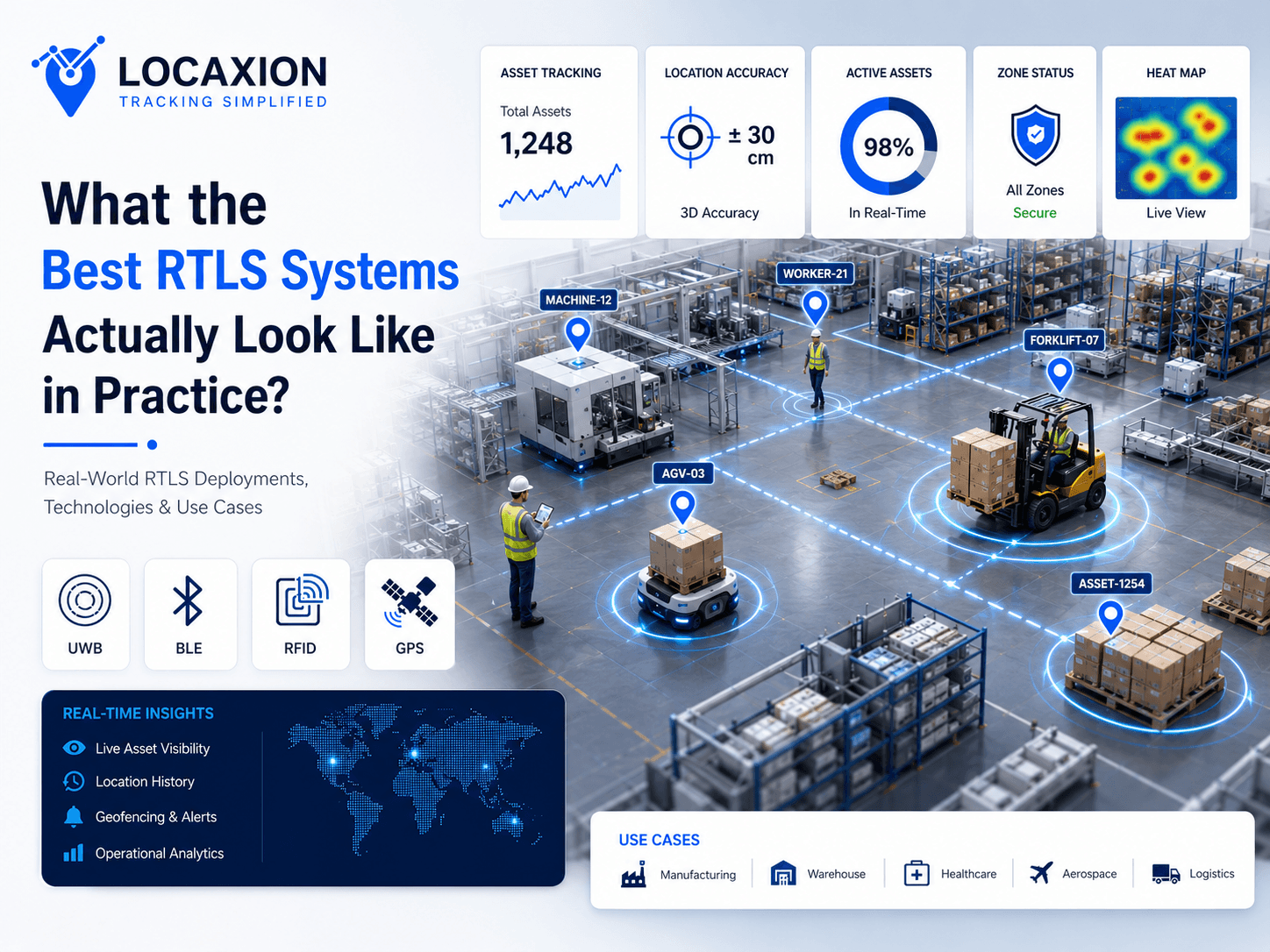
A more useful framing replaces one question with five. What is the purpose of the deployment? What is the environment it has to live in? What is the operational reality on the floor? What is the specific use case the data has to serve? And what is the long-term strategic vision the system has to support? Five variables, one shortlist. The composition of the answer changes for every organization, which is why the best RTLS does too.
The Solution Stack Around the Hardware
The first thing worth correcting is the assumption that RTLS itself is one thing. A real-time location system is not a single product. It is a category of hardware, ranging from UWB anchors and BLE beacons to RFID readers, Wi-Fi positioning, vision systems, and onboard SLAM sensors on autonomous vehicles. Choosing the hardware is only one of the decisions to make, and on its own it does not determine whether the deployment delivers value. What does that work is the wider solution stack the hardware fits into.
Figure 01 · The Three Groupings Of A Working Deployment
CLIENT SYSTEMS TIER 05 · EXISTING CLIENT SYSTEMS MES, WMS, EHR, BI, Real-Time Alerts Acts On The Picture LOCAXION TIER 04 · SYNTHESIS Digital Twin, Spatial Context, What-If Scenario Simulation Builds The Operational Picture RTLS TIER 03 · MIDDLEWARE Location Engine, Raw Event Stream Turns Signals Into Coordinates TIER 02 · NETWORK AND PROTOCOL UWB BLE AoA BLE RSSI Wi-Fi RFID Vision SLAM Carries Signals Across The Site TIER 01 · PHYSICAL Tags, Anchors, Sensors, Gateways Emits Raw Signals RTLS Occupies The Bottom Three Tiers. The LocaXion Digital Twin Sits Above It. Existing Client Systems Consume The Synthesized Picture.
RTLS hardware occupies the bottom three tiers. The LocaXion Digital Twin is the synthesis layer above it. Existing client systems consume the picture and act on it.
At the bottom of the solution stack sit the sensing components: tags, anchors, gateways, readers, and the onboard sensors that SLAM-equipped vehicles carry. This is the layer that produces the raw signal: time difference of arrival, angle of arrival, received signal strength, RFID read events, or the point clouds a vehicle collects as it moves. The physical layer is typically governed by a set of formal standards specific to each technology, and in the case of UWB that means the IEEE 802.15.4z UWB PHY defines what a UWB radio is allowed to do and the FCC Part 15 Subpart F rules govern what it can transmit in the US.
Above sensing is middleware. Position engines, location servers, filtering, and smoothing all live at this layer, which turns raw radio events and sensor data into coordinates, and it is the layer most vendors charge for. Several standards define the format of this data, including the updated ISO/IEC RTLS API and the more recent Omlox open interface, but none of them are strictly enforced, and most middleware in production today remains a proprietary shape defined by the vendor.
Above middleware is the synthesis layer. This is where coordinates become context. A pallet is not a coordinate. It is a pallet of part number X at station 4 waiting on operation Y. The Digital Twin is the synthesis layer. It holds the map of zones, the rules of the floor, and the relationships between assets and work orders. Without it, raw coordinates are dots moving on a screen.
Above synthesis sit the consumer systems: MES on the factory floor, EHR in the hospital, WMS in the distribution center, and BI everywhere. None of them consume raw coordinates directly; what they need is context, which is exactly what the synthesis layer provides.
When buyers talk about choosing an RTLS, what they usually focus on are the three bottom layers, which together make up the RTLS itself. The deployments that hold up over three to five years are the ones where the layers above the hardware, the synthesis layer and the existing client systems it feeds, received equal attention during the design.
Seven Technologies, Seven Trade-Offs
An honest RTLS comparison starts with the technologies themselves, not with the brands that sell them. Each of the seven categories below solves a different problem at a different cost, and the real-life accuracy you see on a working floor is rarely the same number on the vendor’s data sheet, which is why we include both columns in the table that follows.
| Technology | Marketing Accuracy | Real-Life Accuracy | Infrastructure Density | Tag Cost (Relative) | Power Profile | Best-Fit Environments |
|---|---|---|---|---|---|---|
| UWB | 10 to 30 cm | Sub-meter | Medium | High | Moderate (active tags) | High-accuracy, industrial, manufacturing |
| BLE AoA | 0.5 to 2 m | 1 to 3 m | High | Medium | Low (small coin cell) | Healthcare, general manufacturing |
| BLE RSSI | Room / zone level | 3 to 10 m | Medium to High | Low | Very low | Healthcare room-level accuracy |
| Wi-Fi | 3 to 10 m | 3 to 10 m | Existing WLAN (additional beacons often required) | Medium | Moderate to high | Sites with dense existing WLAN |
| RFID (active and passive) | Zone level at choke points | Zone level (read-rate dependent) | Reader-based | Very low (passive) | Passive: none | Inventory at gates, cold-chain pallets, surgical tray traceability |
| Vision / AI Cameras | Sub-meter in line-of-sight | Sub-meter (LoS dependent) | Existing CCTV plus compute | No tag | N/A | No-tag tracking, untaggable items, complementing other categories |
| SLAM | Centimeter-level | Decimeter-level | None (sensor on the asset) | N/A (onboard sensor) | High (on the vehicle) | Autonomous mobile robots, AGVs, manual vehicles (forklifts) |
Table 01. Seven RTLS technologies, seven different trade-offs. The Real-Life Accuracy column reflects what we typically see in deployed environments, which is rarely the same as the lab number on the data sheet.
UWB
Ultra-wideband delivers sub-meter accuracy in real deployments and holds up reasonably well in dense metal environments. It is the right choice when the workflow needs sub-meter truth, typically tool tracking in tight assembly cells, work-order tracking in high-compliance manufacturing, and fleet coordination on a factory floor. The trade-offs are higher tag cost compared with BLE, a smaller variety of tag form factors because most UWB systems are vendor-proprietary, and an install that requires careful anchor planning even at a moderate density.
BLE AoA
Bluetooth Low Energy with angle of arrival lands in the one to three meter band in real deployments. Anchor density can be higher than the marketing material implies, but tag cost is materially lower than UWB and the variety of tag form factors is much wider, including the option to use a smartphone as the tag in many use cases. For most asset-tracking workflows where you need to know which room or which zone an asset is in, BLE AoA tends to win on total cost of operation.
BLE RSSI
Bluetooth signal strength gives you room-level accuracy at a fraction of the infrastructure cost of the higher-accuracy categories. It is the right choice for broad presence detection, lone-worker tracking, and very dense tag populations where centimeter truth would be expensive overkill. Healthcare deployments often rely on it for room-level asset visibility across large facilities.
Wi-Fi
If the site already runs a dense Wi-Fi mesh, Wi-Fi RTLS can ride that infrastructure for room or zone-level indoor positioning, although in practice additional beacons are often required to reach a usable accuracy band. Accuracy is the weakest of the dedicated technologies, but the cost story is strong because much of the radio infrastructure is already in the ceiling.
RFID
RFID is zone-level by design. The reader is the location. Tag cost is the lowest of any category, sometimes single-digit cents for passive labels, which is why RFID dominates use cases where the volume of tagged items is large and per-item cost has to stay close to zero. Cold-chain pallet flow, line-side WIP gating, library-style inventory, and surgical tray traceability all rely on RFID as the right tool.
Vision and AI Cameras
Vision RTLS uses cameras and computer-vision models to locate items without tags. The strengths are the absence of tag logistics and the ability to verify what a tag alone cannot, such as whether an operator is wearing the correct PPE in a restricted zone. The weaknesses are line of sight, lighting variability, and the privacy review that any new camera deployment now triggers. In our experience, vision sits best alongside a tag-based category rather than as a replacement for it.
SLAM
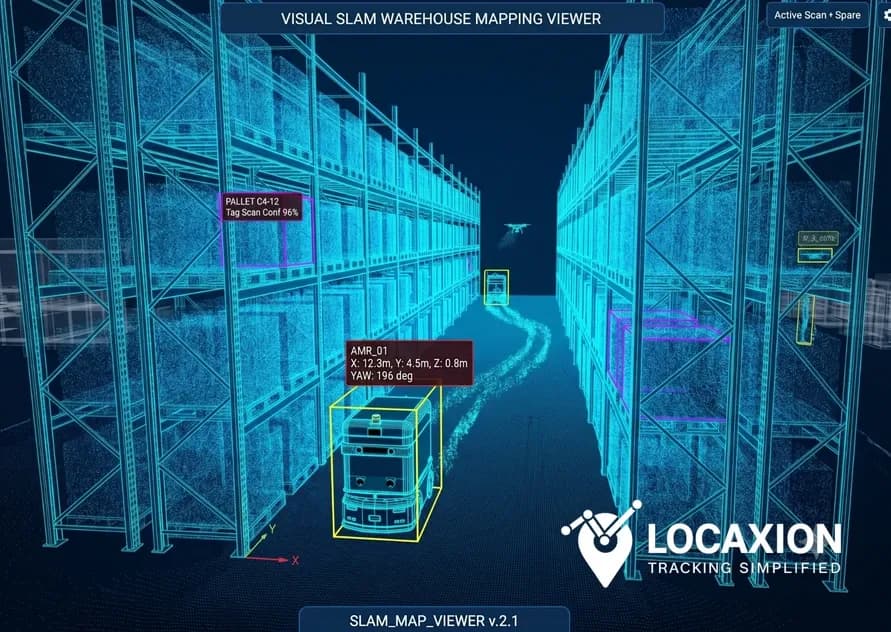
Simultaneous localization and mapping is the category most often missed in RTLS comparisons because it lives on the asset rather than on the wall. A SLAM-equipped autonomous mobile robot, AGV, or manual vehicle such as a forklift carries its own sensors (typically LiDAR, sometimes vision) and builds a map of its surroundings while locating itself within it. There are no anchors and no site-wide infrastructure to deploy, which is exactly why robotics buyers and fleet operators favor it. The trade-off is that SLAM only locates the vehicle it is on, so for mixed-asset tracking it is paired with one of the other categories rather than used in isolation.
For every technology there is additional context that no technical comparison table can capture. BLE, for example, offers a far wider variety of tag form factors than UWB, including the option to use a smartphone as the tag in many deployments, while SLAM is restricted to vehicle-only tracking and cannot localize tagged assets in a general way. The right comparison is always done with a professional who knows the deployment environment, not with the data sheet alone.
The Five Lenses We Apply When We Shortlist
When a customer asks us which of the top RTLS companies in the world they should be talking to first, we rarely answer that question directly. We answer five other questions on their behalf, and the shortlist falls out of those answers.
- Purpose and Use Case. What decision must the location data actually drive? A behavioral health unit tracking patient flow at bed-level needs bed-level accuracy, whereas a hospital-wide search for a wheelchair only needs room-level accuracy. We have seen budgets spent on UWB where BLE AoA would have served the workflow just as well, and the reverse case where buyers under-spent and the data quality never reached the threshold the workflow needed.
- Operational Reality. What does the environment actually look like? What is the ceiling height, how many assets need to be tracked, are the assets even taggable, and is tag battery replacement or recharging a possibility in the day-to-day operation? Vendor demos run under controlled conditions, your plant does not, and the lab spec rarely survives first contact with a real environment.
- Integration Surface. What systems will consume the location data. MES, EHR, WMS, BI, a custom workflow tool. The right RTLS is the one that integrates cleanly into the systems you already run, rather than the one that demands you replace them. If the data has nowhere useful to land, the deployment stalls regardless of how accurate it is.
- Total Cost of Operation. Tag cost is the small number. Anchor density, power, cabling, network changes, tag refresh cycles, and ongoing maintenance are the big ones. We model RTLS TCO over five years. Some hardware specialists win year one and lose by year three on maintenance, which is where the financial picture often inverts.
- Long-Term Strategic Vision. Today’s use case is rarely the last one. What does the organization want to be doing in three years? PPE compliance now, then pallet-level real-time inventory tracking, then fleet orchestration. A vendor-agnostic Digital Twin lets you add categories of hardware without rebuilding the application layer, whereas locking into one hardware stance early tends to close doors you have not yet opened.
Matching Use Cases to the Right Technology
The fastest way to make the five lenses concrete is to walk through the use cases we often encounter and the technology category that usually wins on the evaluation. This is also where the best RTLS systems question finally becomes answerable, one use case at a time. None of these mappings is absolute. Each one assumes the operational reality is reasonably standard. The table below renders the pattern, with the caveat that every site has its own version of the floor.
| Use case | Recommended tech tier | Why |
|---|---|---|
| ED Asset Tracking | BLE and BLE AoA | Mix of room-level accuracy and higher accuracy with BLE AoA, low TCO across many tags |
| Track and Trace of Work Orders in Manufacturing Job Shops | UWB or BLE AoA | Sub-meter accuracy required for high-value assets and high-compliance environments |
| Tool Tracking in Automotive Final Assembly | UWB | High accuracy required for compliance, with AI cameras layered in when bolt-level accuracy is needed |
| Fleet Management | UWB or SLAM | High accuracy required, refresh rate matters, and the platform must remain vehicle-vendor-agnostic |
| Cold-Chain Pallet Flow | RFID or BLE | Zone-level at choke points combined with temperature sensing on pallets |
| PPE Compliance | AI Cameras | No tag cost, and the existing CCTV infrastructure can usually be reused |
| Vehicle Yard | GNSS or LoRa | Neither requires fixed infrastructure to operate, with cable-free RTLS as an alternative when higher accuracy is required |
| Staff Duress | BLE or BLE AoA | Accuracy and button-press latency drive the choice, with BLE AoA reserved for cases where the accuracy threshold demands it |
Table 02. The use case sets the technology, not the other way around.
The pattern that comes through is that the best RTLS technology is the one that matches the decision the workflow needs, not the one with the most centimeters on the spec sheet. A manufacturing plant that requires UWB for work-order tracking on the line may not need the same accuracy for finished-goods tracking in its yard, because the cost of UWB’s infrastructure rarely makes sense outdoors at that scale. The same plant often runs both technologies, on different parts of the operation, under one Digital Twin, and that mix is the rule rather than the exception in deployments that hold up over time.
If you are mid-shortlist and want a second set of eyes on whether the tech tier matches the operational reality, talk to us. We have shortlisted and deployed across every tier in this guide.
Same Goals, Different Technologies: Healthcare Versus Manufacturing
Healthcare and manufacturing pursue the same broad objectives with RTLS, namely productivity through workflow automation, safety, and compliance. What separates the two verticals is the set of technologies that fits each environment, and the gap is wide enough that a shortlist that works in one is rarely the right one in the other.
In healthcare, BLE and BLE AoA dominate the deployed base. The environment includes drywall partitions and dropped ceilings, both of which favor lower-frequency technologies that propagate well and require less infrastructure density to reach room-level accuracy. Hand-hygiene monitoring, staff duress and lone-worker safety, equipment utilization, and patient-flow tracking are the workloads we see most often. The integration surface is dominated by the EHR and clinical workflow tools, and a PubMed systematic review of RTLS in healthcare documents the workflow gains in deployments where the synthesis layer is integrated rather than bolted on.
In manufacturing, UWB and SLAM dominate, often augmented by AI cameras for tasks such as bolt-level verification on a final-assembly line. The environment includes metal racks, dust, heat, line-of-sight obstruction by stacked WIP, and vehicles in constant motion, all of which raise the accuracy and refresh-rate requirements. WIP tracking, tool tracking, forklift and pedestrian safety, and quality and compliance reporting are the typical workloads. The integration surface is dominated by MES and quality systems, and a fleet controller asking the Twin where a forklift is generally needs the answer at five hertz, not five seconds.
Same goals, different technologies. The shortlist that is right for one vertical is rarely the right one for the other.
Why an Integrator Picks Differently Than a Vendor
A hardware vendor has one answer to the shortlist question. It is theirs. This is not cynicism, it is structure. A vendor’s role is to ship the product they make. An integrator’s role is to ship the outcome the customer needs, and those are different problems that reward different shortlists. The vendor optimizes for the sale. The integrator optimizes for a floor that still works in year three.
Figure 02 · Vendor-Agnostic Digital Twin Above Any RTLS Tier
HARDWARE TIERS UWB High-Accuracy Hardware BLE AoA Mid-Accuracy, Low Tag Cost RFID Choke-Point And Inventory Vision And AI Cameras No-Tag Tracking SLAM Onboard Positioning SYNTHESIS LAYER LocaXion Digital Twin Vendor-Agnostic Synthesis Layer CONSUMING SYSTEMS Workflow Systems MES, EHR, WMS Order, Route, Episode Of Care Decisions And Alerts Automated Workflows, Duress, Compliance Triggers Analytics And KPIs Cycle Time, Utilization, SLA, Dwell, What-If Scenarios Swap Or Combine Hardware Below; The Application Logic Above Does Not Change.
A vendor-agnostic Digital Twin sits above any RTLS tier. Hardware can be swapped or combined; the application logic above does not change.
LocaXion’s Digital Twin is vendor-agnostic by design, and that posture is what allows us to choose the hardware that fits the customer’s operational reality, rather than the reverse. When the use case calls for UWB, we deploy UWB. When BLE AoA serves the workflow at a portion of the cost, we deploy BLE. When the asset is an autonomous mobile robot that carries its own sensors, we extract the position data directly from those sensors and feed it into the Twin. When the floor demands a hybrid, we run a hybrid. The application logic above the Twin does not change.
The benefit compounds across use cases. A manufacturing client who deploys UWB for production tracking on the line can extend the same Digital Twin to a warehouse forklift fleet on SLAM six months later, without rebuilding the integration into MES or the existing safety systems. The Twin abstracts the hardware, which is the point of having one in the first place. The NIST work on ISO/IEC 18305 indoor localization testing is a useful read on why vendor-reported accuracy and site-realistic accuracy are rarely the same number, and why a partner with floor experience tends to be the difference between a brochure number and a deployed one.
The right RTLS, in the end, is the one that does its job without drawing attention to itself. Once the synthesis layer is delivering the answers the operations team needs, the question of which radio is in the ceiling stops being a daily concern. That is the bar we set with every deployment.
Frequently Asked Questions
What is the best RTLS system?
There is no single best RTLS system. RTLS comprises a variety of technologies, including UWB, BLE AoA, BLE RSSI, Wi-Fi, RFID, vision, and SLAM. The right shortlist depends on the use case, the operational reality of the site, the systems that must consume the data, and the synthesis layer above the hardware. We pick the technology that fits the decision the data has to drive.
How do UWB and BLE RTLS differ?
UWB delivers sub-meter accuracy and tolerates dense metal environments well, but the tag cost is higher than BLE and the variety of tag form factors is smaller because most UWB systems are vendor-proprietary. BLE AoA reaches one to three meters in real deployments; anchor density can be higher than UWB, but tag costs are lower and the range of tag form factors is much wider, including the option to use a smartphone as the tag. Choose UWB when the workflow needs sub-meter truth, and BLE when zone or room level is enough.
How much does an RTLS deployment cost?
The main cost drivers are anchor density, tag count, tag battery refresh cycle, integration into MES, EHR or WMS, and the synthesis layer that turns raw coordinates into usable context. Because each of these depends on the use case, the environment, and the scale, a single price range is rarely informative. For a structured estimate of where your deployment is likely to land, we built an RTLS ROI calculator that walks through the variables systematically.
Should I pick the RTLS vendor first or the Digital Twin first?
Neither should be selected in isolation. As the technology stack in Section 02 shows, an RTLS deployment has hardware at the bottom, a synthesis layer in the middle, and existing client systems above. The right approach is to select both the hardware and the synthesis layer together, after a structured conversation about the use case, environment, and long-term direction, ideally with a vendor-agnostic integrator. A vendor-agnostic Digital Twin abstracts the hardware, which means hardware can be swapped, mixed, or extended later without rebuilding the application logic above it.