Skip to content

Automotive manufacturers like BMW, Daimler, Honda, John Deere, and Airbus solved torque tool tracking long before it became a buzzword, often with direct involvement from LocaXion’s early work in industrial automation. The goal was never just visibility. It was preventing production failures. When a torque tool entered a vehicle zone, it did not just beep. It pulled the VIN, communicated with the MES, and automatically loaded the correct torque program.
That level of automation where the tool drives the process does not happen by accident. And it rarely happens with a ten-cent sticker.
The biggest mistake operations teams make today is treating “RFID” as a single budget line item. It is not. There is a fundamental operational divide between Passive RFID that counts things and Active RFID that controls flow.
Choose the wrong side of that budget split and you either overspend on hardware you do not need, or worse, deploy a low-cost system that quietly taxes your operation with manual work, missed scans, and constant intervention. This guide breaks down the real budget reality behind active vs passive RFID, and where each one actually earns its cost.
How Active and Passive RFID Generate Cost
To understand the budget, you must first understand physics. The total cost of ownership for any RFID system is always a tradeoff between the tag and the infrastructure. You either pay for intelligence on the asset, or you pay for intelligence on the ceiling.
What is Passive RFID?
Passive RFID is the standard for high-volume inventory tracking and is commonly used on retail apparel tags and cardboard shipping boxes. It is a scan-based identification technology where tags have no internal power source and respond only when energized by a reader. Because of its low per-tag cost and mature global standards, Passive RFID is widely used for inventory audits, warehouse checkpoints, and access workflows.
How Passive RFID Works
Passive RFID relies on reader-driven, event-based updates.
- Passive tags: Contain no battery and activate only when they enter the radio frequency field of a reader, typically using Low, High, or Ultra High Frequency bands.
- Readers and antennas: Generate the energy that powers the tag and captures its ID.
When a tag passes a gate, portal, or workstation antenna, that interaction becomes the recorded event. Movement between read points is not visible, meaning the system always reflects the last scanned location, not where the asset currently is.
Passive RFID performs best in structured workflows where assets reliably pass through predefined checkpoints.
Key Characteristics of Passive RFID
| Category | Details |
|---|---|
| Update model | Point-in-time scans at defined checkpoints |
| Power Source | None. Relies entirely on energy from the reader. |
| Read Range | Short. Typically, 3-15 feet depending on the material. |
| Data Capacity | Low. Usually just a simple ID number or EPC code. |
| Tag types | Passive (LF, HF, UHF) |
| Infrastructure | Fixed readers, antennas, portals |
| Pros | Very low tag cost, scalable for high volumes, longer passive read distances (typically 1 to 10 meters), mature standards |
| Cons | No visibility between scans, dependent on workflow discipline, missed reads create data gaps |
| Best fit | Inventory audits, serialized item tracking, warehouse checkpoints, dock door validation, tool crib workflows |
What is Active RFID?
Active RFID uses battery-powered tags that transmit signals autonomously instead of waiting for reader excitation. This enables more frequent updates and longer detection ranges, making Active RFID suitable for environments where asset movement, visibility, or value justifies higher tag and infrastructure investment. It is commonly used for tracking vehicles, high-value tooling, and mobile equipment in operational workflows where scan-based systems break down.
How Active RFID Works
Active RFID relies on tag-initiated transmissions.
- Active tags: Battery powered and broadcast signals periodically or continuously.
- Readers or gateways: Receive tag transmissions and update the system without requiring the asset to pass through a tight scan zone.
Because the tag initiates communication, Active RFID reduces dependency on precise gate placement and enables broader coverage areas. However, updates still occur at defined intervals, not continuously like RTLS.
Active RFID is often used where checkpoint scanning breaks down, but full real-time precision is not required.
Key Characteristics of Active RFID
| Feature | Description |
|---|---|
| Update model | Periodic, tag-initiated transmissions |
| Power Source | Internal Battery (Replaceable or sealed). |
| Read Range | Long. Typically 30 to 100+ meters (300+ feet). |
| Data Capacity | High. Can transmit ID, temperature, shock, and battery level. |
| Tag types | Battery-powered active RFID tags |
| Infrastructure | Readers or gateways with wider coverage zones |
| Signal Strength | Strong. better at penetrating industrial environments. |
| Infrastructure | Light. Sparse placement of listening gateways. |
| Pros | Longer read range than passive RFID, reduced dependence on exact scan points, better visibility for moving assets |
| Cons | Higher tag cost, battery maintenance required, higher long-term operating cost |
| Best Fit | High-value assets, yard and container tracking, mobile equipment, assets that bypass fixed checkpoints
|
Active RFID vs Passive RFID: Budget and Cost Comparison
Most RFID decisions break down when budgets are built around unit cost instead of operational cost. This is where the active and passive RFID tags difference becomes financially significant, not at the purchase order level, but at scale.
Passive RFID looks inexpensive because tags are cheap. Active RFID looks expensive because tags are not. Once deployments move beyond pilots, however, the budget pressure shifts fast. Infrastructure density, labor dependency, maintenance cycles, and the cost of incorrect location data start to dominate total spend.
The comparison below shows how this cost drivers behave once RFID systems are exposed to a real operational scale.
| Dimension | Passive RFID (UHF) | Active RFID |
|---|---|---|
| Primary purpose | Inventory counting for high-volume, low-value items | Asset tracking for high-value, mobile, or critical assets |
| Tracking model | Scan-based, point-in-time updates | Autonomous, periodic or continuous updates |
| Real-time visibility | No. Last scanned location only | Yes. Current state visibility |
| Typical tag cost | Very low (often $0.10–$0.30 per tag) | Higher (commonly 5–20x passive) |
| Tag volume economics | Millions of items | Hundreds to thousands of assets |
| Infrastructure requirement | Dense readers, portals, tuned read zones | Fewer gateways covering large areas |
| Operational labor | High reliance on scans and process discipline | Low reliance on human interaction |
| Maintenance overhead | Low hardware, high reconciliation effort | Battery replacement must be planned |
| Automation readiness | Limited. Manual triggers required | Strong. Supports automated workflows |
| Cost risk at scale | Hidden labor and exception costs grow over time | Predictable cost tied to asset count |
The Budget Reality
Passive RFID minimizes capital spend, but increases operational effort
Active RFID increases capital spend, but stabilizes operational cost
The wrong choice usually looks cheap in year one and expensive in year two
Industry-Specific Cost Fit
The biggest operational gap between Passive RFID and Active RFID comes down to labor dependency and responsiveness.
Passive RFID ties system accuracy to people and process discipline. Assets must pass through defined checkpoints, and when scans are missed, location data quietly falls behind reality. Over time, teams compensate with manual sweeps, re-scans, and reconciliation work, turning inventory accuracy into an ongoing operational task.
Active RFID reduces this dependency by allowing assets to report their presence automatically. While it is not continuous real-time tracking, the higher update frequency and longer range significantly reduce blind spots. For mobile or high-value assets, this often translates into faster retrieval, fewer exceptions, and less time spent validating system data.
The operational shift is subtle but important: Passive RFID supports counting, while Active RFID supports responsiveness.
Industry-Specific Need
Active vs Passive RFID decisions become clear in environments where asset movement, scan reliability, and the cost of error matter more than tag price alone.
Automotive and Discrete Manufacturing: Passive RFID works well for parts and containers moving through fixed stations. Active RFID is typically used for shared tooling, fixtures, and mobile equipment where missed scans can disrupt production flow.
Distribution Centers and Yard Operations: Passive RFID fits pallet counts and dock-door validation. Active RFID is often used for trailers, roll cages, and yard assets that move outside controlled scan points.
Healthcare and Large Campuses: Passive RFID supports consumables and periodic identification. Active RFID is preferred for shared, high-value equipment where availability and retrieval time directly impact operations.
Airports, Rail Yards, and Industrial Campuses: Passive RFID handles access control and checkpoints. Active RFID is used for vehicles and mobile assets operating across wide, unstructured areas.
Learn More: RTLS vs RFID: What’s the Difference Between Real Time and Scanning
Mitigating Budget Risk in RFID Deployments
The most expensive RFID system is not the one with the highest price tag. The most expensive system is the one that gets ripped out two years later because it failed to deliver value. At LocaXion we see projects fail financially not because the technology was bad but because the budget was allocated to the wrong things. Mitigating risk means being honest about the physics of your facility and the value of your assets before you sign the purchase order.
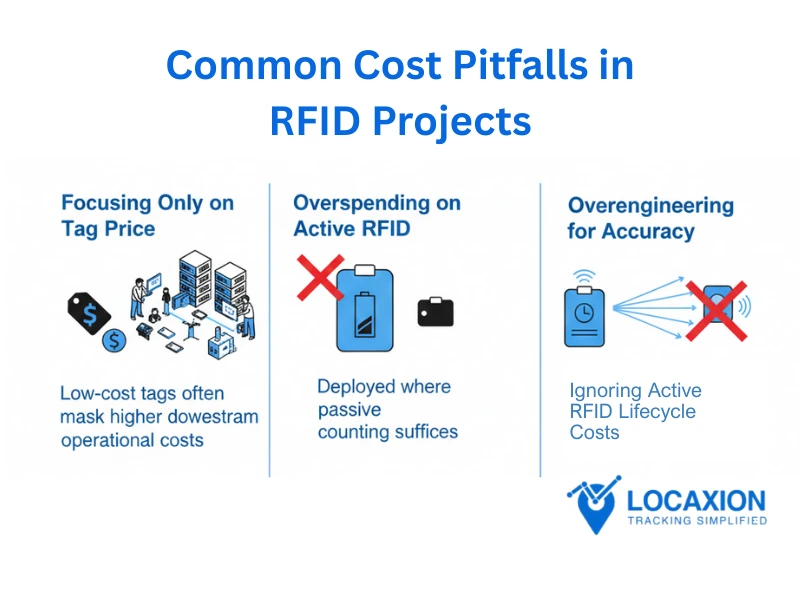
Common Cost Pitfalls in RFID Projects
- Focusing Only on Tag Price: Many budgets focus on per-tag pricing while ignoring infrastructure, labor, and exception handling. Low-cost tags often mask higher downstream operational costs.
- Overspending on Active RFID: Active RFID is sometimes deployed where passive counting would suffice. This inflates tag and maintenance spend without delivering proportional operational value.
- Underbuilding Passive RFID Infrastructure: Passive RFID is frequently assumed to be “lightweight.” In practice, reliable performance requires dense reader placement, antenna tuning, and controlled read zones, all of which drive up cost.
- Ignoring Active RFID Lifecycle Costs: Battery replacement cycles, downtime, and maintenance labor are rarely included in initial budgets. These costs surface later and can materially impact ROI if not planned upfront.
- Overengineering for Accuracy: Teams often design for maximum range or update frequency without aligning to workflow requirements. Paying for accuracy or responsiveness that the process does not use is a common source of budget waste.
LocaXion’s Approach to Cost-Driven RFID Decisions
At LocaXion, we refuse to frame RFID decisions as Active versus Passive. The smartest budgets almost never choose one. They use both intentionally.
Our approach is vendor agnostic and driven by a single question: what is the cost of failure if location data is late, missing, or wrong? We map technology to operational risk, not to tag price or spec sheets.
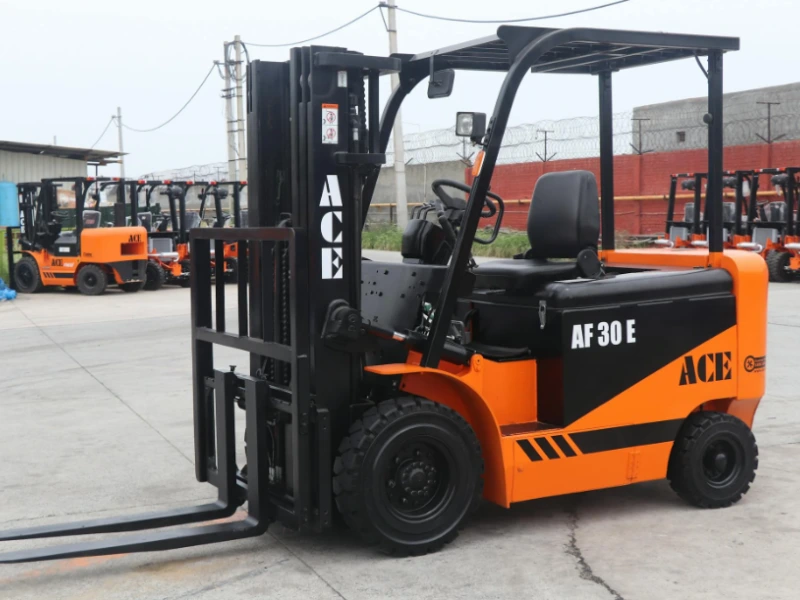
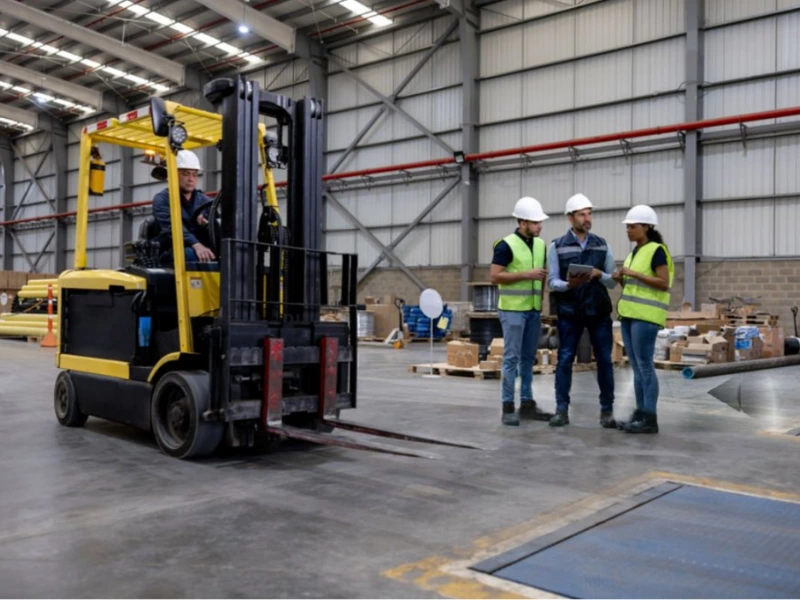
When you have ten thousand plastic bins worth five dollars each, Passive RFID is the right answer. Math demands it. You get scale, identification, and cost control without over-engineering about the problem. But when those same bins are moved by a fifty-thousand-dollar forklift, tracked through congested aisles, or tied directly to throughput, the risk shifts. That is where an Active tag belongs, not on the bin, but on the vehicle driving the flow.
The goal is not to crown a winner. The goal is to build a hybrid visibility model where low-cost tags handle volume, and higher intelligence tags handle movement, exceptions, and automation. Both signals are brought into a single operational view, so teams stop paying for precision they do not need and stop losing time where visibility actually matters.
That is how budgets stay controlled without sacrificing flow, safety, or trust in the data.
How Active and Passive RFID Perform at Scale
A pilot project in a clean room always looks perfect, but the physics changes completely when you deploy fifty thousand tags. The hidden danger of scaling Passive RFID is that a ninety nine percent accuracy rate which looks great in a test actually leaves you with thousands of missing items every single day. This creates a massive operational burden because you have to deploy armies of people to manually scan what the fixed portals missed effectively destroying your ROI with hidden labor costs.
Active systems behave differently because the infrastructure is already paid for and covers wide areas. Once your gateway grid is installed covering the facility, adding another one thousand active tags is as simple as peeling the sticker and turning them on. The marginal cost of expansion with Active is extremely low compared to Passive where every new zone requires a construction crew to run conduit and mount heavy readers.
Conclusion
The debate between Active and Passive RFID is not really about technology. It is about your tolerance for risk. We have seen too many operations managers choose the cheaper tag only to spend ten times that amount in labor trying to find lost assets. We have also seen companies burn their budget on expensive active tags for items that sit on a shelf for months.
The winning strategy is to stop looking at the price of the sticker and start looking at the price of the problem. If your problem is volume, then Passive is your answer because it handles the scale. If your problem is velocity and control, then Active is the only way to safeguard your operation because it handles the flow.
At LocaXion we build Digital Twins that respect your budget. We combine the low-cost density of passive with the high-value intelligence of active to give you a single unified view of your facility. You do not have to choose one or the other. You just have to choose the right tool for the job to ensure you never spend a dollar more than necessary to solve the problem.
Ready to stop guessing and start tracking? Contact us today.
FAQs: Active RFID vs Passive RFID
Is active RFID always more expensive?
Not always. When analyzing active vs passive RFID costs, you must look at infrastructure. Passive needs dense readers while Active uses sparse gateways. For large open facilities Active is often the cheaper total solution because you save thousands on cabling and hardware.
When does passive RFID become unreliable on scale?
Passive RFID tags struggle to achieve 100% accuracy in environments with high-speed movement or heavy metal racking. If you miss just one percent of ten thousand assets, you lose one hundred items daily which destroys the ROI calculation.
How much does battery maintenance impact ROI?
Battery replacement is a planned cost, typically required every 3 to 5 years, and is usually lower than the ongoing labor cost of maintaining scan accuracy with Passive RFID. While batteries can be budgeted and scheduled, manual searches and rescan efforts caused by missed reads often consume far more time and cost over the same period.
Can active and passive RFID be used together?
Yes. This is the default approach at LocaXion. Passive RFID handles high-volume inventory, while Active RFID tracks mobile or high-impact assets like forklifts and critical tools. The combination delivers automation without overspending.
Which RFID type fits warehouse operations best?
It depends on the asset behavior. Passive RFID asset tracking is best for static inventory on shelves while active RFID location tracking is superior for dynamic assets like forklifts. Most modern warehouses actually require both.
How does asset value influence tag selection?
The rule of thumb is simple. Use active RFID tags for critical resources like calibrated tools or vehicles and use passive for commodities like boxes. Never spend more on tracking technology than the cost of losing the assets itself.
What is the biggest budgeting mistake teams make with RFID?
The biggest mistake we see at LocaXion is ignoring the infrastructure limits. Active RFID range covers massive zones with one gateway while passive RFID range requires expensive portals at every chokepoint. Buying the cheapest tag often forces you to buy the most expensive infrastructure.