The automotive industrial landscape is ruthless right now. Finding the optimal production tracking solutions automotive manufacturing facilities can rely on is critical for survival. Plant managers face immense pressure to squeeze yield and prevent costly delays.
Look at your floor. Your Manufacturing Execution System (MES) tells you what each station did and when it received materials. Your Supervisory Control and Data Acquisition (SCADA) system monitors the exact machine state. Between those rigid scan points, there is total silence.
That spatial blind spot is exactly where most of the assembly line's recoverable losses live. To maximize yield and guarantee complete traceability, stop relying on traditional reporting tools. True visibility demands a modern stack, one that maps the physical movement of assets in real time.
This comprehensive guide explores how technology-agnostic architectures and real-time digital twins are fundamentally rewiring the assembly line. We will break down how to achieve undeniable business value, proactive safety, and robust ROI.
The Operational Visibility of Automotive RTLS
Operational visibility is not a single software product you just buy off the shelf. It’s an interconnected stack built on three vital layers: process state from your MES, machine state from your SCADA, and spatial state from a Real-Time Location System (RTLS).
Most Tier 1 and Tier 2 plants nail the first two layers perfectly. Then they drop the ball on the third. The result? A massive spatial blind spot right where that final layer belongs.
Bridging the Gap Between MES and SCADA
That gap is where your operational inefficiencies hide out. Unmonitored material flow between scan points quietly causes unexpected bottlenecks. Mixed fleets sharing congested milk-runs trigger daily traffic jams.
Then there are the misplaced critical tools causing line pauses, or yard movement your MES simply never observes. Run a facility without a spatial tracking layer, and you operate purely on historical assumptions instead of real-time intelligence. You cannot optimize a process you cannot see.
Why Legacy Systems Fall Short
The standard RTLS market is a fragmented mess. Dozens of original equipment manufacturers (OEMs) push proprietary hardware designed to lock facilities into rigid, single-use ecosystems.
Get locked into one vendor, and scaling suddenly becomes incredibly expensive. You end up forcing your unique workflows to fit their software limitations. It should be the exact opposite. A modern approach requires breaking free from vendor lock-in completely to build a unified system.
Achieving Operational Visibility of Automotive RTLS
Achieving full operational visibility of automotive RTLS means treating your facility as a living ecosystem. A digital twin acts as the exact digital mirror of your physical plant. Combine that spatial data with your MES process states, and you finally get the complete picture.
The Role of the Digital Twin-Powered RTLS
That digital twin updates continuously the second assets, personnel, or materials move across the floor. This continuous data stream is what actually empowers predictive analytics.
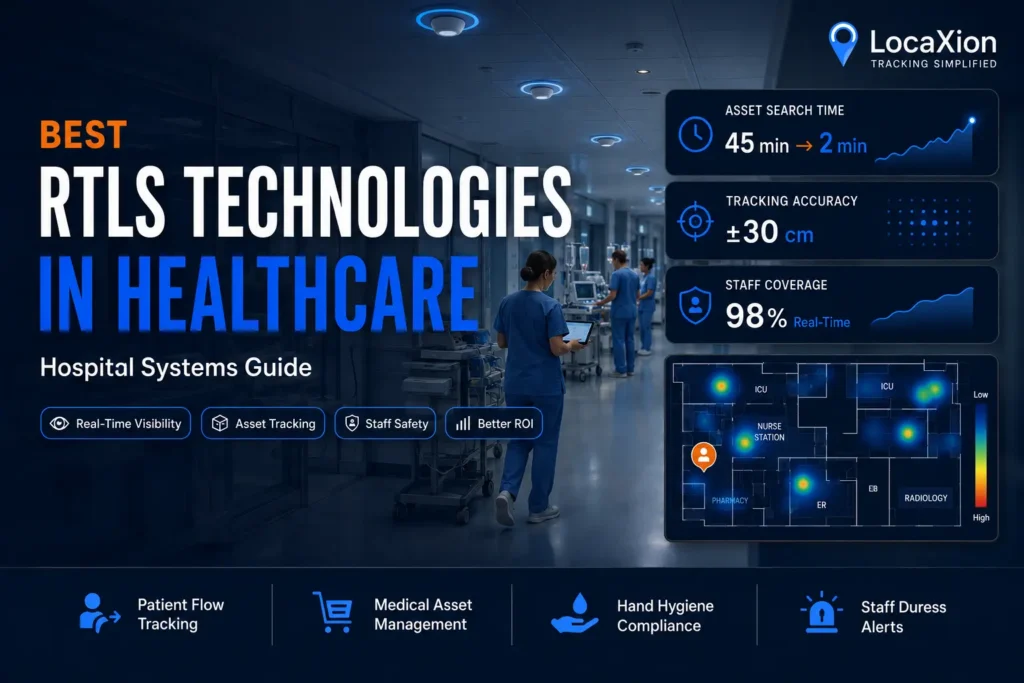
Pull up the historical heat maps. Identify exactly where bottlenecks choke the floor during shift changes. Say a specific shared forklift fleet consistently causes traffic congestion—the digital twin highlights that inefficiency instantly. Simulate alternate workflows. Optimize the routes without disrupting a single second of actual production. That intelligence shifts a facility from reactive firefighting to proactive optimization.
Proactive Safety and Collision Avoidance System
True visibility also encompasses proactive facility safety. Industrial environments are inherently dangerous spaces. Heavy machinery and pedestrians share the same fast-paced zones every single day.
Deploy a robust spatial tracking system, and you fundamentally shift those safety protocols. Establish accurate, centimeter-level location data to unlock active forklift safety solutions. We are talking automated pedestrian separation protocols triggering alerts the moment workers enter high-risk zones.
Automated speed governance physically slows vehicles down in congested areas. Implement intersection stop logic that enforces traffic rules physically, taking human compliance entirely out of the equation. Bake the safety directly into your infrastructure.
Automating Final Assembly with Location Intelligent RTLS
Intelligent tracking methodologies are already proven on the assembly lines of global automotive and aerospace leaders. A prime application of this expertise? Intelligent torque tool tracking for final assembly operations.
Traditionally, tracking these tools demanded rigid physical sequences and fixed workstations. Operators burned valuable cycle time manually scanning tools or verifying sequences.
The Standard for Torque Tool Tracking
Modern tracking completely eliminates those manual steps. Track a tool the moment it enters a moving car's geofence. The spatial system automatically fires the vehicle's specific VIN directly to the tool controller.
Next, the controller instantly retrieves the correct torque program straight from the MES. This proactive automation kills the reliance on fixed stations. Facilities gain the power to run highly flexible assembly workflows with dynamic workstation lengths.
On top of that, the system actively guards your critical tools. If a calibration schedule expires, the asset is automatically disabled—stopping costly quality failures before a single bolt is turned.
Driving Efficiency with RTLS for Automotive Parts
Implementing RTLS for automotive parts is not about just placing a blue dot on a digital map. It is about driving a hard, measurable business outcome. Track your critical parts, and you gain absolute control over both inventory and throughput.
Preventing Line-Down Events in Automotive Manufacturing
Line-down events are the single most expensive failures in discrete manufacturing. They usually happen for a stupid reason: a specialized part or a heavy engine block cannot be found in time.
Track those parts down to the centimeter to pre-position materials exactly where they need to be next. The system predicts demand in real time. Alert your material handlers before a station runs empty. Keep that material flowing continuously.
Real-World ROI in Material Flow
Look at the measurable impact of replacing manual floor walks with automated tracking. We see this exact transformation in material flow constantly:
- The Problem: Line supervisors burn an average of 45 minutes per shift hunting for specific, calibrated tools and specialized automotive parts. That costs facilities hundreds of thousands of dollars annually in wasted labor and line pauses.
- The Solution: Supervisors and operators locate any specific tool or part in under two minutes using a centralized dashboard. That saves massive amounts of capital annually and guarantees a rapid payback period.
Deploying RTLS Solutions for the Automotive Industry
Deploying RTLS solutions for the automotive industry correctly demands a battle-tested roadmap. Start with a comprehensive site survey. You have to understand the physical environment first. Factories are packed with heavy metallic zones and complex signal interference that must be mapped accurately.
A Technology-Agnostic Approach with Automotive RTLS
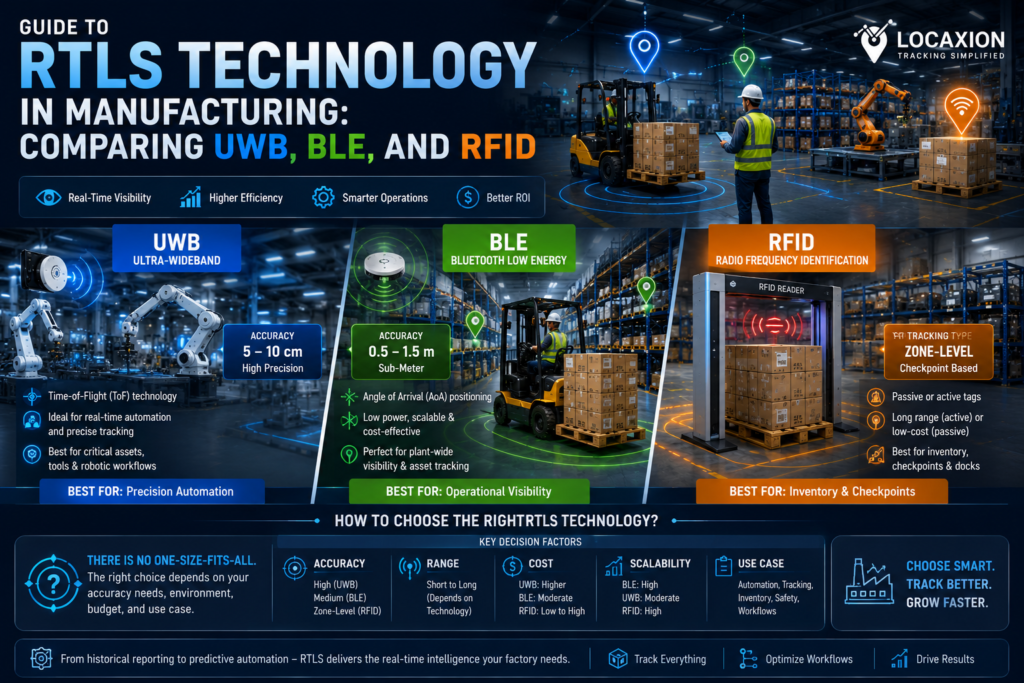
Getting the implementation architecture right is just as critical as the hardware itself. Take a technology-agnostic approach so you are never locked into a single provider. It lets your integration partner select the precise technology required for specific zones. For example, Ultra-Wideband (UWB) is perfect for highly precise final assembly tracking, while Bluetooth Low Energy (BLE) handles broader warehouse tracking beautifully. Mix those technologies. Ensure optimal performance while driving down the total cost of ownership.
Comparing the Approaches:
- Hardware Flexibility: OEM vendors lock you into their proprietary tags. An agnostic approach? You mix and match the absolute best hardware for the specific environment.
- System Scalability: Try adding a new use case to a proprietary system—it usually requires a massive overhaul. Agnostic architectures seamlessly integrate new tracking tech the second your needs change.
- Data Integration: Forget siloed dashboards. Modern integrations feed spatial data directly into your existing MES and SCADA to build a true closed-loop system.
The LocaXion Solution: A Dedicated Integration Partner
Plenty of companies sell tracking hardware. Very few actually understand the messy, complex realities of automotive assembly. LocaXion was built by a team bringing over 15 years of RTLS expertise to the floor. Our methodologies are proven—since 2008—with global leaders like BMW, Daimler, Honda, and Boeing. We are specialized systems integrators, not hardware reps pushing a quota. We guide you through the entire journey with a completely unbiased, vendor-neutral approach.
Proven Production Tracking Solutions for Automotive Manufacturing
LocaXion actually pioneered intelligent torque tool tracking for automotive final assembly 17 years ago. Today, we bridge that massive gap between physical floor operations and enterprise software. We integrate the exact technology your environment demands. The result is a scalable, unified system that plays perfectly with your existing infrastructure. We focus on three things: measurable ROI, complete traceability, and operational excellence.
Key Considerations for Automotive RTLS Implementation
RTLS Applications in the Automotive Industry
It tracks the exact spatial location of critical assets—think torque tools, specialized parts, and heavy machinery—right on the manufacturing floor. Feed that spatial data into your MES and SCADA to achieve complete operational visibility. That unlocks automated tool programming, optimizes your milk-run routes, and prevents expensive line-down events.
RTLS and GPS Serve Different Purposes in Automotive Operations
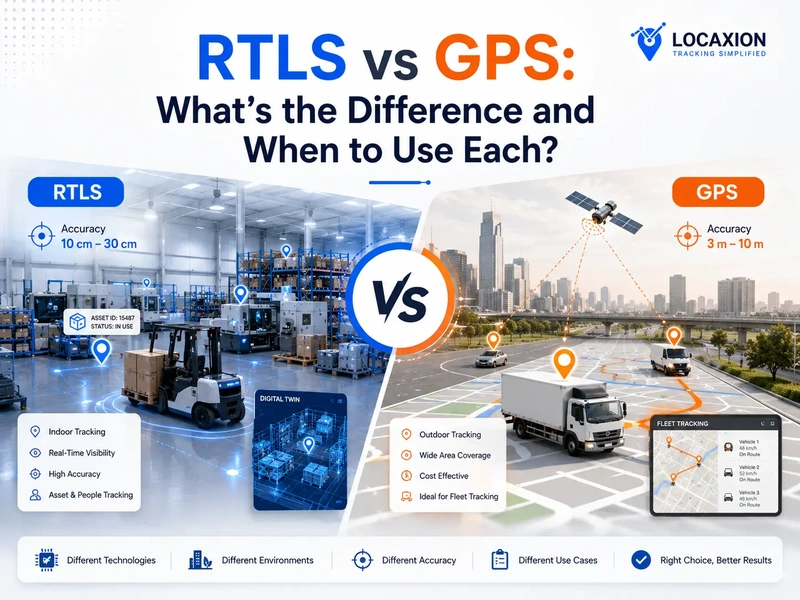
No. GPS is built for outdoor navigation. It completely fails in dense indoor manufacturing environments because it lacks precision. RTLS leverages advanced tech like Ultra-Wideband (UWB) or Bluetooth Low Energy (BLE). It is purpose-built for highly accurate, centimeter-level indoor tracking across the factory floor.
Primary Benefits of Production Tracking Solutions in Automotive Manufacturing
You see measurable ROI almost immediately by eliminating search times and automating tool programming via geofencing. It wipes out the blind spots sitting between your MES and SCADA systems, paving the way for flexible assembly lines while preventing costly production halts.
How a Vendor-Neutral Approach Strengthens RTLS Solutions
It guarantees you are never trapped by a single hardware provider. An unbiased integration partner selects the exact, field-tested technology required for specific zones in your facility. You get optimal performance and drive down your total cost of ownership at the same time.
Why RTLS for Automotive Parts Is Critical to Modern Assembly
Tracking parts guarantees absolute traceability to prevent line-down events. Know exactly where heavy components or specialized parts sit in real time. Facilities can then pre-position materials ahead of time, optimizing inventory flow and ensuring continuous production.