Skip to content
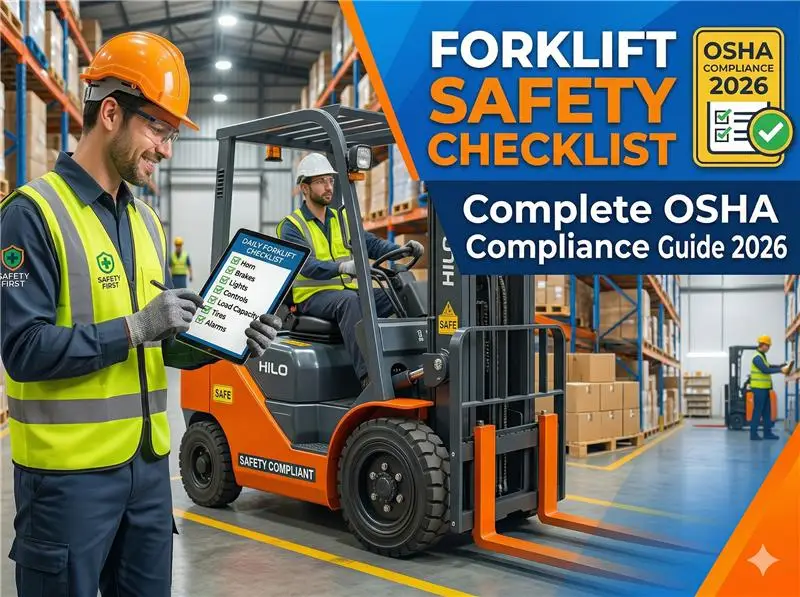
The forklift safety checklist is a baseline document for all facilities using powered industrial trucks. It’s the document confirming an industrial truck is actually fit for service before a shift starts. The official OSHA 29 CFR 1910.178(q)(7) requires an inspection at least once a day and if you're running 24/7, that means an inspection every shift and a very efficient forklift tracking system in place. If a defect turns up, it is required to be reported immediately. The truck stays out of service until it's fixed.
process is a two-part job: a "key-off" visual walk-around, followed by a functional test with the engine running. This guide covers both, breaks down the OSHA mandates, and explains how moving to a digital checklist—specifically one tied to active RTLS tech—finally closes the gap between paper compliance and real-world accident prevention.
As per OSHA, it records 85 deaths and roughly 34,900 serious injuries involving forklifts in the U.S. every year. In 2024, Powered Industrial Trucks reached #6 on OSHA’s most-cited standards. A willful violation can now cost up to $156,259 per instance. In that context, a well-executed digital checklist isn't just a chore—it’s your primary line of defense.
OSHA 29 CFR 1910.178(q)(7) Mandate’s Forklift Inspection Requirements
The regulation states clearly: "Industrial trucks shall be examined before being placed in service and shall not be placed in service if the examination shows any condition adversely affecting the safety of the vehicle." It requires daily checks, or shift-by-shift checks for round-the-clock operations.
The Complete Forklift Safety Checklist 2026: A Two-Stage Framework
A compliant inspection follows a very specific sequence. Don't skip steps.
Stage 1: Off the lift, pre-Start Visual Inspection (Key Off)
Lift mut be parked on level ground, brake set, and key pulled. Operator must walk the entire machine before they touch a single control.
- Fluid Levels and Leaks: Look at the floor first. Puddles? Check the oil, coolant, and hydraulics via the sight glass. An active leak is an immediate "out of service" condition under 29 CFR 1910.178(p)(4).
- Tires and Wheels: For solid tires, look for chunking or flat spots. For pneumatics, check the pressure. Cracked rims or loose fasteners mean the truck gets tagged out right then and there.
- Forks and Carriage: Look for cracks or bends, especially at the heel. Ensure the retaining pin is secure. ASME B56.1-2020 requires removal if blade thickness wears to 90% of the original spec. Also—never weld a fork.
- Mast and Hydraulics: Inspect channels for debris or cracks. Check the lift chains for tension and lube. Use a stick to check tension—never your fingers. Look for "weeping" hoses.
- Overhead Guard and Backrest: Look for broken welds or missing bolts. The load backrest must be secure and unmodified. If these are damaged, the truck is unsafe to operate.
- Operator Compartment: Keep the cab clear of trash or grease. Ensure the pedals are unobstructed and the seat belt clicks.
- Labels and Data Plates: The capacity nameplate must be legible. It has to match the specific model and any attachments you've got installed.
- Specific Fuel Checks: For electrics, check for battery corrosion (wear your PPE). For LP trucks, ensure the tank is mounted with the relief valve pointing up. Look for visible dents.
Stage 2: Operational Check (Key On)
- Visual check passed? Good. Now start the engine and verify the systems in a safe area before heading into the work zone.
- Accelerator and Inch Control: It should be a smooth, progressive response. No sticking.
- Directional Control: Test both forward and reverse. Engagement should be crisp—no grinding or delay.
- Steering: Move the wheel lock-to-lock. It should be responsive without excessive "slop."
- Brakes: Drive slowly and hit the service brake. It should stop straight. If it pulls or takes too long, send it to maintenance. The parking brake should hold on a slight grade.
- Hydraulics: Raise and lower the forks fully. Tilt them. Everything should move smoothly without unusual whining.
- Safety Devices: Hit the horn. Check the lights. Ensure the back-up alarm and blue safety lights are working. These aren't optional accessories; they are required.
- Presence Sensing: If equipped, verify the drive cuts out if you leave the seat.
- Hour Meter: Log the reading to keep maintenance on schedule.
Read more on forklift safety rules in warehouse here.
Digital vs. Paper: Why the "Real-Time Architecture" Matters
ing paper isn't just about "going green." It's about the enforcement baked into the code. A digital system does things a clipboard simply can't:
1. Accountability: It ties every check to a specific operator ID and a timestamp. No "pencil whipping" the whole form at 4:55 PM.
2. Evidence: It requires photo uploads for damaged parts, comparing them against "clean" baseline images.
3. Interlocks: It integrates with the truck's CAN bus. No inspection? No ignition.
4. Analytics: It turns compliance into a query-able data asset, helping you spot trends in equipment wear or operator habits.
Tier-1 Facilities Abandoned Paper
dustry has moved on. Amazon mandated digital pre-shift inspections at major facilities starting in 2022. DHL Supply Chain requires searchable digital records kept for three years. Even Prologis now embeds digital inspection compliance as a tenant KPI in lease agreements.
Beyond the Checklist: LocaXion’s RTLS Platform
Look, a checklist proves the truck was safe at 8:00 AM. It does nothing for a crash at 2:00 PM. That’s where LocaXion’s RTLS (Real-Time Location System) comes in. Using UWB and BLE technology, it tracks equipment and pedestrians with 10cm accuracy.
This creates a "live digital twin" of your facility, offering:
1. B1 Pedestrian-Forklift Separation
2. Mandatory Intersection Stop Logic
3. Zone-Based Speed Governance
4. Speeding and Harsh Braking Detection
5. Collision Warnings and Impact Reporting
The Bottom Line: ROI of Safety Tech
Combining a digital checklist with active RTLS creates measurable results for overall forklift and worker safety:
- Lower Costs: Average injuries cost over $38,000. LocaXion users report reducing accidents by 60%—that pays for itself fast.
- Faster Audits: Instead of digging through filing cabinets, you can generate an OSHA-ready report in 15 minutes.
- Insurance Perks: FM Global credits can shave up to 8% off premiums for facilities using integrated monitoring.
- See it for yourself: LocaXion offers a one-week safety assessment to map your facility's specific risk profile. Learn more at https://locaxion.com/
Frequently Asked Questions: Forklift Safety and OSHA
What's in a complete checklist?
Two stages: Visual (fluids, tires, forks, mast) and Operational (brakes, steering, hydraulics, safety alarms). Both must be finished before the truck moves into the work area per 29 CFR 1910.178(q)(7).
How often is it required?
At least daily before use. For round-the-clock operations, you need an inspection after every shift, not just once a day.
Does OSHA require me to keep the records?
Technically, no. But if they investigate a crash and you have no records, you have no defense. Industry best practice is keeping digital records for three years.
What safety equipment must be verified?
The Overhead guard, backrest, seat belt, presence sensing system, back-up alarm, horn, and all safety lights (including blue lights). Accessories like proximity sensors must be functional before service.
What's the difference between paper and digital?
Digital systems tie checks to operator IDs, store photo evidence, and can physically lock the ignition. Paper has no enforcement mechanism and can't be used for trend analysis.
What are the OSHA penalties?
Under the 2026 schedule, serious violations cost $15,625, while willful or repeated failures hit $156,259 per instance.