Skip to content
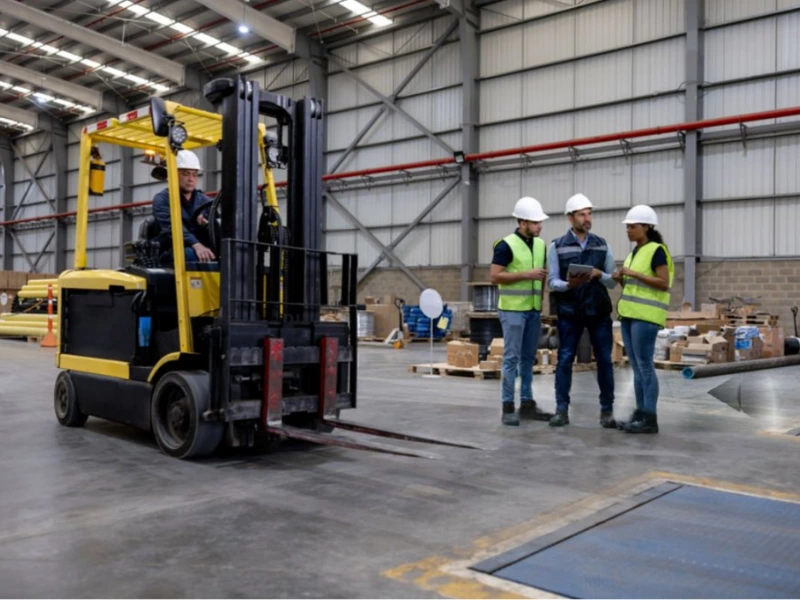
Forklifts hurt thousands of workers each year and factories are seeking alternatives.
To improve forklift and pedestrian safety, industrial leaders are moving beyond simple awareness and toward active vehicle control. In high-velocity warehouses and manufacturing facilities, forklifts are designed for power and maneuverability, not visibility. A standard forklift can weigh three times more than a mid-sized car. When carrying a load, it blocks much of the driver’s forward view.
When ten thousand pounds of moving equipment intersects with a worker on foot, physics does not rely on safety posters. According to OSHA data, approximately 34,900 serious injuries and 85 fatalities occur annually due to forklift-related incidents. Many of these events happen in the 1.5 seconds it takes for a pedestrian worker to step into a blind spot and recognize the danger, often assuming they had been seen or that warning lights and alarms were enough.
LocaXion moves the industry away from awareness-based luck toward engineering certainty. While floor markings and audible alerts improve visibility, they still depend entirely on a human reacting in time. We focus on active systems that intervene via the CANbus to slow or stop a vehicle before the physics of a collision become inevitable.
Why Human Attention Fails to Guard Forklift and Pedestrian Safety
In a high speed distribution center, a forklift travels at roughly 12 feet per second. The average human reaction time is 1.5 seconds. By the time an operator detects a pedestrian and applies the brakes, the machine has already traveled 18 feet.
This 18 foot window is the Reaction Gap, and it is where most pedestrian safety failures occur. Unlike standard RTLS tracking which often focuses on location history, active safety requires immediate intervention.
Where Traditional Forklift Safety Alerts Fall Short
- The Pressure Factor: When operators are under strict production pressure, audible buzzers often become background noise.
- The Visibility Trap: Traditional forklift pedestrian safety systems rely on a driver to see a blue light or floor marking and then act.
- The Latency Problem: By the time a human brain recognizes a threat, physics has already taken over.
To protect your team, LocaXion takes the decision-making out of the operator's hands. By connecting sensors directly to the vehicle’s braking or throttle via the CANbus, the machine is physically prevented from causing harm.
This ensures that even if a pedestrian steps into a blind spot, the system intervenes instantly to prevent a collision.
Is your current safety program fast enough to close the gap?
The Role of Geofencing in Forklift and Pedestrian Safety at Intersections
In the Smart Warehousing 4.0 era, facilities rely on digital precision rather than just human sightlines. While a driver’s view is often obstructed by high-stacked loads, the most significant forklift and pedestrian safety risks occur at the hidden nodes of a facility: the intersections.
Traditional safety relies on the honk and slow rule, but in high-velocity environments, operators under pressure often roll through cross-aisles.
The LocaXion solution moves beyond basic cameras to Digital Compliance enforced by active forklift pedestrian safety sensors.
How LocaXion Control Secures Intersections
- Automatic Stop Commands: By integrating directly with the vehicle's internal CANbus, the system does not just suggest a stop; it enforces a mandatory halt.
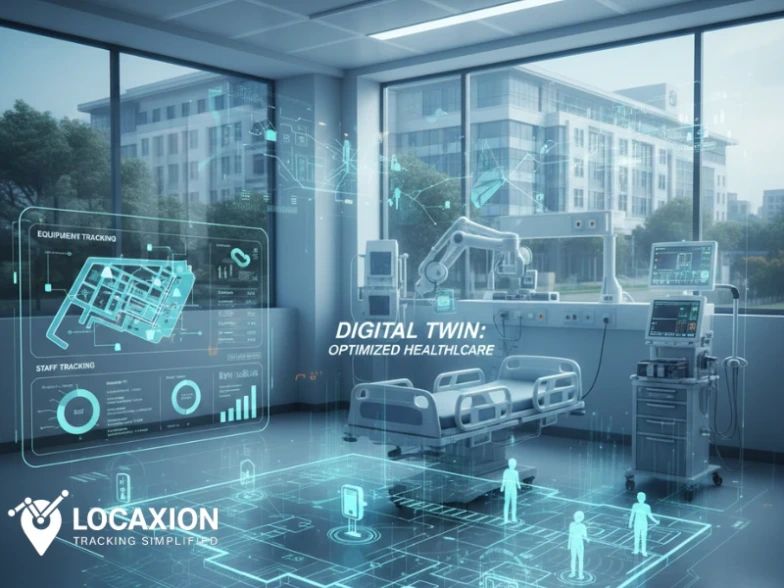
- Geofenced Precision: Using real-time location data, the system identifies when a forklift approaches a designated intersection and interrupts the throttle to bring the vehicle to a controlled stop before it can enter the pedestrian path. This is often enhanced by a Digital Twin of the facility to map out high risk zones.
- Active Speed Governance: In high-traffic zones, the system overrides the operator's foot pedal to govern the machine to a creep speed, reducing braking distance to inches.
Also Read: Real-Time Forklift Tracking: Enhance Safety and Efficiency
Closing the Path with 130 Degree Forklift and Pedestrian Safety Tech
In modern logistics environments, collision avoidance systems must distinguish between a static rack and a moving person. Frequent and serious impacts occur in the direct path of travel, both forward and reverse. Computer vision has replaced basic proximity sensors by identifying the human form with millisecond precision.
Precision Detection for Worker Safety:
- Eliminating False Alerts: Rather than a 360-degree radius that triggers false alarms for every wall or pillar, the system focuses strictly on a 130-degree Field of View at the front and rear.
- Dynamic Envelope Coverage: This specific arc covers the entire travel path of a moving forklift, ensuring a pedestrian is identified long before they reach the side of the chassis.
- Microsecond Authority: Because the detection happens on the vehicle itself, the signal to cut power happens instantly without a server round-trip.
The moment the computer vision identifies a human signature in that 130-degree cone, the system fires a signal to the vehicle's control system, and the forklift stops.
The Forklift Safety Reality: How Simplicity Beats Complex Systems
As facilities modernize, some turn to complex 360-degree sensors that promise total coverage but create false alerts and alarm fatigue, reducing trust in the technology.
True worker safety is built on controlling the highest risk exposure points. By enforcing mandatory stops at intersections and protecting the forward and reverse travel paths, facilities reduce forklift and pedestrian safety risk without adding unnecessary complexity.
For high-compliance sectors like aerospace or medical manufacturing, this is a cost-effective insurance policy. It protects the production line by making common points of failure physically impossible to ignore. It is an engineering control that maintains operational flow while ensuring that personnel protection is no longer a matter of chance.
If your facility still relies mainly on forklift pedestrian safety lights and awareness-based measures, it may be time to evaluate a more active approach.
Take Control of Your Facility Safety. Stop relying on passive alerts. See how active enforcement physically prevents collisions in high-velocity environments.
Explore the LocaXion Forklift Safety Solution
FAQs on Forklift and Pedestrian Safety Systems
Does the 130° field of view cause false alerts in narrow aisles or high-density racking?
No. The 130° arc is tuned to the vehicle's path, filtering out static racks and pillars. This precision creates more reliable forklift pedestrian safety systems by focusing on the immediate path of travel and eliminating operator alarm fatigue.
What happens if a pedestrian or contractor is not wearing a safety tag or vest?
Modern forklift pedestrian safety systems that use computer vision do not depend only on wearable tags. Instead, they detect the human form within the forklift’s travel path. This improves forklift and pedestrian safety even when visitors, contractors, or temporary workers are not wearing a device or high-visibility vest.
How is Active Enforcement in forklift tracking different from standard proximity alarms or blue lights?
Traditional forklift pedestrian safety lights and proximity alarms provide warnings and depend on the operator to react in time. Active enforcement goes further by integrating directly with the vehicle’s control systems. Instead of only sounding an alert, the forklift can automatically slow or stop when a pedestrian enters a defined risk zone.
How easy is it to update safety zones if my warehouse layout changes?
Modern forklift pedestrian safety systems use configurable geofenced zones that can be adjusted as warehouse layouts evolve. Safety parameters such as intersection stops or speed limited areas can be updated without replacing hardware. This flexibility allows facilities to adapt to changing operational workflows while maintaining consistent control.
Can this system work with different forklift brands?
Yes. Most forklift safety systems integrate through standardized vehicle interfaces such as CANbus or relay connections, making them compatible with mixed fleets. LocaXion’s forklift and pedestrian safety approach is designed to support different forklift brands without requiring a full fleet replacement.