Skip to content

OSHA forklift regulations are tightening in 2026. The core standard - 29 CFR 1910.178 - still governs powered industrial truck operations, but the enforcement environment around it has shifted. Two active National Emphasis Programs now target warehouse and distribution operations directly.
Penalty maximums reach $16,550 per serious violation. A first-ever federal heat standard is moving toward finalization. And new automation standards are reshaping how driverless vehicles must be managed alongside human-operated forklifts.
The common thread across all of these changes is documentation. OSHA expects digital, auditable records, not paper clipboards, and filing cabinets: that requires a real-time forklift tracking system that automates these processes. Facilities that deploy RTLS (real-time location system), forklift telemetry, and digital inspection checklists are meeting these requirements while building operational infrastructure that makes compliance sustainable. This guide covers what changed in OSHA forklift regulations, what it means for your operation, and how digital tools address each requirement.
What Changed in OSHA Forklift Regulations for 2026
The Warehousing NEP: Unannounced Inspections at High Injury Rate Facilities
OSHA’s National Emphasis Program on Warehousing and Distribution Center Operations (CPL 03-00-026), launched in July 2023, runs through mid-2026. This program authorizes OSHA to conduct unannounced, programmed inspections at facilities with elevated injury rates, without waiting for a complaint or incident.
Targeted sites are selected from two lists. The first includes facilities under NAICS codes covering warehousing, distribution, courier services, and mail processing. The second targets high-injury retail establishments based on DART (Days Away, Restricted, or Transferred) rates that exceed private industry baselines.
All inspections under this NEP are comprehensive, covering powered industrial vehicle operations, material handling, walking-working surfaces, egress, and fire protection. For any facility running forklifts, this changes day-to-day operations.
A programmed inspection can arrive at any time and will cover every major hazard, not just one trigger. The ability to produce organized training records, daily inspection logs, and operator certifications on demand is what separates passing an inspection from receiving citations.
The Heat NEP and New Forklift OSHA Requirements for Indoor Facilities
OSHA’s Heat NEP (CPL 03-00-024), launched in April 2022 and extended through April 8, 2026, enables proactive inspections in industries with high heat exposure, including warehousing, manufacturing, construction, and food service.
OSHA can inspect when the National Weather Service issues a heat advisory or when the heat index reaches 80°F.
At the same time, OSHA is advancing its first ever Federal Heat Injury and Illness Prevention Standard. Published as a proposed rule in August 2024 with public hearings through July 2025, it would require written Heat Illness Prevention Plans, acclimatization protocols for new workers, access to water and shade, and environmental monitoring across all covered sectors.
For warehouses running forklifts near heat-generating equipment or in poorly ventilated spaces, this creates overlapping forklift OSHA requirements. The Heat NEP is enforceable now. The federal standard will formalize these obligations into permanent regulation. Facilities without documented heat monitoring, rest schedules, and worker training are exposed to citations under the General Duty Clause even before the final rule takes effect.
OSHA Forklift Maintenance Requirements and Updated Penalties
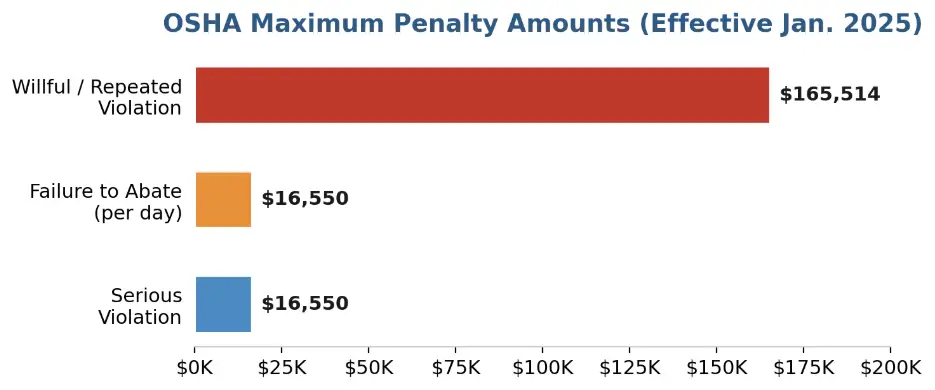
OSHA forklift maintenance requirements under 29 CFR 1910.178 are straightforward: daily pre-shift inspections, immediate removal of defective equipment from service, and documented maintenance records. What has changed is the penalty structure.
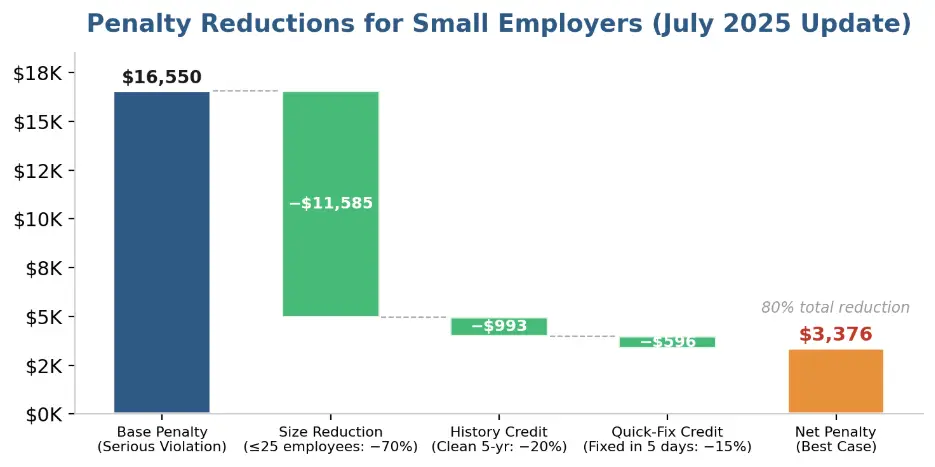
Penalty maximums stand at $16,550 for serious violations and $165,514 for willful or repeated offenses. OSHA’s July 2025 Field Operations Manual update restructured reductions: businesses with up to 25 employees (previously 10) now qualify for up to 70% reduction, a new 15% “Quick-Fix” credit rewards fast hazard correction, and a clean five-year inspection history earns 20% off.
The takeaway: OSHA forklift maintenance requirements are not new, but the cost of non-compliance is steeper. Under the Warehousing NEP, inspectors specifically look for gaps in daily inspection documentation and equipment maintenance records. Facilities that rely on paper-based systems risk producing incomplete records during an audit, or worse, no records at all.
The takeaway: OSHA forklift maintenance requirements are not new, but the cost of non-compliance is steeper. Under the Warehousing NEP, inspectors specifically look for gaps in daily inspection documentation and equipment maintenance records. Facilities that rely on paper-based systems risk producing incomplete records during an audit, or worse, no records at all.
Automation Standards and ANSI B56.5 for Driverless Vehicles
Warehouses deploying Automated Guided Vehicles (AGVs) and Autonomous Mobile Robots (AMRs) face an emerging compliance dimension. OSHA has proposed updating its powered industrial truck standards to incorporate ANSI/ITSDF B56.5, the consensus standard covering driverless industrial vehicles. Key requirements include obstacle detection and braking systems, minimum guide path clearances, hazard zone marking, and emergency stop functionality.
The proposed rule would replace 1969-era references with current ANSI B56 consensus standards for all new equipment. For mixed-fleet operations, where human-operated forklifts and AGVs share the same floor, pedestrian detection, path clearance, and zone management are moving from best practice to codified OSHA requirements. This demands real-time awareness of where every vehicle and every worker is at all times.
Digital Tools That Address OSHA Forklift Requirements
RTLS: Real-Time Visibility Across Manned and Autonomous Fleets
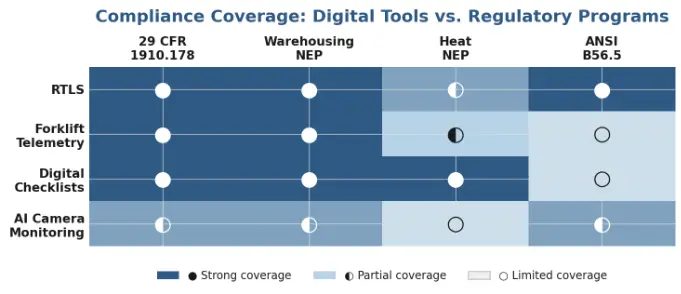
Real-Time Location Systems (RTLS) using UWB, BLE, or SLAM-based track forklifts, AGVs, and pedestrians continuously. From a compliance standpoint, RTLS addresses requirements across multiple enforcement programs:
- Proximity alerts and geofenced speed zones enforce safe distances—supporting 29 CFR 1910.178 and ANSI B56.5 clearance standards.
- Intersection safety logic slows vehicles at blind corners, where the majority of pedestrian-forklift collisions occur.
- Zone-based heat monitoring triggers alerts when workers remain in high-temperature areas, supporting Heat NEP compliance.
- Mixed-fleet coordination and orchestration manages manned and autonomous vehicle paths in a single system, essential for B56.5 compliance.
RTLS generates continuous digital audit trails - exactly the documentation that OSHA inspectors expect during Warehousing NEP inspections.
Forklift Telemetry and OSHA Forklift License Requirements
A common misconception: OSHA does not issue forklift “licenses.” OSHA forklift license requirements are actually certification requirements - operators must complete formal training, a practical evaluation, and a documented assessment under 29 CFR 1910.178.
Recertification is required every three years, or immediately after incidents, unsafe behavior, or assignment to a new vehicle type.
Modern telemetry systems make tracking these obligations automatic. They capture speed, impact events, seatbelt usage, and travel paths in real time while integration with fleet management software enables automated pre-shift inspections, timestamped maintenance records, and certification expiration alerts. Telemetry turns compliance from a manual tracking exercise into a continuous, data-driven process.
Digital Checklists and OSHA Forklift Charging Station Requirements
OSHA forklift charging station requirements are among the most commonly overlooked obligations. Under 29 CFR 1910.178, battery charging stations must have fire prevention equipment, proper ventilation, and acid splash protection.
Fuel handling for diesel, gas, and LPG units must meet NFPA standards. According to Bureau of Labor Statistics data, fire and explosion incidents in material handling environments remain a persistent cause of serious workplace injuries.
Digital inspection checklists ensure these, and every other daily inspection point, are covered systematically. They timestamp entries, flag failures for follow-up, and create searchable records that can be produced during an audit in seconds. With both the Warehousing NEP and Heat NEP adding documentation requirements - environmental monitoring logs, acclimatization tracking, rest break records - digital checklists consolidate growing obligations into one audit-ready platform.
AI-Powered Safety Monitoring in Real-Time
AI camera systems detect PPE compliance, identify pedestrians in forklift paths, and generate incident reports automatically. In mixed-fleet environments, AI vision complements RTLS by adding an independent detection layer. While not yet a formal requirement, AI monitoring aligns with OSHA’s shift toward data-driven enforcement and is already delivering measurable incident reductions at early-adopter facilities.
The Bottom Line
OSHA forklift regulations in 2026 are shaped by converging enforcement programs: the Warehousing NEP brings unannounced inspections, the Heat NEP adds indoor environmental obligations, updated penalties raise the cost of gaps in documentation, and ANSI B56.5 codifies safety requirements for autonomous vehicles.
Facilities that invest in RTLS, forklift telemetry, digital checklists, and AI monitoring are building infrastructure that addresses all these programs from a single platform. The question is whether your operation will make that shift before or after the next inspection arrives unannounced.
Frequently Asked Questions
Can OSHA conduct unannounced forklift inspections at my facility?
Yes, under the Warehousing NEP (CPL 03-00-026), OSHA can conduct programmed, unannounced inspections at facilities selected by NAICS code and high injury rates. These are comprehensive inspections covering powered industrial vehicles, material handling, egress, and fire protection through mid-2026.
Does the Heat NEP apply to indoor warehouse operations?
Yes. The Heat NEP (CPL 03-00-024), extended through April 2026, covers indoor and outdoor environments. OSHA can inspect when the heat index hits 80°F. Warehouses with heat-generating equipment or poor ventilation are in scope, and current OSHA forklift regulations increasingly intersect with heat safety obligations and related forklift OSHA requirements.
What are the OSHA forklift license requirements?
OSHA does not issue forklift “licenses.” OSHA forklift license requirements refer to operator certification: formal training, practical evaluation, and documented assessment under 29 CFR 1910.178. Recertification is required every three years, or immediately after incidents, unsafe behavior, workplace changes, or assignment to a new vehicle type.
What are the OSHA forklift charging station requirements?
Battery charging areas must have fire prevention equipment, proper ventilation, and acid splash protection under 29 CFR 1910.178. OSHA forklift charging station requirements also mandate that fuel handling for diesel, gas, and LPG units following NFPA standards. These are common citation points during Warehousing NEP inspections.
How does ANSI B56.5 affect AGV operations?
ANSI/ITSDF B56.5 defines safety requirements for driverless industrial vehicles including obstacle detection, braking, clearances, and hazard marking. OSHA has proposed incorporating this standard into its OSHA forklift requirements, meaning AGV operators would need to demonstrate compliance with these design and safety standards.
How does RTLS help with OSHA forklift regulations?
RTLS tracks forklifts, AGVs, and workers in real time, generating continuous audit trails. It supports 29 CFR 1910.178 through proximity alerts and speed zones, Heat NEP compliance through zone monitoring, and ANSI B56.5 through mixed-fleet coordination—addressing multiple OSHA forklift regulations from a single platform.