Skip to content
In many operations today, digital models are trusted to confirm that work is progressing as planned. However, a gap exists between the "Planned State" in your MES and the "Physical Reality" on the floor. This gap is often called the Hidden Factory. It is where 20-40% of productivity is lost to undocumented rework, tool searching, and transit delays.
As automation increases and decisions are made faster, this gap becomes harder to ignore. Leaders across manufacturing, logistics, healthcare facilities, and asset-intensive environments are relying on digital representations to guide execution, validate performance, and support accountability. The challenge is knowing whether those representations are based on assumptions or on live operational signals. This is where the distinction between Virtual Twins and Digital Twins begins to matter, and why choosing the right approach directly impacts execution reliability.
How Virtual Twins and Digital Twins Represent Operations
While both Virtual Twins and Digital Twins create a digital representation of physical environments, the way they are built, updated, and used differs significantly. Understanding this difference is essential before comparing their operational impact.
What Are Virtual Twins?
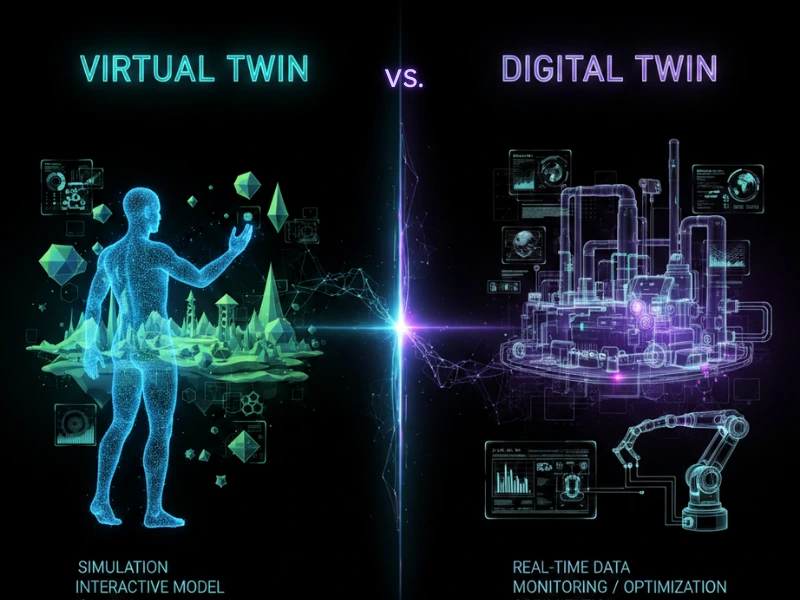
A Virtual Twin is a digital model used for simulation and testing in a virtual environment. It represents how an operation, asset, or process is intended to function, based on design data, process definitions, and historical assumptions rather than live operational data, making it suitable for planning, scenario analysis, and visualization.
How Virtual Twins Work?
Virtual Twins operate on predefined inputs rather than continuous real-time feedback. These inputs typically include CAD models (computer-aided design files that define the physical layout or geometry of an environment or asset), process definitions, historical performance data, and manually updated parameters. The system uses this information to model expected behavior and simulate outcomes.
Because the model is driven by assumptions and planned logic, it does not continuously verify what is happening in the physical environment. This is where the difference between digital twin and simulation often becomes unclear. In practice, many Virtual Twins function as advanced simulations, useful for exploring scenarios and testing designs, but unable to independently detect deviations from real-world execution.
Key characteristics of Virtual Twins
| Category | Details |
|---|---|
| Update Model | Static or periodically refreshed |
| Data Source | Design data, assumptions, historical inputs |
| Primary Use | Planning, simulation, scenario analysis |
| Accuracy Type | Assumed or averaged behavior |
| Pros | Low deployment effort, useful for early design decisions, effective for what-if analysis |
| Cons | Not synchronized with real execution, cannot detect deviations, limited value for operational control |
| Best Fit | Layout design, capacity planning, training, early-stage analysis |
What Is a Digital Twin?
A Digital Twin is a live mirror that reflects current execution using high precision location and state data. It provides a real-time record of how assets, people, and processes are actually operating as work happens.
How Does Digital Twin Work?
A Digital Twin maintains a continuous connection to physical operations through live data streams from RTLS, sensors, and operational systems. As work unfolds, location updates, movement events, dwell times, and state changes are captured directly from the environment.
These signals are processed, often at the edge, to translate raw data into meaningful operational events such as arrivals, departures, dwell time etc. The Digital Twin then updates automatically, ensuring the digital view stays synchronized with actual execution rather than planned or assumed behavior.
Key Characteristics of Digital Twin
| Category | Details |
|---|---|
| Update model | Continuous, real-time synchronization |
| Data source | Live operational data (RTLS, sensors, system events) |
| Primary use | Execution visibility, validation, and operational control |
| Accuracy type | Observed, time-aligned behavior |
| Pros | Reflects actual execution, detects deviations as they occur, supports operational decision-making |
| Cons | Higher integration effort, dependent on data quality and infrastructure |
| Best fit | Active operations, automation support, compliance-critical and execution-driven environments |
Also Read: BLE vs UWB Technology Comparison for RTLS Deployment
Virtual Twin vs Digital Twin: Key Comparison Matrix
The fundamental difference between a virtual twin and a digital twin is the nature of their connection to physical reality. While virtual twins are used for design and planning, digital twins are defined by real-time synchronization with live operations.
The following matrix provides a side-by-side technical and business comparison to help you determine which approach aligns with your operational goals.
| Feature | Virtual Twin (Simulation) | Digital Twin (Execution) |
|---|---|---|
| Operational Basis | Assumed: Reflects design intent and expected behavior. | Observed: Reflects real-time, physical execution. |
| Data Source | CAD files, historical records, and process logic. | Live RTLS, IoT sensors, and system events. |
| Update Model | Static or periodic (manual/batch) updates. | Continuous, real-time synchronization. |
| Logic Type | Model-predicted behavior | Event-verified state |
| Accuracy | Averaged or inferred based on plans. | Time-stamped and event-verified coordinates. |
| Deviation Detection | Post-analysis or manual inspection. | Automated and instantaneous alerts. |
| Primary Value | Optimization of layouts and workflows. | Enforcement of safety and quality rules. |
| Infrastructure | Minimal (Software/Cloud-based). | Intensive (Sensors, Anchors, and Network). |
| Upfront Cost | Lower (Primarily licensing and modeling). | Higher (Hardware, integration, and tags). |
| ROI Driver | Reduced planning time and design errors. | Risk reduction, labor efficiency, and 100% auditability. |
| Decision Latency | High: Analysis happens after data is collected and modeled. | Ultra-Low: Decisions are made in milliseconds as events occur. |
| Trust Boundary | Theoretical: Limited to the accuracy of the initial assumptions. | Evidence-Based: Verified by physical ground truth (RTLS). |
The Operational Impact of Digital Twin vs Virtual Twin
The shift from a virtual twin vs digital twin is defined by a transition in Decision Latency. While a virtual twin allows for long-term planning, a digital twin enables immediate reaction. This moves the system from a reporting tool to an execution engine capable of enforcing rules in real time.
Trust Boundaries and Compliance
The most significant operational change is where the Trust Boundary resides. In a digital twin vs simulation framework, the twin moves the boundary from a mathematical guess to observed physical evidence.
Virtual Twin (Assumed Logic): You trust the model. If a simulation predicts a process takes 10 minutes, the schedule is built on that assumption.
Digital Twin (Observed Evidence): You trust the Ground Truth. By using RTLS, the twin records actual task durations and asset locations. This provides a deterministic audit trail, ensuring compliance with safety and quality standards (such as ISO 23247 or NIST) by proving that work was performed exactly as required.
Execution and Automated Enforcement
When evaluating the difference between digital twin and simulation, the deciding factor is the ability to intervene before an error occurs.
High Latency (Simulation): Data is analyzed after the fact. By the time a report is generated, a quality spill or safety incident has likely already happened.
Zero Latency (Digital Twin): Because the twin is synchronized via UWB, BLE or so, it can trigger Automated Enforcement instantly. For example, the system can automatically lock a torque tool if the digital twin detects it is being used on the wrong workstation, preventing a defect rather than just reporting it.
Strategic Use Cases: ROI by Industry
| Industry | Virtual Twin Focus (Planning) | Digital Twin Focus (Execution) | Primary ROI Driver |
|---|---|---|---|
| Manufacturing | Testing line speed changes. | Synchronizing tools to units. | Zero manual rework. |
| Healthcare | Simulating patient flow. | Real-time tracking of crash carts. | 100% equipment readiness. |
| Logistics | Optimizing rack placement. | Collision avoidance for AGVs. | 15% flow speed gain. |
| Aerospace | Modeling structural integrity. | FOD prevention via tool tracking. | Verified digital thread. |
| Energy | Modeling emergency paths. | Live tracking of all personnel. | Instant safety headcounts. |
Mitigating Implementation Risks
Moving to a Digital Twin involves more than improving models or visuals. Success depends on reliably connecting planned logic with live operational conditions, a step that is often underestimated during design.
Common Pitfalls in Digital Twin Initiatives
Data latency
A Digital Twin is only as current as its data. Manual entry or batch updates mean the model reflects past conditions. Without RTLS synchronization, it remains a historical view rather than an execution tool.
Visuals over accuracy
High-end 3D graphics do not compensate for poor data quality. If execution requires 10 centimeter precision, location data that drifts by meters cannot support enforcement or automation.
Integration gaps (ERP and MES)
A Digital Twin must connect to systems like SAP/ERP for work orders and MES for shop floor execution. Projects stall when RTLS data is not translated into meaningful business events that these systems can consume.
Network readiness (WAP and backhaul)
Digital Twins depend on reliable anchors and backhaul. If your cabling and infrastructure are not designed for high-density sensor traffic, the twin will suffer from signal drops, breaking the live connection.
Read More: RFID vs NFC Tags: Differences in Cost, Range, and Industrial Use Cases
LocaXion’s Approach: From Planning to Performance
We match the technology to your specific operational needs to ensure the investment aligns with your
business goals and ROI.
Defining the Boundary: We determine whether a virtual twin or a digital twin is required for your specific use case. For design and layout planning, a virtual twin allows you to test scenarios in a risk-free environment without the cost of installing live sensors.
RTLS Digital Twin Capability: Using UWB or BLE, we replace manual updates with sub-second, centimeter-level signals. This enables risk-free testing of What-If scenarios and automation scripts, letting you validate optimizations without disrupting live physical operations.
Enterprise Integration: We bridge the gap between the shop floor and the front office by syncing the twin with your SAP/ERP and MES. This ensures your business records reflect the actual state of your physical environment in real-time.
Conclusion
Choosing between a virtual twin and a digital twin isn’t about choosing a better technology; it’s about choosing the level of control your operation actually needs.
A virtual twin works when planning, layout design, and low-risk simulations are the priority. An RTLS Digital Twin becomes essential when live precision drives automation, safety, or enforced execution. Many facilities end up using a hybrid strategy, planning with virtual models and executing with live digital twins only where accuracy is non-negotiable.
The right deployment starts by defining where approximation is acceptable and where it isn’t. Not sure where that line sits in your facility?
Contact LocaXion for a Technical Architecture Review.
We’ll help you find the most cost-effective way to turn location data into operational results and ensure your SAP or MES integration is seamless.
Frequently Asked Questions
What is the difference between a digital twin and a virtual twin?
A virtual twin is primarily a simulation used for planning and "what-if" testing without needing a physical counterpart yet. A digital twin is a live mirror of an existing physical asset, updated in real-time with sensor data to reflect its current state.
What are the four types of digital twins?
The industry generally categorizes them by scope:
- Component Twins: Focus on a single part or piece of equipment.
- Asset Twins: Monitor how two or more components work together.
- System/Process Twins: Visualize an entire production line or workflow.
- Facility Twins: Provide a comprehensive model of an entire building or factory.
How does an RTLS Digital Twin differ from a standard Digital Twin?
A standard digital twin often tracks status, such as whether a machine is on or off. An RTLS Digital Twin adds the dimension of location. By processing spatial data with sub-second latency, it can trigger automated actions based on exactly where an asset or person is moving.
What is the typical ROI for a Digital Twin implementation?
Most industrial facilities see a return through a 20-30% reduction in maintenance costs and up to a 90% reduction in asset search time. By preventing unplanned downtime and quality failures, the system often pays for itself within 12 to 18 months.
Does Tesla use digital twins?
Yes. Tesla creates a digital twin for every vehicle it manufactures. This allows them to simulate performance data, identify potential faults, and even push software updates to "fix" physical behaviors based on what the digital model predicts.
Can a digital twin integrate with my existing SAP or MES?
Absolutely. For a twin to provide business value, it must connect to your SAP/ERP or MES. This integration allows the twin to automatically update work orders, track material consumption, and verify that the physical work on the floor matches the digital production plan.