
- What is RTLS Safety: Key Applications and Benefits
- What Does RTLS Have to Do with Workplace Safety?
- How Does a Location Signal Become a Safety Alert?
- How Worker Safety RTLS Tracking Helps Prevent the Next Workplace Near-Miss?
- RTLS Employee Safety in Healthcare for Staff and Patient Protection
- Patient Flow and Safety with UWB RTLS: Improving Visibility Across Care Journeys
- What Are Physical Barriers? Physical Safeguards Vs. RTLS Geofencing
- UWB, BLE and Other RTLS Technologies: Which is the Right Fit for Safety?
- Thinking About RTLS Safety Deployment? Start with These Questions First
- Frequently Asked Questions about RTLS Safety
- Conclusion
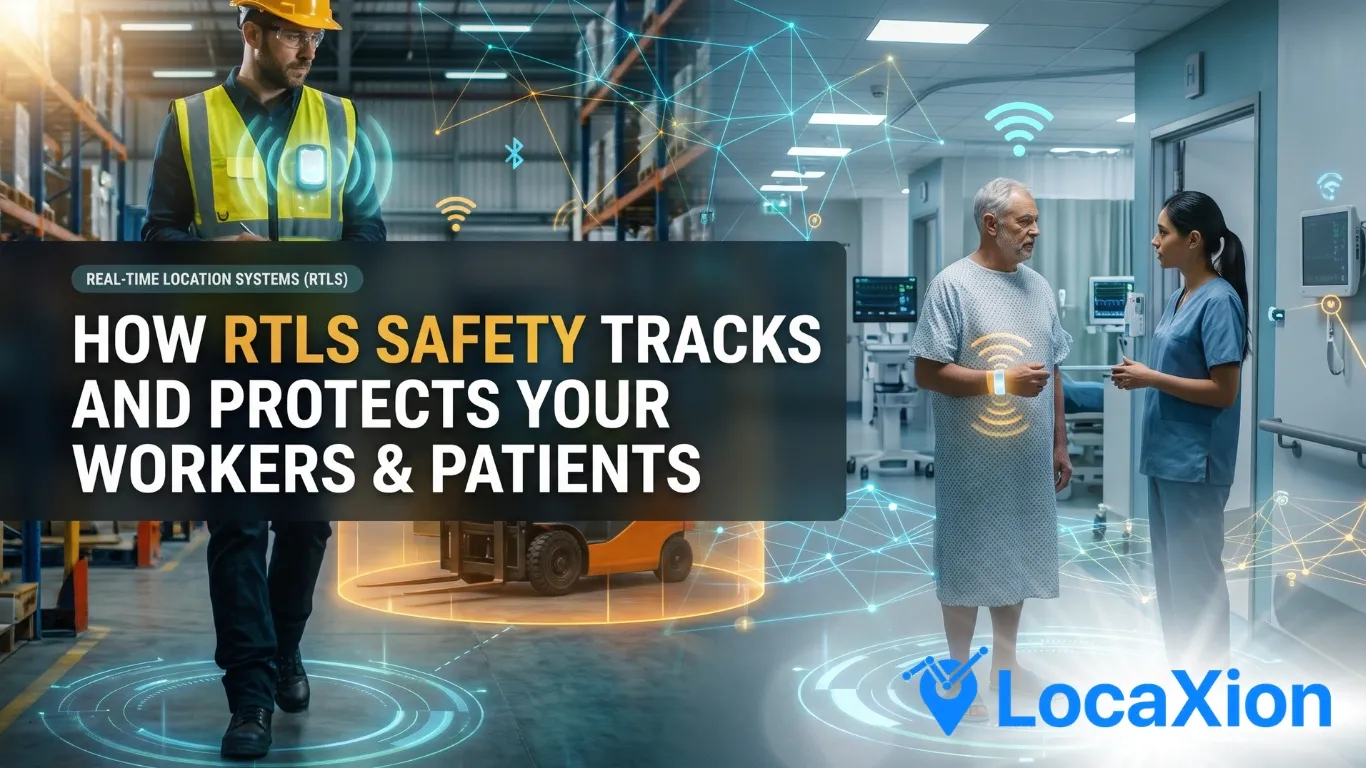
RTLS safety refers to using real-time positioning tags, fixed anchors, and automated rules engines to prevent collisions, protect isolated staff/worker, and safeguard patients before an incident occurs. By continuously tracking the distance between people, moving machinery, and restricted zones (down to 10–30 cm with Ultra-Wideband aka UWB) an RTLS safety solution turns raw spatial data into immediate visual, audible, or automated machine-slowdown alerts.
Across manufacturing plants, warehouses, and hospitals, static rules and manual check-ins leave critical visibility gaps. A forklift rounding a blind corner, a technician entering a high-voltage cell, or a memory-care patient approaching an unlocked exit all require sub-second intervention.
What is RTLS Safety: Key Applications and Benefits
Different environments demand different levels of spatial precision and response speed. The table below summarizes the core applications of RTLS & employee safety across industrial and clinical settings, alongside verified operational benchmarks.
| Safety Application | Primary Environment | Recommended Technology | Core Mechanism | Measured Impact |
|---|---|---|---|---|
| Forklift & AGV Collision Avoidance | Manufacturing, Warehousing | UWB (10–30 cm) | Dynamic proximity bubble triggers tag vibration and vehicle slowdown | 40%–68% reduction in vehicle-pedestrian incidents |
| Lone Worker Protection | Utilities, Steel, Chemical Plants | UWB + IMU / BLE | Man-down tilt detection, SOS button, and automated check-in timers | 50%–70% faster emergency response times |
| Restricted Zone Geofencing | High-Voltage, Robotic Cells, Yards | UWB or BLE AoA | Virtual perimeter triggers alarms or locks out equipment on entry | 60%–80% overall safety incident reduction |
| Emergency Mustering & Evacuation | Refineries, Large Plants, Campuses | BLE + UWB | Real-time headcount at muster stations and last-known location of missing staff | Up to 67% faster emergency mustering |
| Patient Flow & Elopement Safety | Hospitals, Memory Care, EDs | UWB + BLE | Infant/patient tags lock exit doors; automated duress alerts for clinical staff | 21% reduction in ED length of stay; zero unmonitored exits |
What Does RTLS Have to Do with Workplace Safety?
Traditional workplace safety relies on static controls: painted floor lines, convex mirrors, periodic supervisor walkthroughs, and post-incident audits. Those measures document hazards after the fact, whereas worker safety RTLS monitors spatial relationships continuously as conditions change second by second.
In high-throughput facilities, hazards are rarely stationary. Forklifts change lanes, temporary maintenance zones open up, and shift handovers alter floor density. By equipping personnel with wearable badges or helmet tags and outfitting vehicles and hazard zones with transceivers, an RTLS safety system maintains live situational awareness across the entire floor.
When integrated into a unified RTLS digital twin platform, location data goes beyond reactive alarms. Safety teams can replay historical "spaghetti diagrams," spot high-traffic intersections where pedestrians and vehicles routinely cross paths, and redesign floor layouts before a near-miss becomes a reportable injury.
How Does a Location Signal Become a Safety Alert?
Turning a radio pulse into a life-saving intervention takes less than a second, relying on a four-stage data pipeline from the factory or hospital floor to the control layer.
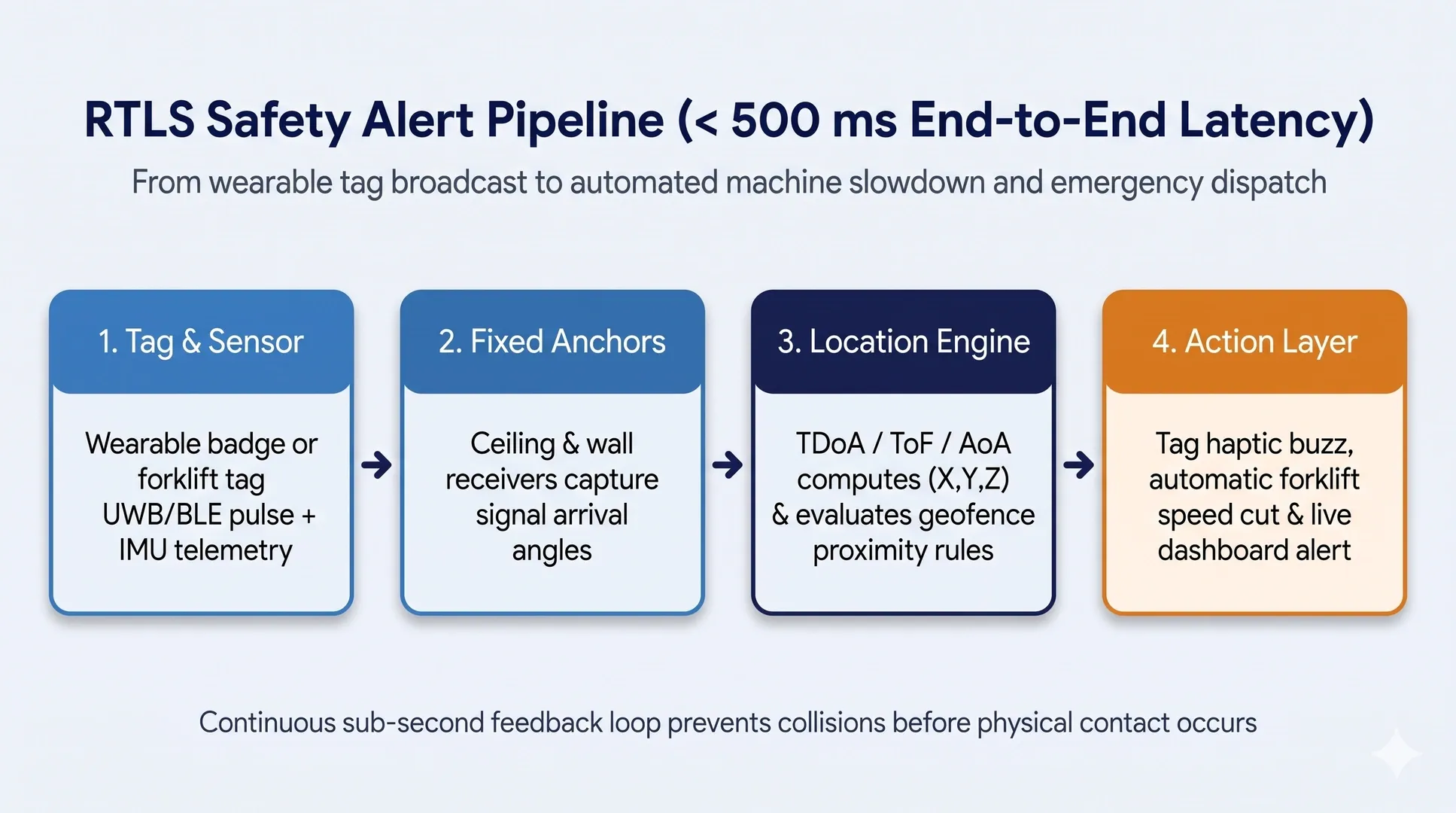
- 1. Tag Transmission: A worker's wearable tag (badge, wristband, or hard-hat clip) or a vehicle-mounted transceiver broadcasts a wireless signal at set intervals i.e., typically 1 to 10 times per second for high-risk safety zones. Many tags include onboard accelerometers (IMUs) to detect sudden falls or prolonged immobility.
- 2. Anchor Reception: Fixed anchors mounted on walls or ceilings pick up the signal. Depending on the technology, the infrastructure measures Time Difference of Arrival (TDoA), Two-Way Ranging (TWR), or Angle of Arrival (AoA) to pinpoint exact coordinates.
- 3. Location Engine & Digital Twin Rules: The positioning engine converts raw timestamps into real-time (X, Y, Z) coordinates with sub-50 ms processing latency. A spatial rules engine compares those coordinates against dynamic exclusion zones, vehicle trajectories, and worker role permissions.
- 4. Automated Intervention: If a rule is violated (such as, an unauthorized worker stepping within two meters of an active robotic arm) the platform simultaneously triggers a local alert through tag vibration, audible beep, or strobe light, slows down nearby machinery via PLC/IoT integration, and logs the event on the safety dashboard.
How Worker Safety RTLS Tracking Helps Prevent the Next Workplace Near-Miss?
Most severe industrial accidents are preceded by dozens of unreported near-misses. Workforce safety RTLS addresses both immediate collision prevention and long-term hazard elimination:
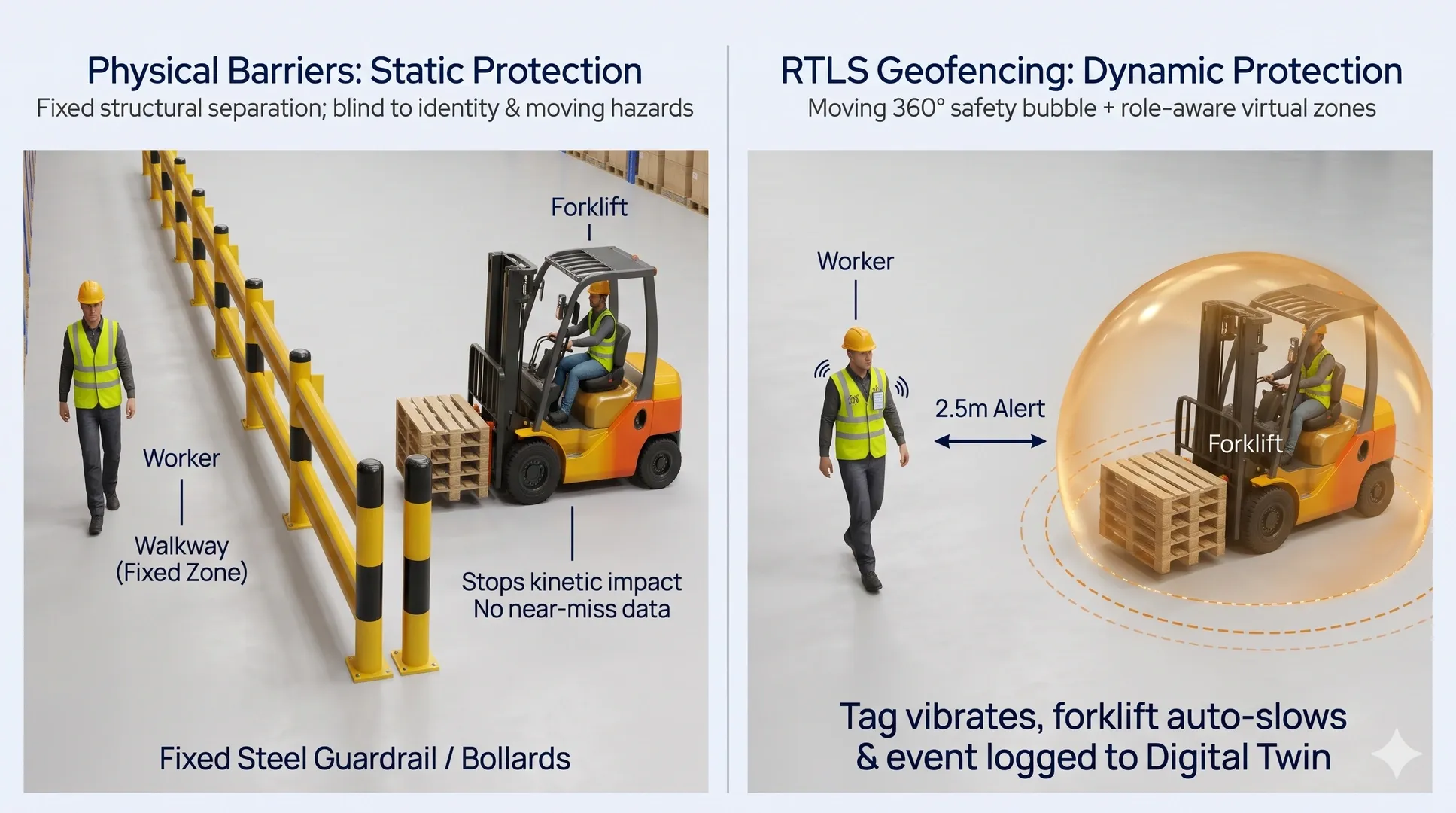
- Dynamic Vehicle-to-Pedestrian Buffers: Unlike fixed sensors that only watch a single doorway, UWB tags create a moving 360-degree safety bubble around forklifts, reach trucks, and Autonomous Guided Vehicles (AGVs). If a pedestrian steps out from behind dense pallet racking, both the operator and pedestrian receive an immediate alert, and the vehicle can be throttled automatically.
- Automated Lockout/Tagout (LOTO) Verification: Before heavy machinery is energized, the system verifies that no maintenance technicians remain inside the hazardous equipment envelope—eliminating human error during complex multi-team repairs.
- Near-Miss Heatmapping: Every time two tags breach a warning threshold without colliding, the digital twin logs the exact coordinates, time of day, and asset IDs. Environmental Health and Safety (EHS) managers use these heatmaps to reroute pedestrian walkways, add lighting, or adjust shift schedules at proven bottleneck intersections.
- Environmental & Ergonomic Exposure: Pairing location tracking with gas, temperature, or noise sensors ensures workers do not exceed permissible exposure limits in hazardous zones, triggering automatic rotation alerts when time thresholds are reached.
If a Lone Worker Needs Help, Would Anyone Know Where to Find Them?
In remote utility substations, sprawling steel mills, basements, or late-shift warehouses, an incapacitated worker can go unnoticed for hours. Lone worker safety with UWB RTLS removes the guesswork from emergency response by combining precise indoor positioning with automated distress detection.
- Automated Man-Down & No-Motion Alerts: Built-in accelerometers detect sudden impacts, slips, or horizontal tilt angles sustained beyond a preset threshold (e.g., 15 seconds). If the worker does not cancel the pre-alarm on their wearable badge, the system automatically dispatches an emergency alert.
- One-Touch SOS Panic Buttons: Workers facing a medical emergency, chemical spill, or security threat can press a tactile SOS button on their badge or lanyard to summon immediate help without needing to unlock a phone or speak over a radio.
- Sub-Meter Rescue Guidance: GPS fails indoors, and Wi-Fi floor-level estimates can still leave first responders searching dozens of rooms or behind heavy machinery. UWB pinpoints the worker's exact bay, aisle, and elevation, cutting emergency response times by 50% to 70%.
RTLS Employee Safety in Healthcare for Staff and Patient Protection
Hospitals face dual safety pressures: protecting clinical staff from workplace violence and preventing vulnerable patients from experiencing falls, abductions, or delayed care. Implementing RTLS & employee safety in healthcare creates a unified safety net across clinical wings.
- Silent Staff Duress Alerts: Nurses, emergency department (ED) clinicians, and behavioral health staff wear discreet badge tags equipped with silent panic buttons. Pressing the tag immediately alerts hospital security with the staff member's exact room or corridor (even if the confrontation moves down the hall) avoiding loud alarms that might escalate an aggressive situation.
- Infant & Pediatric Abduction Prevention: Tamper-evident UWB/BLE ankle or wrist bands continuously verify that newborns remain within authorized maternity units. If a tag approaches an elevator bank or stairwell without an authorized staff escort, doors lock automatically and security cameras cue to that exact exit.
- Wandering & Elopement Protection: Memory-care and cognitive-impairment patients wear lightweight wristbands that trigger gentle, localized alerts at unit perimeters, preserving patient dignity and freedom of movement within safe zones while preventing unmonitored exits.
Patient Flow and Safety with UWB RTLS: Improving Visibility Across Care Journeys
Safety in a hospital is closely tied to operational flow. Overcrowded emergency departments, delayed diagnostics, and missing mobile equipment directly increase clinical risk. Deploying patient flow and safety with UWB RTLS gives care teams real-time visibility from admission to discharge.
- Eliminating Bottlenecks & Hallway Boarding: By tracking patient wristbands alongside exam room occupancy and clinician locations, a healthcare digital twin identifies care delays automatically—such as a patient waiting too long for radiology transport or lab clearance. Leading health systems using RTLS flow optimization have cut Emergency Department length-of-stay by over 20%.
- Fall Prevention & Rounding Compliance: For high-fall-risk patients, UWB and bed-sensor integration alert nurses the moment a patient attempts to stand unassisted. Automated rounding logs also verify that staff have visited isolation or high-acuity rooms on schedule without manual clipboard entry.
- Life-Saving Equipment Readiness: Nurses often spend 20% to 30% of their shifts hunting for infusion pumps, telemetry packs, or crash carts. Real-time tracking ensures clean, calibrated equipment is always staged where needed, preventing critical delays during code events.
What Are Physical Barriers? Physical Safeguards Vs. RTLS Geofencing
Safety engineers frequently weigh traditional physical safeguards against virtual RTLS perimeters. Understanding where each excels is essential for compliant facility design.
Define Physical Barriers
Physical barriers are tangible, structural obstructions engineered to separate people from hazards or restrict unauthorized access to sensitive areas. If you are asking what are physical barriers in an industrial or clinical setting, they include fixed perimeter fencing, steel bollards, safety guardrails, interlocked machine cages, locked security doors, and concrete jersey walls.
What Are the Physical Barriers Most Commonly Used—and Where Do They Fall Short?
While physical barriers provide absolute mechanical stopping power—a steel bollard will physically deflect an errant forklift—they are rigid, expensive to relocate, and blind to context. They cannot distinguish between an authorized maintenance technician and an untrained visitor, nor can they move alongside a mobile hazard like an overhead crane or forklift.
RTLS geofencing establishes dynamic, software-defined virtual boundaries around rooms, machinery, or moving vehicles. Rather than blocking movement with steel, geofencing monitors identity, role, and proximity in real time.
| Comparison Factor | Physical Barriers | RTLS Geofencing |
|---|---|---|
| Mechanism | Structural separation (fencing, bollards, walls) | Virtual 2D/3D spatial boundaries via UWB/BLE |
| Flexibility | Rigid; requires construction to reconfigure | Software-defined; updated in minutes via digital twin |
| Moving Hazards | Cannot protect dynamic vehicle-pedestrian zones | Moves continuously with forklifts, AGVs, and cranes |
| Identity Awareness | Treats everyone identically (unless paired with badge locks) | Differentiates certified operators, visitors, and patients |
| Near-Miss Analytics | None | Captures every boundary breach and dwell time |
| Best Use Case | High-energy kinetic impact protection and perimeter security | Dynamic floors, shared aisles, LOTO zones, and hospital wards |
In practice, the safest facilities layer both: physical barriers absorb kinetic energy around permanent heavy machinery, while RTLS geofencing governs dynamic intersections, mobile equipment, and role-based zone access.
UWB, BLE and Other RTLS Technologies: Which is the Right Fit for Safety?
No single radio technology fits every safety use case. Selecting hardware before defining accuracy and latency requirements is one of the primary reasons 67% of RTLS projects miss their objectives.
| Technology | Typical Accuracy | Range | Latency / Update Rate | Safety Strengths | Primary Limitations |
|---|---|---|---|---|---|
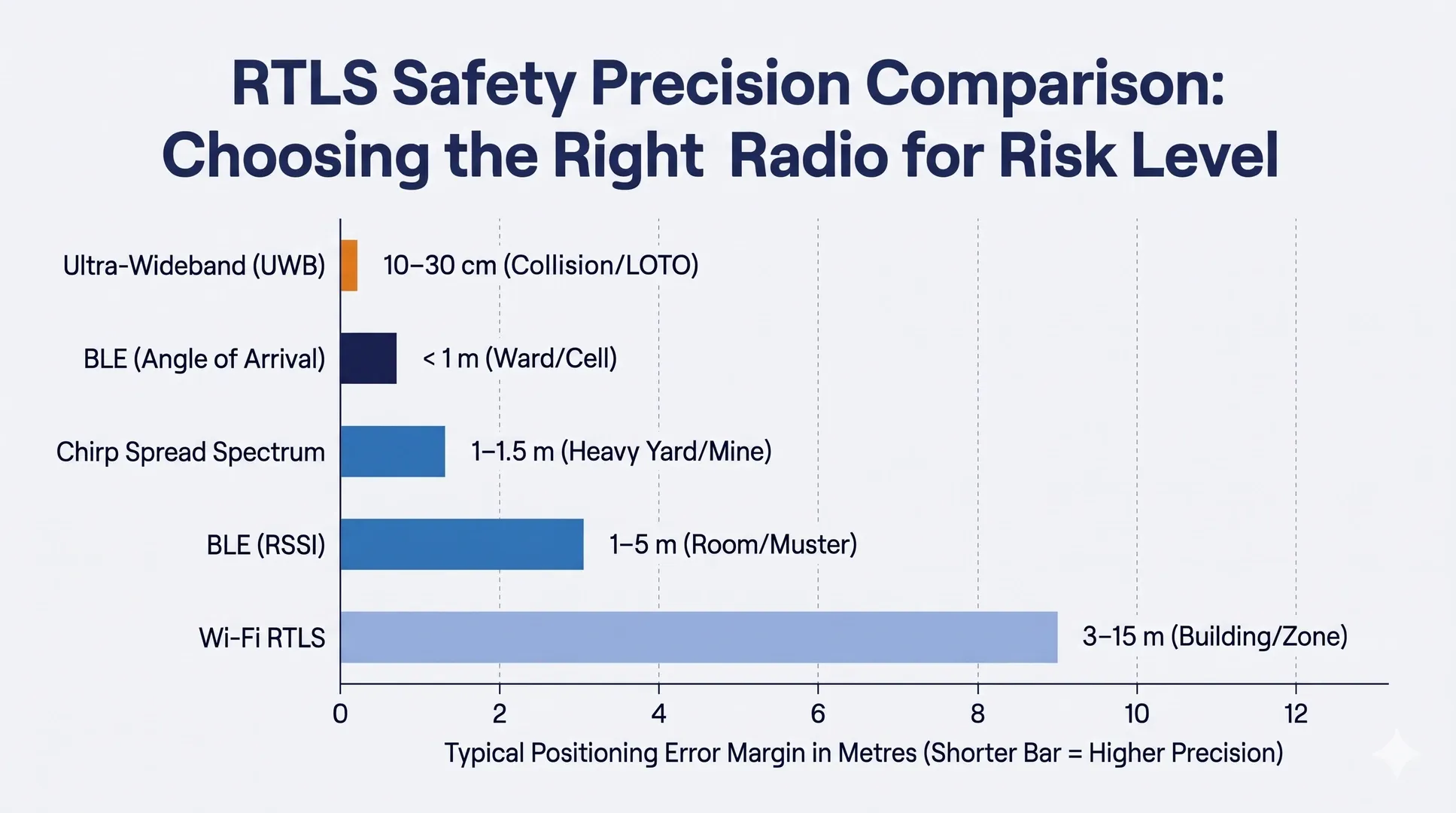
| Ultra-Wideband (UWB) | 10–30 cm | Up to 200 m | Sub-second (100–500 ms) | Forklift collision avoidance, robotic cell geofencing, infant security | Higher anchor and tag cost; shorter battery life at high refresh rates |
| BLE (RSSI & AoA) | 1–5 m (RSSI); <1 m (AoA) | 10–50 m | 1–5 seconds | Muster tracking, staff duress, ward-level patient flow, lone worker zones | RSSI struggles with metal reflections; slower update rates for fast vehicles |
| Wi-Fi Based RTLS | 3–15 m | 100–150 m | 5–30 seconds | Uses existing APs for coarse building-level presence | Insufficient precision and latency for collision avoidance |
| Chirp Spread Spectrum (CSS) | 1–1.5 m | 100–300 m | 1–5 seconds | Heavy industrial plants, mines, and outdoor yards with heavy steel | Lower precision than UWB for tight indoor proximity buffers |
| Passive UHF RFID | Chokepoint / Portal | 1–10 m | Event-driven at gates | Confirming PPE pickup or gate passage | Zero visibility between readers; unsuitable for continuous safety tracking |
For high-speed collision avoidance and sub-meter exclusion zones, Ultra-Wideband (UWB) is the clear standard because its wide frequency spectrum resists multipath reflections off metal racking and machinery. For facility-wide emergency mustering, staff duress, and room-level patient flow, BLE offers multi-year battery life at a fraction of the infrastructure cost. A vendor-agnostic digital twin platform lets you combine both radios in one unified safety layer.
Thinking About RTLS Safety Deployment? Start with These Questions First
Before comparing hardware vendors, clarify these four operational questions. They settle most architecture decisions faster than any lab demo:
- 1. What is the maximum acceptable latency? A forklift moving at 12 km/h travels over three meters every second. Collision avoidance demands sub-500 ms UWB updates, whereas emergency muster roll-calls tolerate 3-to-5-second BLE intervals.
- 2. How challenging is your RF environment? Dense steel shelving, liquid tanks, and heavy welding equipment distort radio signals. Always run an on-site RF survey and pilot in the toughest corner of your facility rather than trusting open-air datasheet ranges.
- 3. What happens when an alert triggers? An alarm that only flashes on a control-room screen will not stop a moving vehicle. Define whether your RTLS safety solution must vibrate wearable tags, trigger strobe lights, lock doors, or interface directly with forklift PLCs.
- 4. How will worker privacy and adoption be handled? Clear communication is critical. Configure role-based privacy rules so tracking applies strictly to active safety zones and shift hours, ensuring frontline teams view wearables as protective gear rather than surveillance.
Frequently Asked Questions about RTLS Safety
What is an RTLS safety solution?
LocaXion's RTLS safety solution combines wearable tags, vehicle transceivers, fixed anchors, and a real-time rules engine to continuously monitor distances between people, moving machinery, and hazardous zones—triggering instant warnings or automated equipment slowdowns to prevent accidents.
How accurate does RTLS need to be for worker safety?
It depends on the hazard. Vehicle-pedestrian collision avoidance and robotic cell geofencing require 10–30 cm accuracy (typically achieved with UWB). Facility-wide emergency mustering, lone-worker check-ins, and hospital staff duress alerts work reliably at 1–5 m accuracy using BLE.
Can RTLS geofencing replace physical barriers?
No, they serve complementary roles. Physical barriers like steel guardrails and bollards are required to stop physical kinetic energy around permanent hazards. LocaXion's RTLS geofencing adds dynamic, identity-aware protection around moving equipment, shared aisles, and temporary maintenance zones where fixed barriers cannot go.
How does UWB RTLS improve patient flow and safety in hospitals?
UWB and BLE tags provide continuous visibility into patient locations, staff rounding, and mobile medical equipment. This prevents infant abductions and patient wandering, enables silent staff duress alerts, and removes care bottlenecks, and cutting Emergency Department length-of-stay by over 20% in leading health systems.
Who can help design a multi-technology RTLS safety system deployment?
LocaXion is a vendor-agnostic RTLS and digital twin systems integrator. Because we are not tied to a single hardware brand, we start with a site survey and safety risk assessment, then integrate UWB, BLE, RFID, and existing facility systems into one unified platform.
Conclusion
Effective RTLS safety is not about buying the most expensive radio tag—it is about matching spatial precision and response speed to real-world hazards. Passive checkpoints confirm where people have been, physical barriers block static hazards, and continuous UWB and BLE tracking protects workers and patients where risk moves every second.
Whether you are eliminating forklift near-misses on a factory floor, safeguarding lone technicians, or streamlining patient flow across a hospital campus, start by defining your safety outcomes and unifying your location data in a single digital twin layer. To map the right mix of technologies to your facility, talk to LocaXion about a technology-agnostic RTLS safety assessment.
This guide is written by LocaXion, a vendor-agnostic RTLS and digital twin systems integrator—breaks down how workforce safety RTLS works in practice, how it compares to physical barriers, and which positioning technologies fit high-risk environments.