
- AMR vs AGV: A Quick Comparison
- Understanding AGV and AMR
- How do AGVs and AMRs Navigate?
- AGVs vs AMRs: Comparing their Flexibility, Safety and Performance
- AGV vs AMR Price: What Drives the Total Cost?
- AMR and AGV: Exploring the Better Job-Fit for Your Needs
- From Robot Deployment to Fleet Intelligence
- Role of RTLS and Digital Twins in Mixed Fleet Tracking
- Questions to Ask Before You Choose between AGV and AMR
- Frequently Asked Questions on AGV and AMRs
- Conclusion
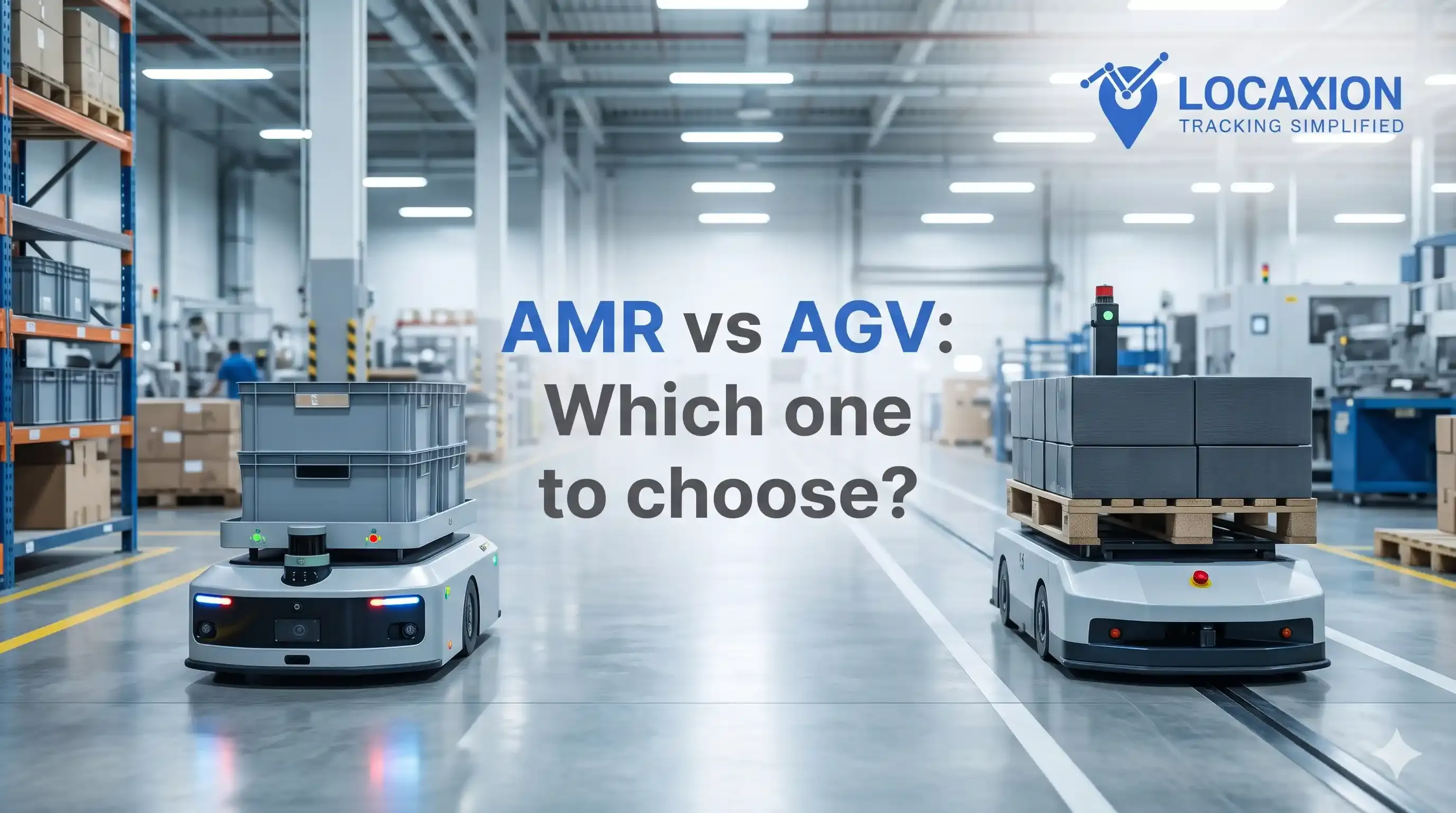
In this article, we are going to know about and delve deeper into AMR vs AGV. An Automated Guided Vehicle (AGV) generally follows a predefined route or guidance system, while an Autonomous Mobile Robot (AMR) uses onboard sensing and navigation software to understand its environment and adapt its path. AGVs can be a strong fit for stable, repeatable material routes. AMRs are often better suited to dynamic facilities where routes, obstacles and priorities change. The right choice depends on the workflow and not simply which vehicle is newer.
Quick answer: which one should you choose?
- Choose AGVs when material flows are predictable, routes are fixed and repeatability is the priority.
- Choose AMRs when layouts or traffic conditions change and vehicles need to navigate around obstacles.
- Consider a mixed fleet when some movements are fixed and others need flexible, point-to-point delivery.
- Use fleet tracking and a unified management layer when AGVs, AMRs, forklifts and people share the same operating space.
AMR vs AGV: A Quick Comparison
| Feature | AGV | AMR |
|---|---|---|
| Meaning | Automated Guided Vehicle | Autonomous Mobile Robot |
| Navigation | Typically follows fixed or predefined guidance, routes or markers | Uses sensors, mapping and onboard navigation to localize and plan routes |
| Route changes | Usually require route or infrastructure changes and validation | Can often re-plan routes in software when conditions change |
| Obstacle response | May stop when an obstacle blocks its path; behaviour depends on system design | Can detect obstacles and navigate around them when safe and permitted |
| Infrastructure | May use magnetic tape, wires, reflectors, QR codes or other guidance references | Often relies on LiDAR, cameras, depth sensors, maps and localization software |
| Best fit | Stable, repetitive material movement | Dynamic workflows and flexible point-to-point transport |
| Cost drivers | Vehicle, guidance infrastructure, installation and route changes | Vehicle, sensors, software, mapping, integration and fleet management |
Understanding AGV and AMR
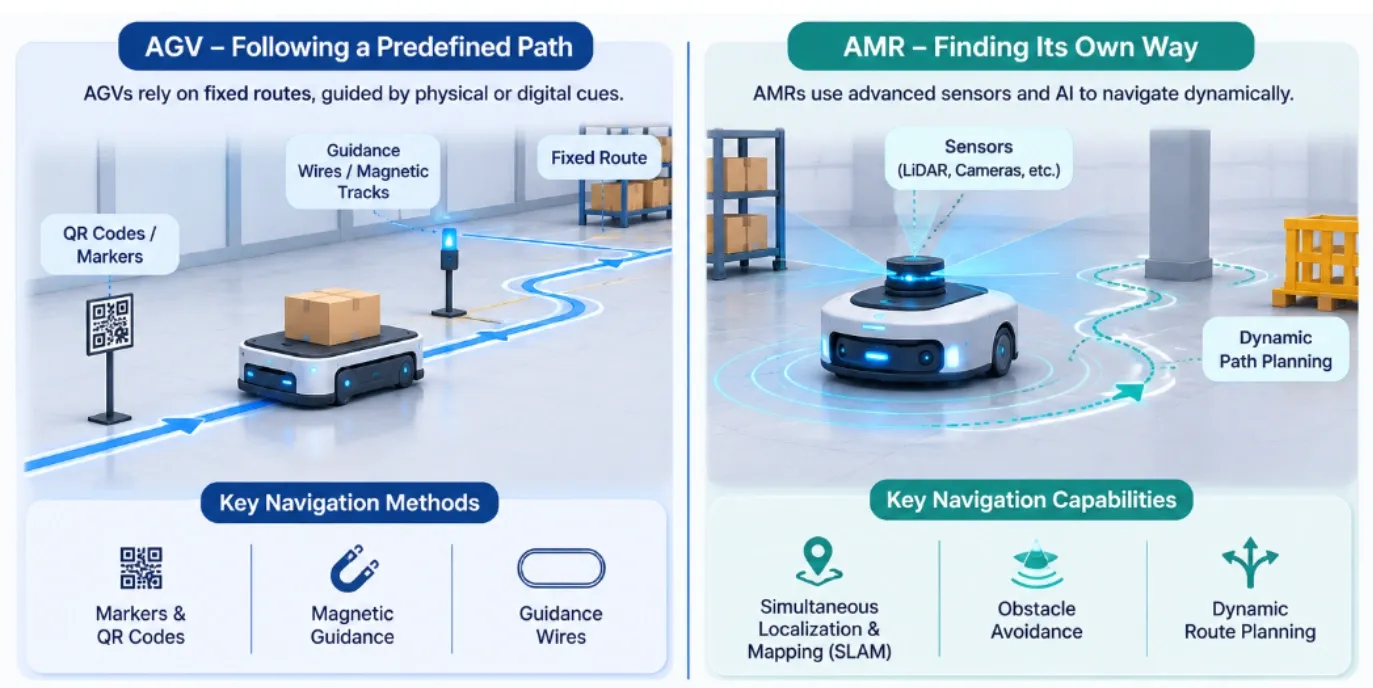
AGV stands for Automated Guided Vehicle. It is an industrial vehicle designed to transport materials without a human driver, usually by following a defined path or guidance reference. Depending on the installation, that guidance may come from magnetic tape, embedded wires, optical markers, QR codes, reflectors or other navigation infrastructure.
AMR stands for Autonomous Mobile Robot. An AMR is designed to perceive its surroundings, determine its position and plan movement through an environment. It commonly uses technologies such as LiDAR, cameras, depth sensors, maps and onboard computing. Instead of relying solely on a permanently defined path, it can often choose or recalculate a route within configured operating rules.
These are useful general definitions, not absolute boundaries. Modern AGVs may include more sophisticated navigation and safety features, while AMRs still operate within mapped areas, traffic rules and safety constraints. The specific vehicle architecture matters more than the label on a brochure.
How do AGVs and AMRs Navigate?
The practical AGV vs AMR distinction starts with how the vehicle knows where to go. An AGV is typically guided along a route established during system design. The route is reliable and repeatable, which makes it suitable for moving pallets, components or containers between known stations. However, a blocked route or a production layout change may require intervention, route reconfiguration or physical infrastructure work.
An AMR uses onboard perception and localization to understand its position relative to a map and nearby objects. It can plan a path to a destination and, where its software and safety configuration allow, adjust that path when an aisle is blocked or another vehicle is present. This flexibility can reduce the need to redesign physical routes every time operations change.
Neither approach removes the need for good facility planning. Aisle width, floor condition, load dimensions, traffic density, lifts, doors, charging points, pedestrian crossings and emergency procedures all affect performance. A pilot in the actual operating environment is more reliable than choosing from navigation specifications alone.
AGVs vs AMRs: Comparing their Flexibility, Safety and Performance
| Decision area | AGV considerations | AMR considerations |
|---|---|---|
| Layout flexibility | Strong in stable layouts; changes may require route updates or infrastructure work. | Often easier to adapt to changing routes through map and software updates. |
| Traffic and obstacles | May stop at an obstruction; coordinated traffic control is important. | May re-route around obstacles, subject to safe operating space and rules. |
| Repeatability | Predictable performance on established routes and hand-off points. | Flexible point-to-point missions; performance depends on mapping and traffic conditions. |
| Deployment planning | Plan guidance infrastructure, routes, stations and integration. | Plan maps, localization coverage, operating zones, traffic rules and integration. |
| Human interaction | Requires clearly marked shared routes and appropriate safety systems. | Requires equally rigorous pedestrian detection, speed control and safety validation. |
Safety should never be reduced to “AMRs are safer” or “AGVs are safer.” Both need risk assessment, safety-rated protective functions, emergency stops, controlled speeds, clear pedestrian interfaces and suitable operating procedures. A robot’s ability to re-route is not permission to move through an unsafe or unapproved area.
AGV vs AMR Price: What Drives the Total Cost?
There is no dependable universal price for an AGV or AMR. Cost varies with payload, dimensions, speed, battery capacity, duty cycle, navigation package, safety equipment, charging method, software licensing, fleet size, installation and service requirements. A low vehicle purchase price can become expensive if the facility needs extensive infrastructure or costly workflow changes.
- AGV cost components: vehicle hardware, route-guidance infrastructure, installation, commissioning, traffic controls, maintenance and the cost of modifying routes later.
- AMR cost components: vehicle hardware, sensors and compute, mapping and commissioning, fleet-management software, connectivity, integration, charging and ongoing support.
- Total cost of ownership: include utilization, labour impact, downtime, battery replacement, maintenance, software, expansion and the cost of operational disruption.
For a fair agv vs amr price comparison, calculate cost per completed movement or delivered load—not only cost per robot. Estimate how many trips the fleet completes per shift, how often it waits, how much manual handling it replaces and what happens when demand changes. A slightly more expensive system may deliver better value if it avoids infrastructure changes or improves vehicle utilization.
AMR and AGV: Exploring the Better Job-Fit for Your Needs
| Operating scenario | Potential fit | Why |
|---|---|---|
| Fixed production-line replenishment | AGV | Repeatable routes between known stations can make guided movement effective. |
| Dynamic warehouse picking support | AMR | Routes and priorities may change as orders, people and congestion change. |
| Pallet movement between fixed docks | AGV or AMR | Choose based on route stability, load type, traffic and required flexibility. |
| Mixed pedestrian and vehicle traffic | Either, with integrated safety and tracking | Visibility and coordinated traffic rules matter more than the vehicle label. |
| Frequent layout changes or temporary work zones | Often AMR | Map-based navigation may adapt more readily, subject to site validation. |
| Mixed manual and automated material handling | AGV + AMR + manual fleet | A unified fleet view can coordinate different vehicle types and people. |
A facility may not need to standardize on one vehicle type. A fixed, high-volume transfer lane may favour AGVs, while variable replenishment or point-to-point deliveries may suit AMRs. The key is to manage the complete material flow rather than optimize each robot in isolation.
From Robot Deployment to Fleet Intelligence
An AGV or AMR fleet manager coordinates missions and traffic for the vehicles it supports. But complex facilities also contain manual forklifts, tuggers, workers, work-in-progress (WIP), storage locations and production constraints. If each system sees only its own devices, supervisors may still lack a complete picture of what is happening across the floor.
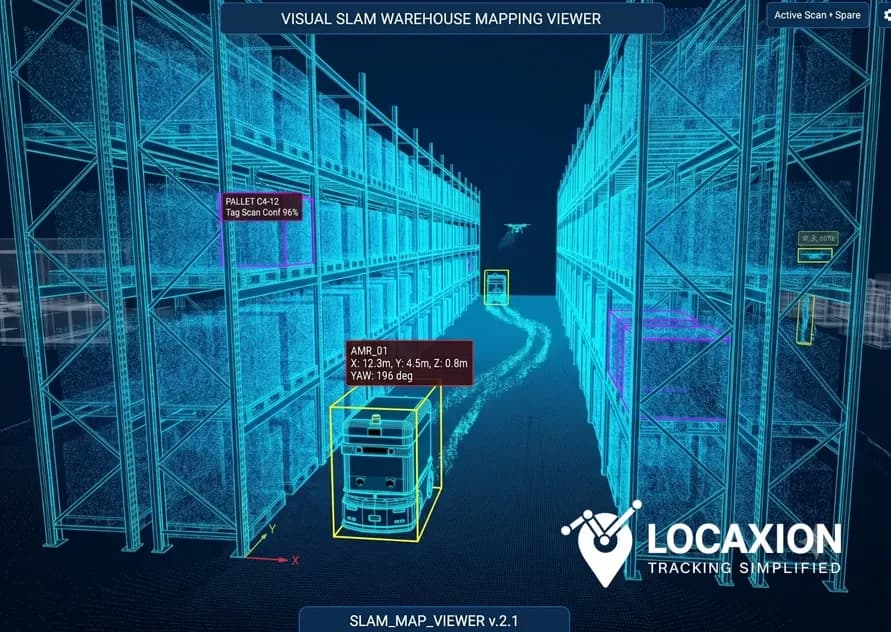
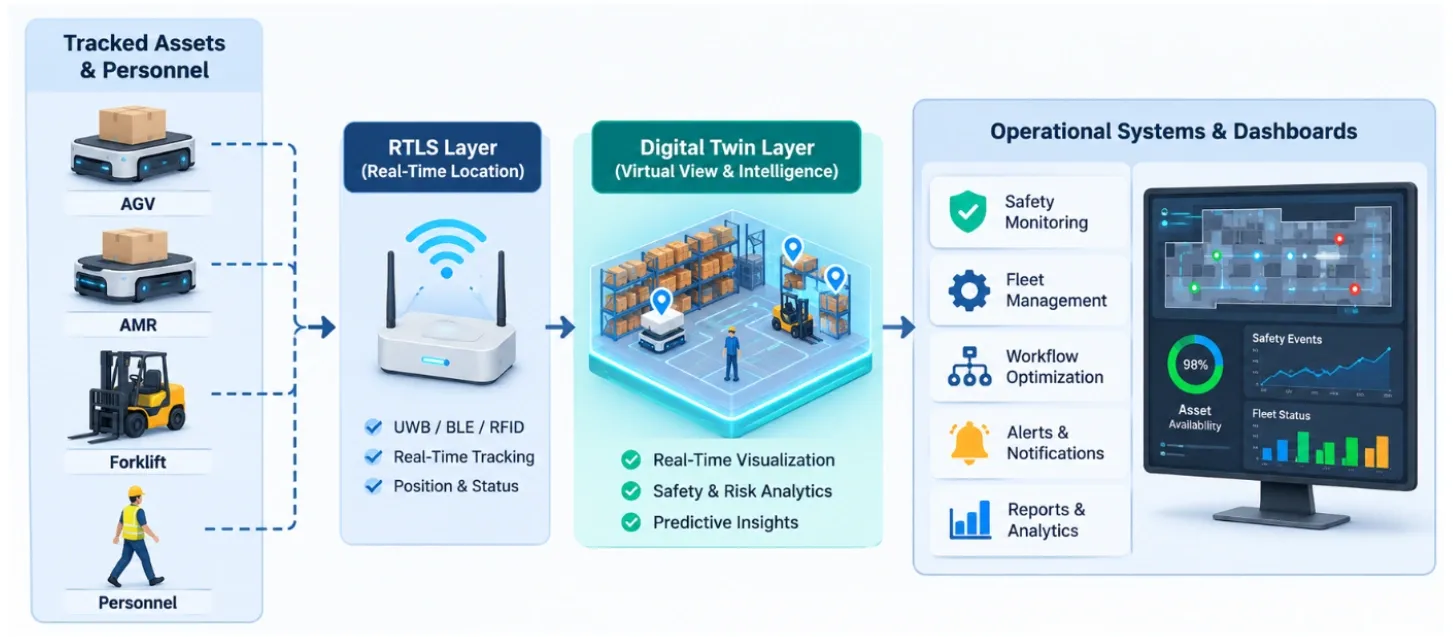
This is where fleet tracking and a reliable fleet tracker become important. RTLS can provide location data for vehicles, people and assets. Depending on the environment and accuracy requirement, the tracking design may combine UWB, BLE, Wi-Fi, SLAM, sensors or other technologies. The objective is not merely to display dots on a map; it is to make location data useful in operational decisions.
- Unified vehicle visibility: View AGVs, AMRs, forklifts and tuggers together rather than switching between disconnected systems. - People and vehicle safety: Support proximity alerts, geofencing and dynamic speed policies in shared zones. - Production-aware movement: Prioritize vehicles carrying critical WIP and identify routes affected by bottlenecks. - Utilization analysis: Identify idle time, congestion, empty travel and underused vehicles. - Operational history: Review movement patterns to support root-cause analysis and process improvement.
LocaXion’s AGV fleet management approach combines RTLS and digital twin technology to bring automated vehicles, human-driven vehicles and personnel into a common operational view. Its published solution describes capabilities such as unified vehicle tracking, personnel safety tracking, production-aware routing and collision warnings. These capabilities complement—not necessarily replace—the vehicle OEM’s own control and safety systems.
Role of RTLS and Digital Twins in Mixed Fleet Tracking
RTLS provides real-time location information. A digital twin adds operational context by connecting those positions to a model of the facility, its assets, processes and workflows. In a connected architecture, location events can be combined with production status and enterprise data, then presented through dashboards, analytics or operational applications.
For example, a digital twin can show where AGVs and AMRs are moving, where forklifts and pedestrians are located, and whether a production station is waiting for material. With historical movement data, teams can identify recurring congestion or unnecessary travel. Simulation can then help test a revised layout, traffic rule or fleet size before making the physical change.
LocaXion describes a layered RTLS digital twin approach: collect spatial data, fuse it with other operational information, model the facility and use analytics to support optimization. Integration with systems such as ERP, WMS and MES can connect vehicle movement to inventory, orders and production priorities. The result is a shift from simply tracking vehicles to understanding how material flow affects the wider operation.
Questions to Ask Before You Choose between AGV and AMR
- Are routes stable or frequently changing? Stable, repetitive routes may favour AGVs; changing workflows may benefit from AMRs.
- What payload and duty cycle are required? Validate load dimensions, centre of gravity, travel distance, speed, shifts and charging windows.
- How will people and manual vehicles share the floor? Define safety zones, right-of-way rules, crossings and visibility requirements.
- What must the fleet connect to? Confirm integration with WMS, MES, ERP, warehouse controls and the fleet-management layer before procurement.
Run a pilot on the most demanding route—not only in an empty demonstration area. Measure completed missions, delivery time, waiting, blocked routes, near misses, manual interventions, battery performance and system uptime. Agree on acceptance criteria before the pilot begins.
Frequently Asked Questions on AGV and AMRs
What is the main difference between AGV and AMR?
An AGV generally follows a predefined route or guidance system. An AMR uses onboard sensing, localization and navigation software to plan and, where permitted, adapt its route in response to the environment.
What does AGV stand for?
AGV stands for Automated Guided Vehicle. It is a driverless industrial vehicle used to move materials along guided or predefined routes.
What does AMR stand for?
AMR stands for Autonomous Mobile Robot. It is a mobile robot that uses sensors, maps and navigation software to move through an environment with a degree of autonomy.
Are AMRs always more expensive than AGVs?
Not necessarily. Pricing depends on payload, vehicle design, navigation, infrastructure, software, integration and support. Compare total cost of ownership and cost per completed movement rather than purchase price alone.
Can AGVs and AMRs work together?
Yes. Many facilities can use AGVs for stable, repeatable transfers and AMRs for flexible deliveries. A coordinated fleet-management and tracking layer helps provide visibility across both vehicle types and any manual fleet sharing the space.
What is fleet tracking for AGVs and AMRs?
Fleet tracking is the process of monitoring vehicle locations, movement, status and utilization. When LocaXion integrates their fleet tracking system to RTLS and operational systems, it can also help teams understand traffic, safety interactions and material-flow performance.
How does a Digital Twin help manage an AGV and AMR fleet?
LocaXion's Digital Twin combines live location and operational data with a model of the facility. It can help visualize movement, identify bottlenecks, analyze historical performance and test operational changes through simulation.
Conclusion
The practical answer to AVG vs AMR - what’s the difference is navigation flexibility. AGVs are often effective when routes and material flows are stable. AMRs are useful when movement needs to adapt to changing conditions. Neither is automatically the better investment: payload, facility design, safety, throughput, integration and total cost determine the right fit.
For many operations, the bigger opportunity is to connect AGVs and AMRs with forklifts, people, WIP and production systems. RTLS and digital twin integration can turn separate vehicle feeds into a shared operational picture—supporting safer movement, better fleet utilization and more informed planning. LocaXion helps organizations assess these requirements and design vendor-agnostic RTLS and digital twin integrations around measurable operational outcomes.
This guide is written from the perspective of LocaXion’s vendor-agnostic RTLS and digital twin integration approach. It compares navigation, flexibility, safety, cost and fleet visibility. The goal is to help operations teams select the right automation model and connect vehicle data to the wider facility. Explore LocaXion’s RTLS solutions, Digital Twin Approach and RTLS Digital Twin IoT Platform for the location-intelligence layer behind connected operations.