

- What is RTLS Asset Tracking & How Does It Work?
- How RTLS Differs from Traditional Asset Tracking Methods?
- How RTLS Asset Tracking Helps Businesses?
- Choosing the Right RTLS Technology for Asset Tracking
- RTLS System Selection: Key Questions to Evaluate Before Deployment
- Final Thoughts
- FAQs on RTLS Asset Tracking
In warehouses and manufacturing facilities, delays often occur because teams do not know where tools, equipment, or pallets are at the moment they are needed. Manual logs and periodic scans provide limited visibility, especially in large or fast-moving operations. RTLS asset tracking addresses this gap by providing continuous location data that helps teams find assets faster and keep them available when required.
What is RTLS Asset Tracking & How Does It Work?
RTLS asset tracking refers to the use of location-aware technologies to track and locate physical assets in real time within controlled operational environments. It gives teams visibility into where assets are, how they move through a facility, and how they are used, without relying on manual scans or periodic updates.
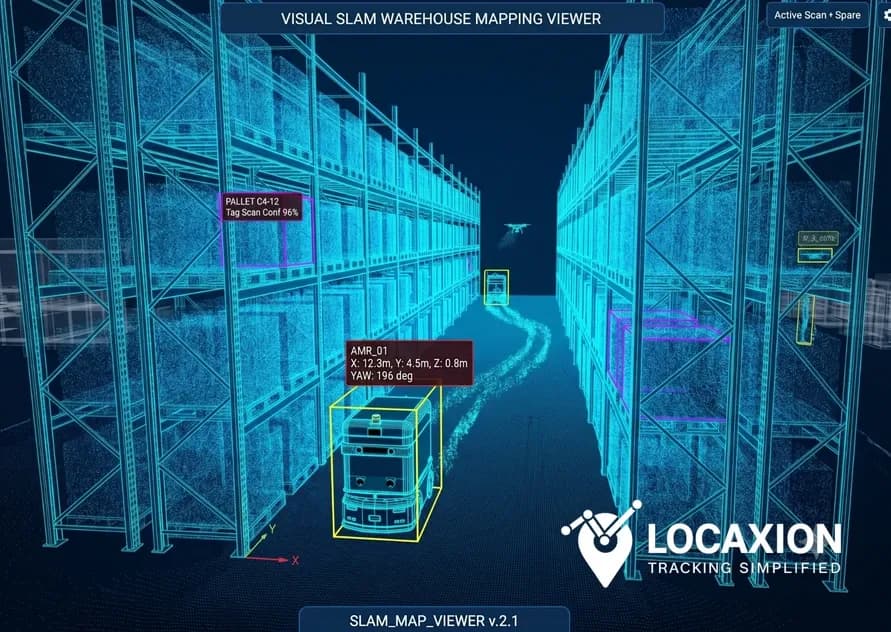
From an implementation standpoint, RTLS uses asset tags and fixed location infrastructure installed at known positions across a facility. As part of broader asset monitoring solutions, technologies such as UWB, BLE, Wi-Fi, RFID, and Infrared determine asset location by measuring signals exchanged between tags and the fixed infrastructure. RTLS software processes these signals to calculate asset position, with accuracy influenced by the technology used and the facility layout. This model supports RTLS for warehousing by enabling real-time asset tracking where asset availability and movement affect daily operations.
How RTLS Differs from Traditional Asset Tracking Methods?
Unlike traditional asset tracking methods that rely on barcode scanning, manual logs, or passive RFID systems, RTLS tracking solutions enable real-time asset tracking through continuous, automated location data without human intervention. Below are the key differences between RTLS asset tracking and traditional tracking methods:
| Feature | RTLS Asset Tracking | Traditional Asset Tracking |
|---|---|---|
| Tracking Type | Real-time, continuous | Periodic, manual updates |
| Technology Used | UWB asset tracking, BLE, RFID, Wi-Fi, IR | Barcode, spreadsheets, passive RFID |
| Accuracy | High (up to cm-level with UWB) | Low to moderate (dependent on manual entry) |
| Automation | Fully automated data capture | Requires human scanning or input |
| Scalability | Scalable across multiple locations | Requires manual infrastructure updates |
| Data Insights | Location history, asset utilization analytics, predictive maintenance with RTLS | Basic asset presence verification |
Also Read: BLE vs UWB Technology Comparison for RTLS Deployment
Traditional asset tracking often leads to inefficiencies, such as misplaced equipment, inventory discrepancies, and labor-intensive audits. In contrast, RTLS tracking solutions eliminate these inefficiencies by providing real-time asset visibility, automated tracking, and data-driven decision-making—helping businesses improve productivity, security, and operational efficiency in warehouses and other industries.
By implementing RTLS-based asset tracking, organizations can reduce asset retrieval times, minimize losses, optimize inventory management, and enhance overall workflow efficiency, making it a vital technology for industries like manufacturing asset monitoring, warehouse asset tracking, healthcare equipment tracking, and logistics asset management.
How RTLS Asset Tracking Helps Businesses?
In industrial environments, businesses need clear visibility into where assets are and how they are used to reduce losses and improve efficiency. RTLS asset tracking supports this by providing real-time visibility into asset location and movement, helping teams identify delays, reduce bottlenecks, and make informed operational decisions.
Below are the key ways RTLS tracking solutions benefit B2B enterprises across manufacturing asset monitoring, warehouse asset tracking, healthcare equipment tracking, and logistics asset management.
1. Enhancing Asset Visibility & Utilization
RTLS tracking solutions provide businesses with location visibility for assets, tools, equipment, and inventory across manufacturing floors, warehouses, and distribution centers. Unlike traditional methods that rely on periodic scans or manual records, RTLS enables teams to track and locate assets without delays, reducing search time and asset idle periods.
- Optimized asset usage: Identifying underutilized or misplaced assets allows better resource allocation.
- Faster asset retrieval: Employees spend less time searching for tools, machinery, or inventory.
- Reduced equipment downtime: Asset usage data supports maintenance planning based on actual wear.\For industries with time-sensitive operations, such as automotive manufacturing or healthcare, real-time asset visibility ensures seamless workflows, reducing unnecessary delays.
2. Reducing Asset Loss, Theft, and Misplacement
Asset monitoring solutions mitigate asset loss, misplacement, and theft by enabling geofencing, automated alerts, and real-time visibility into asset movement.
- Unauthorized movement alerts: Notifications flag asset movement outside defined or restricted zones.
- Location history tracking: Movement records help teams identify where assets were last recorded.
- Geofencing controls: Defined zones limit accidental removal or misrouting of assets.
For example, in warehouse asset tracking and logistics asset management, RTLS helps reduce pallet misplacement and unauthorized inventory movement, limiting downstream inefficiencies. In healthcare equipment tracking, it supports the availability of critical medical devices when they are needed.
3. Improving Operational Efficiency with Automated Tracking
Traditional asset tracking methods require manual intervention, often leading to errors and inefficiencies. RTLS-based asset tracking automates tracking, significantly improving operational efficiency in warehouses, manufacturing asset monitoring, and logistics asset management.
- Automated inventory visibility: Asset locations update without manual checks.
- System integration: RTLS data can integrate with ERP, WMS, and MES systems.
- Lower administrative effort: Reduced manual tracking decreases operational workload.
For organizations managing large facilities, this supports more consistent execution and fewer process interruptions.
4. Using Real-Time Data Insights to Support Decisions
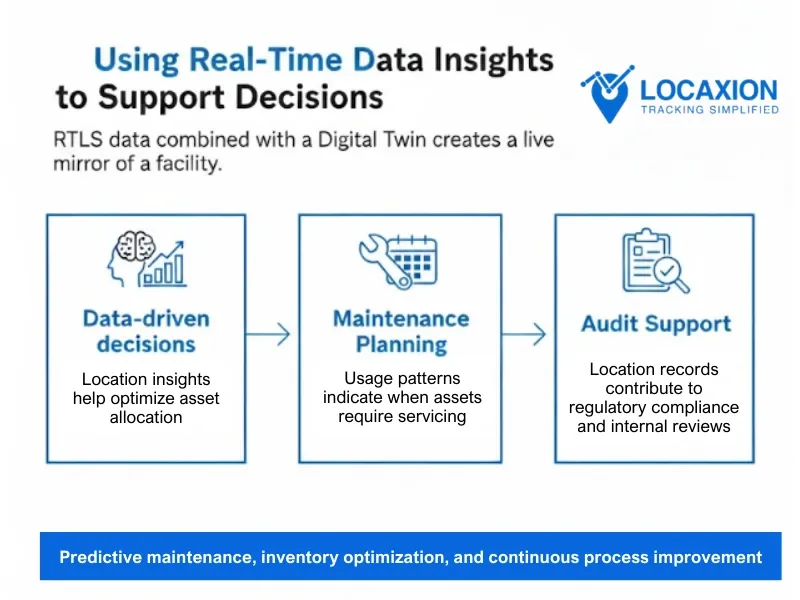
One of the key advantages of RTLS-based asset tracking is its ability to collect and analyze real-time asset data. When combined with a Digital Twin, this data creates a live mirror of the facility, helping teams support predictive maintenance, inventory optimization, and continuous process improvement.
- Data-driven decisions: Location insights help optimize asset allocation.
- Maintenance planning: Usage patterns indicate when assets require servicing.
- Audit support: Location records contribute to regulatory compliance and internal reviews.
For example, manufacturers can monitor production efficiency by analyzing asset movement trends, while logistics providers can optimize fleet and warehouse operations by leveraging real-time asset visibility insights.
By implementing RTLS-based asset tracking, businesses gain a competitive edge through enhanced efficiency, improved asset utilization, and automated workflows. Whether optimizing inventory management, securing high-value assets, or driving predictive maintenance with RTLS, RTLS tracking solutions deliver tangible ROI for modern B2B enterprises.
Choosing the Right RTLS Technology for Asset Tracking
Selecting the right RTLS technology depends on factors such as facility layout, asset density, accuracy requirements, and reporting needs. The goal is to choose an approach that helps teams track and locate assets reliably while aligning with operational constraints and data needs. The table below compares common RTLS technology options.
| RTLS Technology Type | How It Works | Key Advantages | Key Limitations | Best-Suited Environments |
|---|---|---|---|---|
| Infrastructure-Based RTLS (UWB, BLE) | Fixed anchors or gateways calculate asset location | High positional accuracy; supports safety and inventory visibility; suitable for Digital Twin modeling | Higher setup effort due to infrastructure deployment | Complex indoor facilities requiring precise location data |
| Non-Infrastructure Ranging (TWR) | Direct ranging between devices with minimal infrastructure | Lower setup cost; simpler deployment | Reduced effectiveness in obstructed layouts | Open-layout facilities with fewer physical barriers |
| Vision-Based Tracking (Camera, LiDAR) | Visual detection using cameras or LiDAR | Strong contextual awareness; supports safety and collision detection | Sensitive to lighting and environmental conditions | Areas requiring visual context |
| Indoor–Outdoor Hybrid Tracking | Combines indoor RTLS (UWB or BLE) with outdoor GPS/RTK | End-to-end visibility; flexible technology mix | Lower outdoor accuracy compared to indoor RTLS | Operations spanning warehouses, yards, and outdoor staging areas |
RTLS System Selection: Key Questions to Evaluate Before Deployment
Before selecting an RTLS system, teams should step back and assess how location data will be used across daily operations, not just how the technology performs in isolation. These questions help clarify operational priorities, environmental constraints, and future requirements so the chosen approach supports effective asset tracking and management across real-world workflows.
Key areas to review during early RTLS evaluation include:
- Primary objectives: Safety, productivity, or a combination of both
- Future scope: Whether RTLS asset tracking is the starting point or part of a broader roadmap
- Facility environment: Obstructions, dust, or harsh operating conditions
- Scalability: Ability of the RTLS system to grow with the facility
- System integration: Alignment with existing WMS, MES, and safety systems.
Final Thoughts
RTLS asset tracking is transforming how industrial facilities manage high-value assets. By providing real-time visibility and optimizing utilization, it has become a baseline requirement for maintaining operational consistency and control. Whether the focus is on inventory tracking, equipment management, or worker safety, a robust asset tracking and management strategy eliminates the “lost time” that drains profit margins.
In high-pressure environments, the difference between efficiency and chaos is visibility. Transitioning to an RTLS + Digital Twin framework allows you to stabilize production flow and establish execution-aware evidence across your entire facility. To determine the most effective scale and technology mix for your specific environment, collaborate with LocaXion to define a deployment roadmap tailored to your operational needs.
FAQs on RTLS Asset Tracking
How do asset tracking systems work?
These systems utilize a network of tags and sensors to automate data collection, providing a live digital record of physical operations. By centralizing this data in a software dashboard, organizations improve their asset tracking and management by replacing manual logs with automated updates.
What technology is used for asset tracking?
Most industrial facilities deploy a mix of UWB, BLE, RFID, or vision-based systems to capture location data. These are often integrated into an asset management RTLS to provide consistent location visibility across complex environments.
What are the benefits of asset tracking?
The primary advantages include reduced search time, minimized asset loss, and better equipment utilization. Organizations see the most value when they leverage real time asset tracking to make timely operational adjustments on the floor.
How accurate is asset tracking technology?
Accuracy depends on the hardware choice and infrastructure density, ranging from room-level presence to centimeter-level precision. This level of detail is critical for warehouse asset tracking, where knowing the exact shelf or bay location of a pallet can save hours of labor daily.
How to implement real-time asset tracking in warehouses?
Successful deployment starts with defining clear use cases, such as tool tracking or inventory flow, before selecting a technology. A phased asset management tracking approach helps ensure the system integrates with existing WMS or ERP systems and supports long-term scalability.
How does RTLS improve asset management in logistics operations?
RTLS provides a continuous audit trail of asset dwell times and handoff points, helping reduce bottlenecks in high-velocity hubs. This use of rtls for logistics helps ensure that trailers, containers, and high-value shipments move through facilities without visibility gaps.