

- Understanding BLE Technology and Its Role in RTLS
- Advantages of BLE in RTLS
- Applications of BLE-based RTLS: Beyond Simple Tracking
- Technical Implementation: How BLE RTLS Works?
- Challenges and Limitations of BLE-based RTLS
- Security and Privacy Considerations: Protecting Your Data
- Future Trends and Innovations: What’s Next for BLE?
- BLE Asset Tracking as an Operational Layer
- When to Choose Bluetooth Tracking Over Other Technologies?
- Conclusion: Applying BLE Where It Fits Best
- FAQs on BLE Technology
In today’s data-centric operating environment, real-time visibility of assets and personnel is no longer optional. It is a practical requirement for maintaining control across logistics, manufacturing, and large facilities. Bluetooth Low Energy (BLE) technology has become a widely used option within Real-Time Location Systems (RTLS), offering a balance of efficiency, affordability, and deployment flexibility.
Let’s dive into how BLE is transforming industries and why it is the right choice for your asset tracking needs.
Understanding BLE Technology and Its Role in RTLS
Bluetooth Low Energy (BLE), introduced with the Bluetooth 4.0 specification, is a wireless communication protocol designed to support low-power communication for battery-operated devices over extended periods. Its energy-efficient design and simple deployment model have made it a practical choice across IoT environments.
Unlike classic Bluetooth, BLE is optimized for short, periodic data transmissions rather than continuous connectivity. This makes it well suited for BLE RTLS and asset tracking scenarios, where devices only need to broadcast location or status information at intervals instead of maintaining constant connections.
Advantages of BLE in RTLS
BLE technology has gained massive traction by solving the historical trade-off between battery life and data accuracy. Below, we explore the specific advantages of BLE in RTLS that allow businesses to track assets without breaking the budget.
-
Low Power Consumption: BLE devices can operate for extended periods, often years, on small batteries. This makes BLE well suited for RTLS deployments where frequent battery replacement is not practical.
-
Cost-Effectiveness: The maturity of the BLE ecosystem has lowered the cost of tags and infrastructure, making Bluetooth asset tracking systems accessible to organizations of all sizes.
-
Scalability and Flexibility: BLE technology supports different deployment models, from simple proximity detection to larger Bluetooth RTLS networks, allowing systems to scale as operational needs grow.
-
Seamless Indoor and Outdoor Mapping: BLE location tracking can support asset movement across indoor and semi-outdoor environments.
Applications of BLE-based RTLS: Beyond Simple Tracking
BLE technology is reshaping how assets and people are tracked across diverse industries:
-
Asset Tracking: BLE asset tracking is commonly used in healthcare, logistics, and manufacturing to monitor equipment, inventory, and transport carts
-
Personnel Tracking: BLE helps improve safety and coordination in large facilities or hazardous environments.
-
Indoor Navigation: BLE enables navigation and wayfinding in complex spaces such as hospitals, airports, and commercial buildings.
-
Inventory Control: Bluetooth asset tracking improves visibility into pallets, crates, and containers, reducing manual checks and inventory errors.
-
Condition Monitoring: BLE sensors can transmit location along with environmental data such as temperature, humidity, or open and closed status.
-
Cargo Monitoring: Attach BLE tags to cargo to track shipments in real time, providing location and condition information for perishable or sensitive goods on the road.
-
Increase Asset Utilization: Movement data from BLE tracking helps teams understand usage patterns and availability to improve operational efficiency.
Technical Implementation: How BLE RTLS Works?
A typical BLE RTLS deployment is built around a small number of core components.
-
BLE Beacons and Tags: These small devices attach to assets and transmit signals at regular intervals. There are a variety of third-party Bluetooth tags in various shapes and sizes that typically offer multi-year battery life with configurable update rates.
-
Receivers or Gateways: Positioned strategically, these capture BLE signals from beacons and tags, relaying the data to a central system.
-
Data Processing: Location is calculated using received signal data and made available through APIs or asset management platforms. Most systems support standard formats such as iBeacon and Eddystone, alongside proprietary frames. The Bluetooth low energy data transfer rate is optimized for small, frequent data packets rather than high-bandwidth communication.
Comparative Analysis of BLE with Other RTLS Technologies
| Technology | Accuracy | Cost | Power Consumption | Range | Ideal For |
|---|---|---|---|---|---|
| BLE | Medium | Low | Very Low | Up to 100m | Wide-area asset tracking, indoor navigation |
| UWB | High | High | Medium | Up to 150m | High-precision tracking, environments requiring accuracy |
| Wi-Fi | Low | Medium | High | Up to 50m | Leveraging existing infrastructure for basic tracking |
| RFID | Low | Low | Very Low | Up to 10m | Short-range identification, access control |
Also Read: BLE vs UWB Technology Comparison for RTLS Deployment
Challenges and Limitations of BLE-based RTLS
While BLE offers numerous benefits, it’s important to acknowledge its limitations:
-
Signal Interference: Physical obstacles, metal structures, and radio interference can affect signal stability, which may impact BLE location tracking accuracy.
-
Limited Accuracy: Compared to high-precision technologies such as Ultra-Wideband (UWB), BLE typically provides accuracy within a few meters, making it less suitable for workflows that require exact positioning.
-
Range Limitations: BLE can cover moderate areas effectively, but very large outdoor environments may require additional infrastructure or complementary technologies to maintain reliable BLE tracking coverage.
**Security and Privacy Considerations: Protecting Your Data **
Security remains a critical consideration in any Bluetooth Low Energy technology deployment.
-
Encryption: AES-128 bit encryption protects data transmission, ensuring confidentiality.
-
Privacy Measures: Features like MAC address randomization safeguard user privacy, preventing unauthorized tracking.
Future Trends and Innovations: What’s Next for BLE?
The future of BLE technology in RTLS is shaped by steady, practical improvements rather than radical shifts. As adoption grows across industrial IoT environments, BLE continues to evolve as a reliable foundation for scalable deployments.
-
Integration with IoT and AI: BLE is poised to play a central role in smart cities, Industry 4.0 initiatives, and predictive maintenance applications.
-
Improved Location Accuracy: Ongoing advancements aim to enhance location precision through techniques like angle-of-arrival (AoA) and angle-of-departure (AoD).
-
Extended Range: Ongoing updates to the Bluetooth standard are improving range and signal stability, expanding the viability of BLE tracking across larger operational environments
BLE Asset Tracking as an Operational Layer
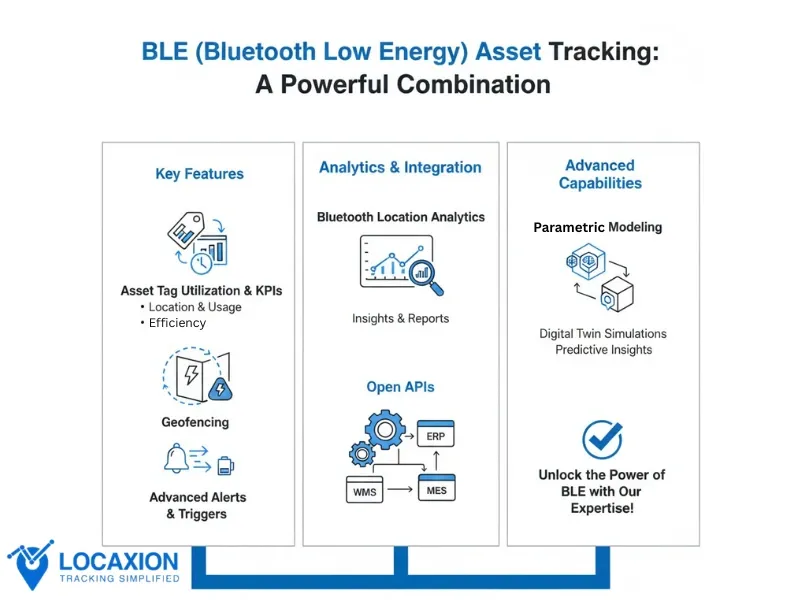
A Bluetooth Low Energy based asset tracking solution typically combines real-time location visibility with advanced management capabilities, including:
-
Asset Tag Utilization and KPIs: Tracks asset usage, location, dwell-time, and other key performance indicators (KPIs) to optimize resource management and efficiency.
-
Geofencing: Creates virtual boundaries to trigger alerts or actions when assets enter or leave predefined zones.
-
Bluetooth Location Analytics and Reporting: Analyzes location data to provide insights into asset movement, usage patterns, and operational efficiency with detailed reports.
-
Advanced Alerts and Triggers: Configurable alerts notify users of specific events, such as unauthorized movement, low battery, or geofence breaches.
-
Open APIs: The system allows for easy integration with your ERP, WMS, or other systems.
-
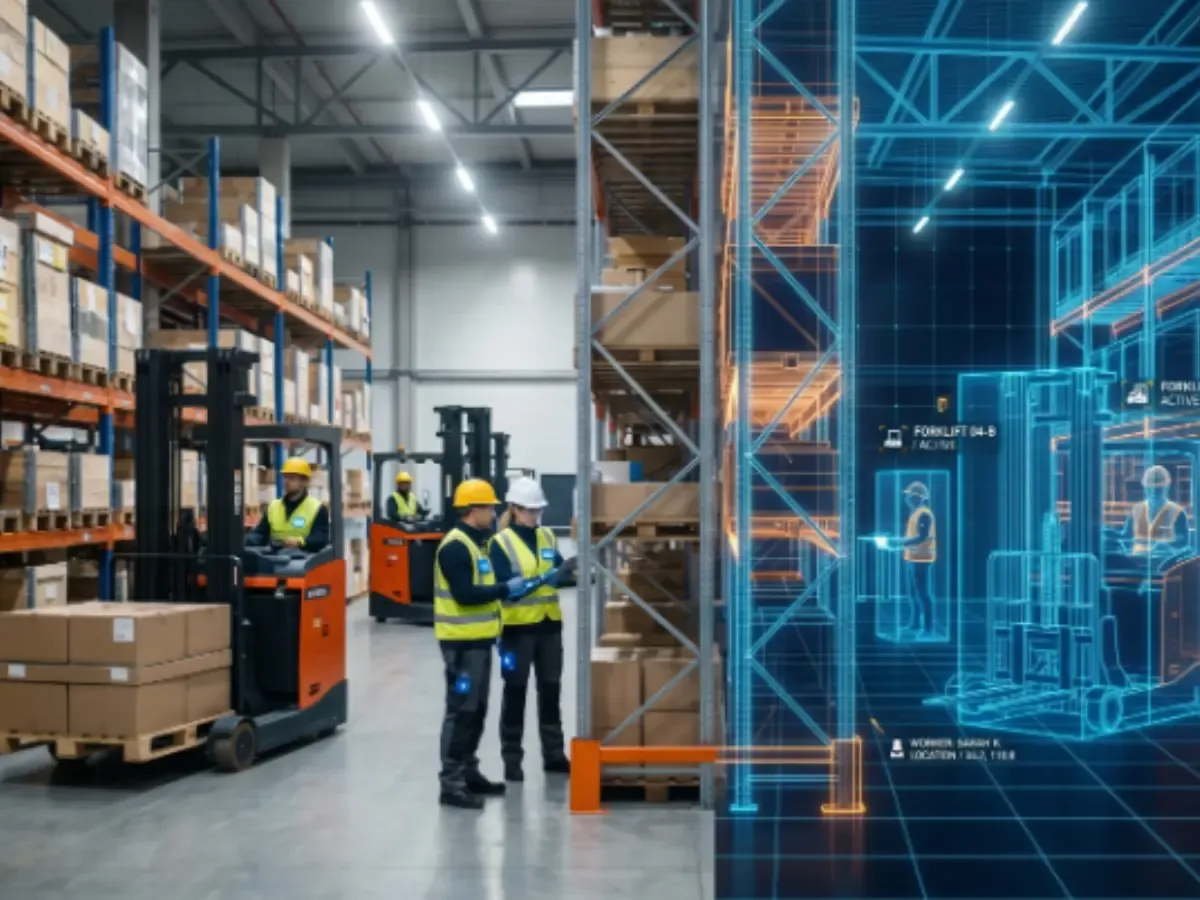
Digital Twin Enablement: Location and movement data from RTLS deployments can feed Digital Twin models to simulate asset flow and support predictive insights as operating conditions change.
When to Choose Bluetooth Tracking Over Other Technologies?
Compared to other tracking technologies like RFID, GPS, and NFC, Bluetooth offers a balance between range, cost, and energy efficiency. While GPS provides global tracking and RFID can be very accurate over short distances, Bluetooth is ideal for medium-range, medium accuracy tracking. With Bluetooth indoor location tracking, the typical accuracy is around 5-10m. If better accuracy is required, ultra-wideband technology is recommended, which has a positioning accuracy of about 10cm.
Conclusion: Applying BLE Where It Fits Best
Bluetooth Low Energy technology has become a practical option for Real-Time Location Systems, particularly where long battery life and simple deployment are important. One of the key advantages of BLE in IoT is its ability to support reliable asset and personnel visibility without adding unnecessary infrastructure or operational overhead.
For many organizations, Bluetooth asset tracking provides a straightforward way to improve day-to-day workflows and maintain better control over physical assets. When applied thoughtfully, BLE-based tracking allows teams to start small, validate value, and scale only where it makes sense.
Unlock the Power of BLE with Our Expertise!
Looking to apply Bluetooth Low Energy to your RTLS use case? LocaXion works with organizations to design, implement, and optimize BLE solutions that fit real operational needs. If you’re evaluating how BLE can improve visibility or efficiency in your environment, we can help clarify the right next steps.
FAQs on BLE Technology
What is Bluetooth Low Energy (BLE)?
BLE is a wireless communication standard designed for short-range data exchange with very low power consumption. It is commonly used in IoT and tracking applications where devices need long battery life.
How does BLE differ from classic Bluetooth?
BLE is designed for low power consumption and short, periodic data transmissions, making it suitable for devices that run on small batteries for long periods. Classic Bluetooth is built for continuous, high-bandwidth connections such as audio streaming, which require more power and constant connectivity.
What are the typical use cases for BLE?
BLE is commonly used in asset tracking, wearables, healthcare devices, smart buildings, and other IoT applications where low power usage and reliable short-range communication are required.
What are the range and data rate of BLE?
BLE typically supports a range of up to 100 meters, depending on the environment, and offers a maximum data rate of 2 Mbps, which is sufficient for signaling and tracking use cases.
How secure is BLE for tracking applications?
BLE includes encryption, secure pairing, and bonding to protect data during transmission. When implemented correctly, BLE is suitable for tracking and monitoring use cases where controlled access and data protection are required.
How does BLE achieve low power consumption?
BLE conserves power by transmitting small data packets and keeping devices in sleep mode when they are not actively communicating.
What is a BLE beacon?
A BLE beacon is a device that broadcasts a signal at regular intervals, allowing other BLE enabled devices to detect its presence and perform actions, such as location-based notifications.