
- What is Location Intelligence and Why It Matters in Manufacturing?
- BMW’s Digital Twin: A Revolutionary Milestone
- How Google’s Location Model Inspires Manufacturing?
- Key Benefits of Location Intelligence in Manufacturing
- Should You Consider Location Intelligence Strategy: Competitive Stakes are High
- Cultural and Technological Transformation: The Shift to Data-Driven Manufacturing
- Conclusion
What is Location Intelligence and Why It Matters in Manufacturing?
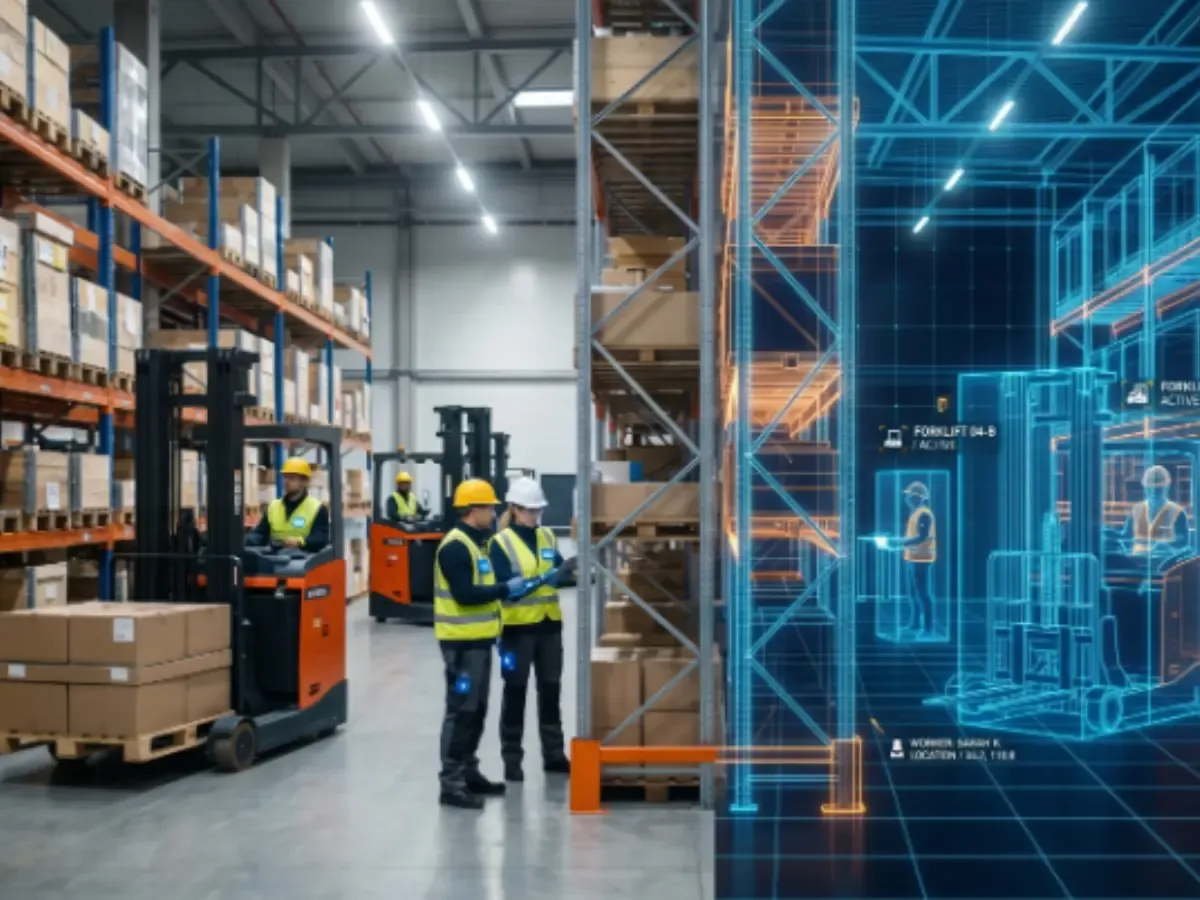
What is location intelligence? Location Intelligence (LI) refers to the use of geospatial data—combined with other technologies like RTLS (Real-Time Location Systems), GPS, RFID, and IoT sensors—to gain real-time visibility into the movement and position of staff, equipment, and assets. Understanding what location intelligence is means recognizing it as a suite of location intelligence technologies that together enable smarter, data-driven operations.
Location intelligence technologies have become central enablers of smart manufacturing, delivering unprecedented visibility, traceability, and operational efficiency. Real time location intelligence is no longer the domain of futurists—it is fast becoming a competitive necessity for manufacturers across every sector of the location industry.
Manufacturers that deploy location intelligence software can optimize their supply chains end to end, minimize downtime, maximize asset utilization, and proactively ensure worker safety. Location intelligence for supply chain management, in particular, has emerged as one of the highest-ROI applications, helping teams eliminate costly blind spots between suppliers, production floors, and distribution networks.
BMW’s Digital Twin: A Revolutionary Milestone
Over the past 15 years, a quiet revolution has unfolded in manufacturing. In the mid-2000s, BMW pioneered digital tool tethering at its Regensburg and Munich plants, using Real-Time Location Systems (RTLS) to track tools and parts with pinpoint accuracy, deploying one of the earliest full-scale live digital twins. Today, all of the world’s top 10 automotive assembly and top 3 aerospace facilities have integrated RTLS to improve compliance, margins, traceability, productivity, and quality.
RTLS is no longer a tool for early adopters— it is a foundational layer of the modern location industry. . Industry analysts, including Gartner RTLS researchers, consistently rank real-time location as a top priority for industrial digital transformation. As industry leaders like Apple introduce consumer-grade RTLS (e.g., AirTags), manufacturers and supply chain executives must recognize that failing to implement a comprehensive Location Intelligence framework within the next 3–5 years could leave them struggling—similar to companies that hesitated to adopt Wi-Fi in the early 2000s.
How Google’s Location Model Inspires Manufacturing?
- Basic tracking pilots may solve one problem but fail to scale to mission-critical real time location intelligence applications like forklift dynamic navigation, robotic process automation (RPA), or enterprise-wide demand sensing.
- Enterprise-wide location intelligence for supply chain and production can be transformative, but digitalization leaders must assess if the transformative value of real-time location data across functions applies to their business. Strategic Imperative: Building a Location Intelligence Infrastructure
A fragmented collection of single-use tracking pilots may address immediate pain points—such as locating misplaced pallets—but Industry 4.0 demands a holistic approach. Manufacturers must treat location intelligence software not as a point solution but as a foundational element of their digital transformation strategy.
The right location intelligence software unifies location intelligence data from the shop floor, supply chain, and workforce into a single operational picture—enabling decisions at a speed and precision that disconnected systems simply cannot match.
Key Benefits of Location Intelligence in Manufacturing
-
Hyper-Optimize Production – Track Work-In-Process (WIP) at every stage using real time location intelligence and dynamically adjust workloads. Real-time bottleneck identification powered by location-based insights improves efficiency and reduces downtime.
-
Elevate Quality & Safety – Location data intelligence enables proactive risk management by correlating worker movements with quality control and near-miss incidents.
-
Drive RPA & Autonomous Systems – RTLS facilitates seamless operation of AGVs, robotics, and other automation technologies with minimal human intervention.
-
Empower Innovation – Manufacturers can leverage RTLS for AI-driven workflows, predictive analytics, and immersive training environments.
-
Intent-Based Maintenance – Instead of adhering to static maintenance schedules, manufacturers can prioritize servicing based on actual equipment utilization—reducing unplanned downtime. Explore how RTLS improves Employee Safety Tracking.
Should You Consider Location Intelligence Strategy: Competitive Stakes are High
Financial and Operational Impact of Location Intelligence
Understanding the financial implications of RTLS adoption—or its absence—is critical for long-term operational competitiveness. Several studies provide insights into how tracking technologies impact cost structures and efficiency:
- Impact on Profit Margins – A 2023 Deloitte study found that companies effectively utilizing location intelligence data experienced a 3–5% increase in gross margins, largely due to reduced downtime and improved asset utilization. A Manufacturing Leadership Council survey found that factories with real-time tracking reduced excess inventory costs by 7–12% by improving supply chain transparency through location intelligence for supply chain management.
- Labor and Search Time Inefficiencies – A McKinsey & Company analysis found that inadequate location based insights lead to a 15–20% increase in labor costs due to extended search times. Workers spend an estimated 30–50 hours per month searching for misplaced tools and materials—a figure that compounds rapidly in large-scale facilities.
- Capital Expenditure Risks – Without real-time asset visibility, companies often overspend by 8–10% on redundant equipment and excess inventory. This over-purchasing results from inaccurate utilization data, leading to unnecessary capital allocations that could otherwise be reinvested in innovation and automation. Check out our solutions for Manufacturing Process Optimization.
- Regulatory and Compliance Impacts – Manufacturers operating in highly regulated industries, such as pharmaceuticals and aerospace, risk substantial non-compliance penalties if they lack proper tracking mechanisms. RTLS provides the necessary audit trails to meet industry standards, reducing potential fines by up to 40%.
Cultural and Technological Transformation: The Shift to Data-Driven Manufacturing
Real time location intelligence is not just a technology upgrade—it represents a fundamental shift toward a data-driven, automated, and predictive approach to operations. The impact extends from the shop floor into workforce culture, safety, and innovation:
-
Workforce Productivity & Decision-Making – BCG found that manufacturers utilizing location based insights saw a 15–30% increase in productivity through better workflow optimization. Decision-makers had 24% faster response times when managing operational disruptions.
-
Safety & Risk Mitigation – Companies implementing location intelligence technologies for worker tracking reduced workplace incidents by 20–25%, particularly in high-risk automotive and heavy machinery environments. AI-driven geofencing prevents unauthorized personnel from entering restricted zones.
-
Predictive Maintenance & Equipment Utilization – Integrating location intelligence data with AI-driven predictive maintenance systems has led to a 30–50% reduction in unplanned downtime, per PwC’s Industry 4.0 Benchmark Report. Intent-based servicing, driven by real time location intelligence, extends asset longevity and reduces unexpected failures.
-
Scalability & Digital Twin Integration – Leading manufacturers have begun incorporating location intelligence software into digital twin models, enabling real-time operational simulation. Gartner predicts that by 2027, over 60% of global manufacturers will leverage digital twins alongside location intelligence technologies to improve forecasting and resource allocation.
LocaXion’s Signature 5-Step Maturity Model
| Maturity Level | Definition | Key Answers | Key Characteristics |
|---|---|---|---|
| Level 1: Visibility | Basic visibility of assets, equipment, people on the plant floor | What is happening? | Tagged or Tag-less Tracking of Raw Material, WIP, Finished Goods to eliminate ‘searching’ |
| Level 2: Analytics | Sub-meter accuracy, sub-second granularity data collection from all operationally significant movements on the plant floor | Why is it happening? | Granular, real-time reporting of: Live WIP inventory, Dwell time, Process step-time, Repair-rework-loops, station-asset-labor utilization rates |
| Level 3: Optimization | Connecting RTLS with enterprise systems | Make it happen less! | Dynamic workload balancing, live capacity-inventory-lead time driven pricing – automated workflows, real-time feedback loops |
| Level 4: AI-ready | AI-driven analytics & predictive insights | Fix it before it happens! | Automated decision making with human supervision, intent based maintenance |
| Level 5: Enterprise Scale | Global standardization across all sites | Fix it like I like it! | Synchronizing the supply chain, production, and demand in real-time |
Conclusion
As manufacturing leaders navigate the complexities of Industry 4.0, the question is no longer about whether location intelligence will play a role—it already does. The challenge lies in how organizations choose to leverage it. Should they take incremental steps with limited-use tracking solutions, or embrace a comprehensive framework that transforms their entire operational strategy?
For executives responsible for long-term innovation and digitalization, the decision goes beyond technology adoption. It is about defining the company’s vision for efficiency, automation, and competitiveness in a rapidly evolving industrial landscape. What priorities will shape your roadmap for the next decade?