
What is Indoor Positioning?
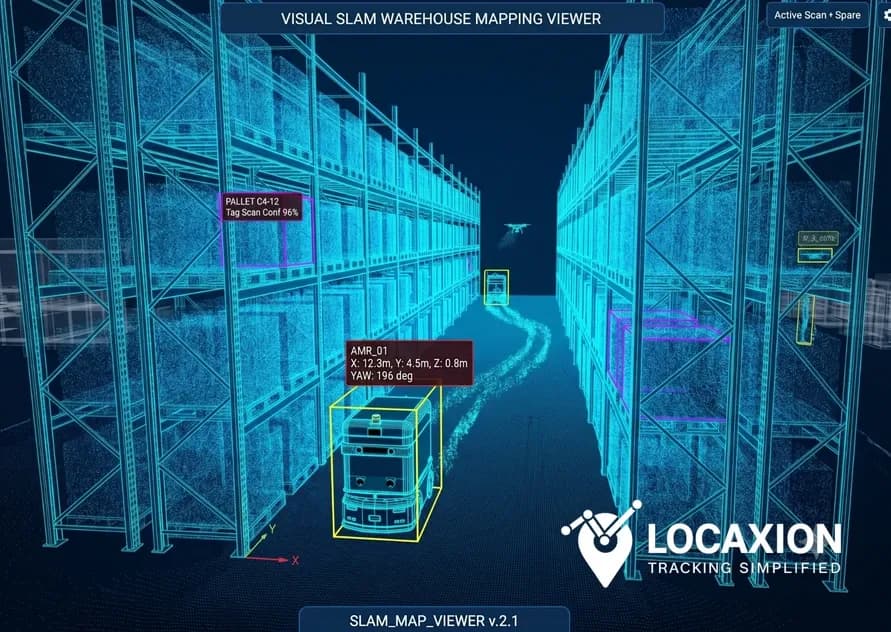
Indoor positioning is the core function of RTLS systems. Several techniques are employed to calculate the precise location of tagged assets or people within a defined area. As organizations continue to adopt automation and digital transformation, accurately locating people, equipment, and assets inside buildings has become increasingly important. Indoor positioning technologies form the foundation of every indoor positioning system, enabling businesses to determine precise indoor locations where GPS signals are unreliable or unavailable.
From manufacturing plants and warehouses to hospitals and airports, these technologies power modern RTLS platforms, improve operational visibility, and support smarter decision-making. Understanding how different indoor positioning techniques work can help organizations choose the right solution based on their accuracy, infrastructure, and business requirements.
Different Indoor Positioning Techniques
Different indoor positioning technologies use different methods to calculate location. Each technique offers unique advantages depending on the environment, infrastructure, and required level of accuracy.
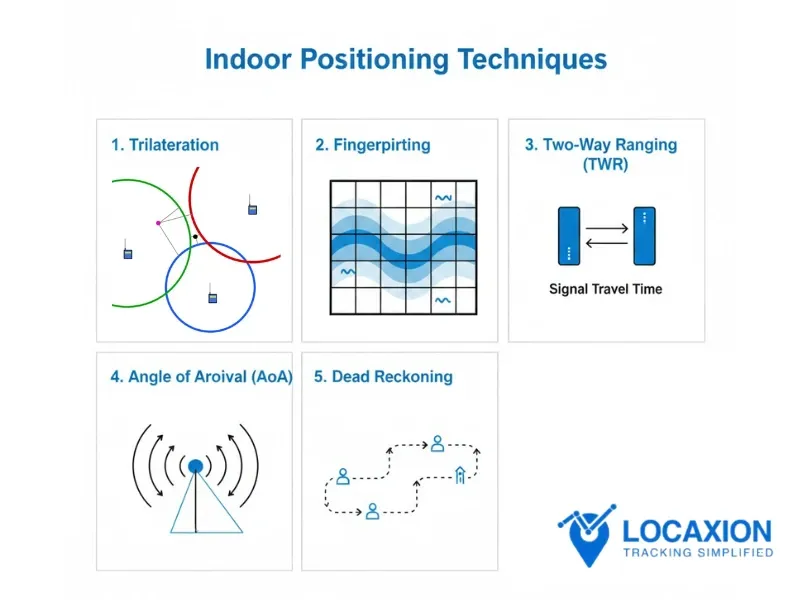
Trilateration
-
Principle: Determines the location of a point by measuring distances to three known points.
-
Process: Anchors transmit signals, and the tag measures the time it takes for the signals to arrive. By calculating the distances to three anchors, the tag’s position can be determined.
-
Advantages: Accurate and reliable in ideal conditions.
-
Disadvantages: Can be affected by multipath interference and non-line-of-sight conditions.
Trilateration is commonly used in an indoor positioning system where high accuracy is required for asset tracking and personnel visibility.
Multilateration
-
Principle: Similar to trilateration, but uses more than three anchor points for improved accuracy.
-
Process: By involving additional anchors, the system can better filter out noise and errors, resulting in more precise location data.
-
Advantages: Higher accuracy compared to trilateration.
-
Disadvantages: Requires a denser network of anchors, increasing costs.
This technique is frequently deployed in enterprise indoor positioning technologies where accuracy takes priority over infrastructure costs.
Fingerprinting
-
Principle: Creates a radio map of the environment by collecting signal strength data from multiple locations.
-
Process: During a calibration phase, signal strength measurements are taken at various points within the area. This data is used to create a database of “fingerprints.” When a tag’s signal is received, its location is estimated by comparing the signal strength to the stored fingerprints.
-
Advantages: Can be used in complex environments with obstacles.
-
Disadvantages: Requires extensive calibration and may be less accurate than trilateration or multilateration.
Fingerprinting is widely used in Wi-Fi-based indoor location technology, particularly in offices, shopping malls, and public buildings.
Dead Reckoning
-
Principle: Estimates the current position based on previous positions and movement data.
-
Process: By tracking changes in direction and speed, the system can calculate the new position relative to the starting point.
-
Advantages: Can be used in conjunction with other techniques to improve accuracy and reduce reliance on GPS signals.
-
Disadvantages: Accumulated errors over time can lead to decreased accuracy.
It is commonly combined with other indoor positioning technologies to improve tracking continuity during temporary signal loss.
Two-Way Ranging (TWR)
-
Principle: Uses two-way communication between devices to sense the distance between them.
-
Process: Devices start ranging with each other when in close proximity, determining distance based on the time it takes for a signal to travel between them.
-
Advantages: Enables location-aware communication without additional infrastructure.
-
Disadvantages: Limited to close-proximity interactions.
Two-Way Ranging is often implemented in Ultra-Wideband (UWB)-based indoor positioning systems because it provides highly accurate distance measurements.
Angle of Arrival (AoA)
-
Principle: Uses the angle of incoming signals to determine location.
-
Process: A mobile asset transmits to a fixed RTLS sensor with a multi-antenna array. The phase shift of the received signal is measured to determine the angle of the transmitting device.
-
Advantages: High accuracy with fewer reference points needed compared to multilateration.
-
Disadvantages: Complex setup and requires advanced hardware.
AoA is increasingly adopted in advanced indoor tracking systems where high precision and low latency are essential.
Received Signal Strength Indicator (RSSI)
-
Principle: Uses signal strength to estimate location.
-
Process: Fixed RTLS sensors detect the signal strength of a transmitting device. The location engine analyzes the signal strength data using multilateration algorithms to estimate the device’s location.
-
Advantages: Low-cost and easy to implement.
-
Disadvantages: Susceptible to signal attenuation, absorption, reflection, and interference, leading to lower accuracy.
Although RSSI is cost-effective, it is generally less accurate than other indoor positioning technologies, making it better suited for applications where approximate positioning is acceptable.
Hybrid Indoor Positioning Approaches
In many cases, a combination of these techniques is used to achieve optimal performance. For example, dead reckoning can be used to estimate position between GPS fixes, and fingerprinting can be employed in areas with poor GPS reception.
Comparing Indoor Positioning Techniques
| Technique | Accuracy | Infrastructure Required | Best Applications |
|---|---|---|---|
| Trilateration | High | Medium | Asset tracking |
| Multilateration | Very High | High | Industrial RTLS |
| Fingerprinting | Medium | Medium | Offices, malls |
| Dead Reckoning | Medium | Low | Navigation |
| TWR | Very High | Medium | UWB RTLS |
| AoA | High | High | Industrial automation |
| RSSI | Low–Medium | Low | Cost-sensitive deployments |
Conclusion
By understanding these indoor positioning techniques, you can select the most appropriate method for your RTLS application based on factors such as accuracy requirements, environmental conditions, and cost constraints. As indoor positioning technologies continue to evolve, organizations can leverage the right indoor positioning system to improve asset visibility, optimize operational efficiency, and enable smarter, data-driven decision-making. Choosing the right approach today lays the foundation for a scalable, future-ready location intelligence strategy.
FAQs on Indoor Positioning Technologies
What are indoor positioning technologies?
Indoor positioning technologies are methods used to determine the real-time location of people, equipment, or assets inside buildings where GPS signals are unavailable or unreliable. These technologies form the foundation of modern indoor positioning systems.
What is an indoor positioning system?
An indoor positioning system combines hardware, software, and positioning techniques such as trilateration, RSSI, or TWR to provide accurate indoor location data for operational visibility and asset tracking.
Which indoor positioning technology offers the highest accuracy?
Technologies such as Ultra-Wideband (UWB) using Two-Way Ranging (TWR) or Angle of Arrival (AoA) typically provide centimeter-level accuracy, making them suitable for industrial RTLS applications.
What industries use indoor positioning systems?
Manufacturing, healthcare, warehousing, logistics, airports, retail, and smart buildings commonly use indoor positioning systems to improve asset tracking, workforce safety, navigation, and operational efficiency. LocaXion helps organizations deploy indoor tracking solutions tailored to these environments.
How do I choose the right indoor positioning technology?
The ideal indoor positioning technology depends on factors such as accuracy requirements, infrastructure, deployment environment, and budget. LocaXion works with organizations to evaluate these factors and implement scalable indoor positioning solutions that align with their operational goals.