Skip to content
Forklift tracking software is the operational backbone of any facility that needs real-time visibility into fleet movements, utilization, safety and compliance. It collects data from tags, sensors, cameras, or telematics hardware and turns it into dashboards, alerts, and reports that help managers make faster, better decisions.
The challenge most buyers face is that “forklift tracking software” is not one product category. It mostly spans three distinct platforms: OEM fleet telematics tied to a single equipment brand, RTLS-native software built on precision indoor location data, and AI-powered solutions that add advanced analytics. Each solves different problems and each has its’ trade-offs. Choosing the wrong one means paying for capabilities you don’t need while missing the ones you do.
This guide helps you navigate that decision. We break down the three software categories, explain what each delivers, and provide a practical framework for matching the right forklift fleet management software to your facility’s goals, layout, and existing systems.
Three Categories of Forklift Tracking Software
Most comparisons treat all forklift management software as interchangeable. It is not. Understanding the fundamental differences between these categories is the first step toward a sound investment.
Fleet Telematics: OEM-Specific and Brand-Agnostic
Fleet telematics platforms capture operational data from forklift hardware: engine hours, impact events, battery health, operator identity, speed, and basic location. They come in two flavors with an important distinction.
OEM-specific platforms are built by forklift manufacturers predominantly for their own equipment. The hardware and software are tightly integrated, delivering deep diagnostics and seamless data capture for that brand. The trade-off is vendor lock-in: they typically do not support equipment from other manufacturers under the same dashboard or provide limited analytics only.
Brand-agnostic telematics work across multiple forklift brands. They use aftermarket hardware that can be installed on any unit, giving mixed-brand fleets a single consolidated view of the entire operation. Some systems include AI-powered pedestrian detection and vehicle access control across any OEM. These platforms are the stronger choice for forklift truck fleet management when your floor runs equipment from two or more manufacturers.
What it does well: Deep equipment diagnostics, pre-shift inspection checklists, impact recording, and maintenance scheduling. These platforms excel at forklift truck fleet management within a single-brand fleet because the hardware and software are purpose-built for each other.
Where it falls short: OEM telematics typically cannot track forklifts indoors with precision, do not support mixed-brand fleets under one dashboard, and create data silos when your facility runs equipment from multiple manufacturers. They tell you what a forklift is doing, but not exactly where it is.
Best fit: Single-brand fleets focused on maintenance, operator accountability, and basic utilization reporting or safety checklists.
RTLS-Native Software Platforms
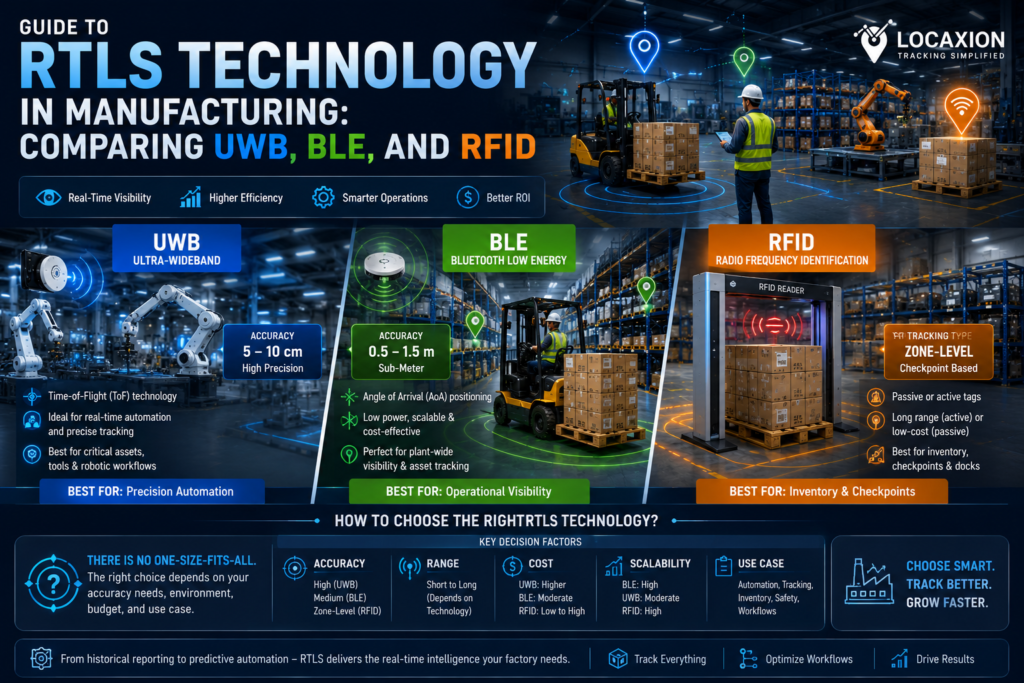
RTLS-native platforms are built on real-time indoor positioning technology, typically UWB, BLE or SLAM-based. They deliver sub-meter location accuracy updated multiple times per second, enabling heatmaps, spaghetti diagrams, route optimization, and zone-based safety automation. The software is equipment-brand-agnostic: it tracks any forklift regardless of manufacturer.
What it does well: Precise indoor location tracking, collision avoidance with proximity alerts, geofenced speed zones, near-miss logging, fleet right-sizing analytics, and Digital Twin integration. This is the strongest category for facilities where RTLS forklift safety and spatial intelligence are priorities.
Where it falls short: Requires infrastructure deployment (ceiling-mounted anchors, tags on vehicles). The software alone cannot capture deep equipment diagnostics like engine health, battery condition or operator sign-ins — that data must come from telematics or sensor integration. Can typically provide only basic fleet analytics.
Best fit: Mixed-brand fleets, high-traffic facilities, safety-critical environments, and operations planning to scale into other use cases, or requiring real-time movement visibility across entire fleet for further data processing using Digital Twin.
AI-Enhanced Software: Forklift-Mounted Cameras and Intelligent Reporting
AI-enhanced platforms add a layer of intelligence on top of fleet data. This takes two forms. First, forklift-mounted AI cameras use computer vision and deep learning to detect and classify objects in the vehicle’s field of view — pedestrians, pallets, racking, other forklifts — and trigger graded safety responses in real time. Second, AI-powered reporting engines analyze historical fleet data to surface patterns, predict maintenance needs and flag recurring safety risks that manual analysis would miss.
What it does well: Context-aware safety — the system knows not just that something is nearby, but what it is and whether it poses a risk. AI platforms can also provide behavioral analytics, video-verified incident reports, and more contextualized reports.
Where it falls short: Camera-based systems can be affected by dust, lighting variation, and visual obstructions common in industrial settings. They provide strong safety coverage in the camera’s field of view but do not deliver facility-wide fleet positioning the way RTLS does. These platforms typically complement, rather than replace, dedicated RTLS or telematics for complete forklift fleet management solutions.
Best fit: Facilities wanting advanced pedestrian and object detection at the vehicle level together with advanced analytics with safety reports.
How the three categories compare at a glance:
| Capability | Fleet Telematics | RTLS-Native | AI-Enhanced |
| Vehicle Compatibility | OEM-locked or agnostic | Any brand | Any brand |
| Safety Automation | Basic alerts, impact logging | Proximity, geofencing, collision avoidance | Object detection, pedestrian recognition |
| Equipment Diagnostics | Deep (engine, battery, fuel) | Limited (requires integration) | Limited (enhances other data) |
| Fleet Utilization | Hours, idle time | Heatmaps, routes, dwell time | Pattern analysis, predictive insights |
| Integration Depth | OEM ecosystem or open API | Open APIs (WMS, MES, ERP) | API; typically sits on top of RTLS/telematics |
| Infrastructure Needed | On-vehicle hardware | On-vehicle OR Ceiling anchors + tags | Forklift-mounted cameras How to Match Forklift Management Software to Your Operation. |
How to Match Forklift Management Software to Your Operation
Instead of starting with products, start with the decisions your operation actually faces.
What problem comes first — safety, utilization, or compliance? If pedestrian protection and collision avoidance are the priority, RTLS-native or AI-powered forklift tracking software delivers the strongest results. If equipment health and operator accountability matter most, OEM telematics is the natural starting point. Most facilities ultimately need both, but knowing where to start prevents scope creep.
Is your fleet single-brand or mixed? Single-brand operations can extract strong value from OEM platforms. Mixed-brand fleets need equipment-agnostic forklift fleet management software — typically RTLS-native — to consolidate data into one view. Running separate telematics dashboards per brand creates blind spots and management overhead.
Do you need to know where or what? Telematics tells you what a forklift is doing: hours, speed, impacts, battery. RTLS tells you where it is: real-time position, route, dwell time, proximity to people. AI tells you why things happen: behavioral patterns, root causes, predictive risk. The most effective forklift fleet management solutions layer these capabilities together.
What existing infrastructure can you leverage? Facilities with camera networks can deploy AI agents immediately. Those with strong Wi-Fi coverage may benefit from BLE-based RTLS. Operations already running OEM telematics can add RTLS on top for spatial intelligence without replacing what works.
How critical is system integration? Forklift tracking software that operates in isolation wastes most of its value. The platform should feed data into your WMS, MES, or ERP through open APIs. Closed ecosystems limit your ability to correlate fleet data with warehouse throughput, labor productivity, and inventory accuracy.
Essential Forklift Tracking Software Capabilities
Regardless of which category you choose, effective forklift management software should deliver these core capabilities.
Real-time fleet visibility. Live dashboards showing every forklift’s location, status, and operator identity across the entire facility. This is the foundation that every other capability builds on.
Safety automation. Proximity alerts, geofenced speed zones, intersection slowdowns, and near-miss logging. The best systems intervene before incidents happen rather than documenting them after the fact.
Compliance documentation. Digital pre-shift inspection checklists, operator certification tracking, impact event logs, and OSHA-ready audit reports. Under current OSHA enforcement programs, facilities face unannounced inspections where producing organized digital records quickly is the difference between passing and receiving citations.
Utilization analytics. Idle time tracking, active vs. loaded movement, shift-level comparisons, and fleet right-sizing recommendations. The data should tell you not just that a forklift was running, but whether it was doing productive work.
Maintenance intelligence. Automated alerts based on usage hours, impact severity, and diagnostic codes. Predictive maintenance scheduling reduces unplanned downtime and extends equipment life.
Integration architecture. Open APIs for WMS, MES, ERP, and telematics data exchange. The software should fit your existing technology stack, not force you to rebuild around it.
Scalability. Architecture that supports expansion from a single-zone pilot to multi-site deployment. Forklift fleet management solutions that require rearchitecting at scale are expensive to grow.
Why a Technology-Agnostic Approach to Forklift Tracking Software Matters
Every software vendor and solution provider will highlight the key benefits of their platform. OEM providers emphasize seamless equipment integration, while RTLS vendors highlight positioning accuracy. AI companies showcase predictive analytics. Each claim is valid within its own category, but incomplete as a total solution.
The reality is that most facilities with 20+ forklifts and mixed operational demands will eventually need elements from more than one category. A forklift management software strategy that accounts for this from the start avoids costly rip-and-replace cycles later.
This is where working with a technology-agnostic integrator delivers the highest ROI. An integrator evaluates your facility layout, traffic patterns, safety requirements, and existing systems, then recommends the combination of forklift tracking software that fits — without being locked to any single vendor’s hardware or platform.
Get Started with Expert Forklift Tracking Solutions
LocaXion is the world’s first pure-play RTLS and Digital Twin systems integrator. With over 25 combined years of deployment experience and 100+ implementations across manufacturing and warehousing, we help facilities select, deploy, and integrate the right forklift tracking software for their specific operation.
We evaluate every technology on the market, OEM telematics, RTLS platforms, AI-powered solutions, and recommend only what fits your layout, fleet composition, safety priorities, and growth plans. No vendor lock-in. LocaXion ties in fleet telematics for equipment health, RTLS for indoor positioning, AI cameras for pedestrian detection, all together under a single umbrella. Left unconnected, these systems become isolated data silos that each tell part of the story. LocaXion’s technology-agnostic Digital Twin platform unifies these scattered data streams into a single, facility-wide operational model. You get the best of each software category without managing them in isolation, and you gain a foundation that scales as your operation evolves.
FAQs on Forklift Tracking Software
Is forklift tracking software the same as fleet telematics?
Not exactly. OEM fleet telematics captures equipment data — engine hours, impacts, battery health, and operator identity — but typically lacks precise indoor location. Forklift tracking software is a broader category that includes telematics, RTLS-native platforms with sub-meter positioning, and AI-powered solutions. The right choice depends on whether you need to know what your forklifts are doing, where they are, or both.
Can forklift tracking software work with mixed-brand fleets?
OEM telematics platforms are usually designed for a single manufacturer’s equipment. For mixed-brand fleets, RTLS-native forklift fleet management software is the better choice because it tracks any forklift regardless of brand through equipment-agnostic tags and sensors. AI-powered camera solutions are also brand-independent.
What accuracy level do I need for safety applications?
Safety use cases such as collision avoidance, geofenced speed zones, and pedestrian proximity alerts require sub-meter accuracy with fast update rates. UWB-based RTLS typically delivers 10–30 cm precision, and SLAM-based tracking 5 – 10 cm, which is the standard for forklift tracking software used in safety-critical environments. Basic utilization and zone-level tracking can work with lower accuracy.
How does forklift management software support OSHA compliance?
Effective forklift management software generates digital audit trails for pre-shift inspections, operator certifications, impact events, speed violations, and near-miss incidents. These records can be produced in minutes during an OSHA inspection. Facilities using digital compliance systems have eliminated citation risk by maintaining continuous, searchable documentation.
Can I add RTLS tracking to my existing OEM telematics?
Yes. RTLS and OEM telematics are complementary. Telematics captures equipment health and operator data. RTLS adds precise indoor location, route analytics, and safety automation. Many forklift fleet management solutions integrate both through open APIs, giving you a combined view of what your forklifts are doing and exactly where they are.
What ROI should I expect from forklift tracking software?
Most deployments achieve payback within 6–12 months. Primary returns come from fleet right-sizing (typically 15–20% reduction in underutilized units), reduced maintenance costs through predictive scheduling, fewer accident-related downtime events, and improved labor productivity. Combining multiple use cases — safety, utilization, and compliance — on a single platform delivers the strongest ROI.